B2B Customer Service: AI Agents Built for Complex Support

Rajni
September 2, 2026
B2B customer service means supporting multiple people within the same account, including end users, admins, finance or procurement contacts, and executive sponsors, each with a different definition of a resolved ticket.
Traditional support bots handle one conversation at a time and often lose account context when requests move between contacts, channels, or teams, forcing customers to repeat the same information.
Vendor-published resolution rates rarely reflect complex, multi-contact B2B escalations, so headline automation numbers may not match what happens in a real B2B support queue.
Effective B2B support requires role-aware account context, grounding in approved account and policy data, and controlled actions across connected billing, CRM, and ticketing systems.
Strong governance is essential for action-taking AI because the permissions that allow an agent to resolve billing or account issues can also create risk if the wrong record or system is accessed.
Most customer support tools are built around a simple unit of work. One person, one ticket, one answer. A customer opens a ticket, an agent solves it, and the case closes.
B2B customer service rarely works that way. A single support case might have five or six people watching it, and each one cares about something different. One person wants technical detail, another wants a timeline, and someone else just wants confirmation that it is handled.
This is the real test for AI agents built to handle B2B support. Answering a question accurately is only part of the job. The agent also needs to track which contacts are part of the account, which channel each one used, and what the vendor already promised them, so the second or third person who reaches out never starts from zero.
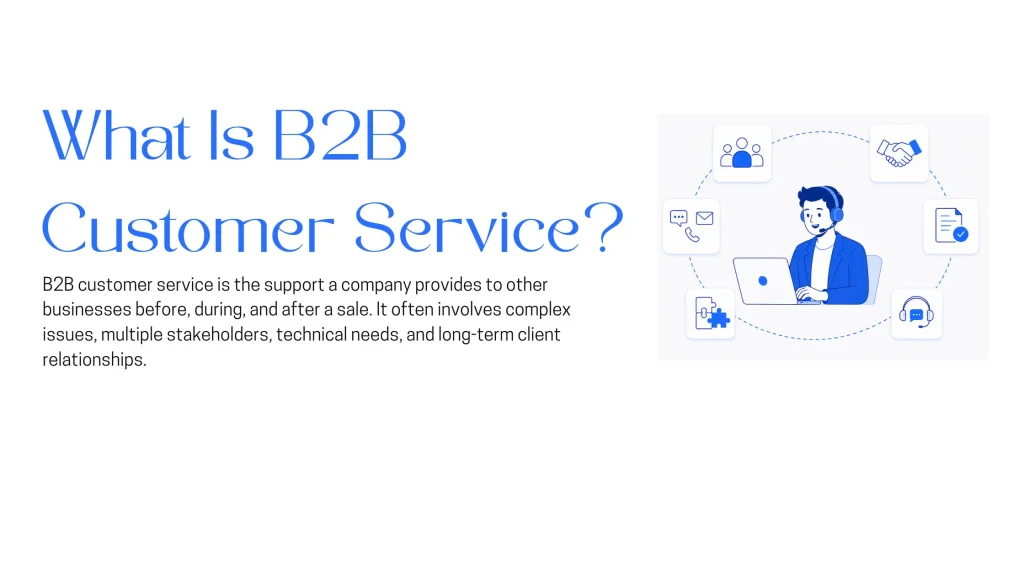
B2B customer service, or business-to-business customer service, is the support, relationship management, and post-sale engagement a company provides to the other businesses it sells to. Consumer support is largely transactional. B2B support is relational, technically complex, high-stakes, and tied directly to the commercial relationship between vendor and client.
A B2B customer is an organization rather than an individual with a single problem, and that organization brings multiple stakeholders, a procurement process, a dedicated account relationship, integration dependencies, and a contract that renews or terminates on a schedule. The service team has to navigate that complexity on behalf of every client, consistently, and often in real time.
The cost of getting it wrong is well documented, if often quoted loosely. NewVoiceMedia’s 2018 Serial Switchers report, based on a survey of 2,002 US consumers conducted by Opinion Matters, put annual losses from poor customer service at more than $75 billion, up $13 billion from its 2016 figure. That study measured consumer behavior, so it understates the B2B picture. In B2B, a service failure reaches past the individual account into referral pipelines, renewal rates, and standing inside industries where buyers talk to each other.
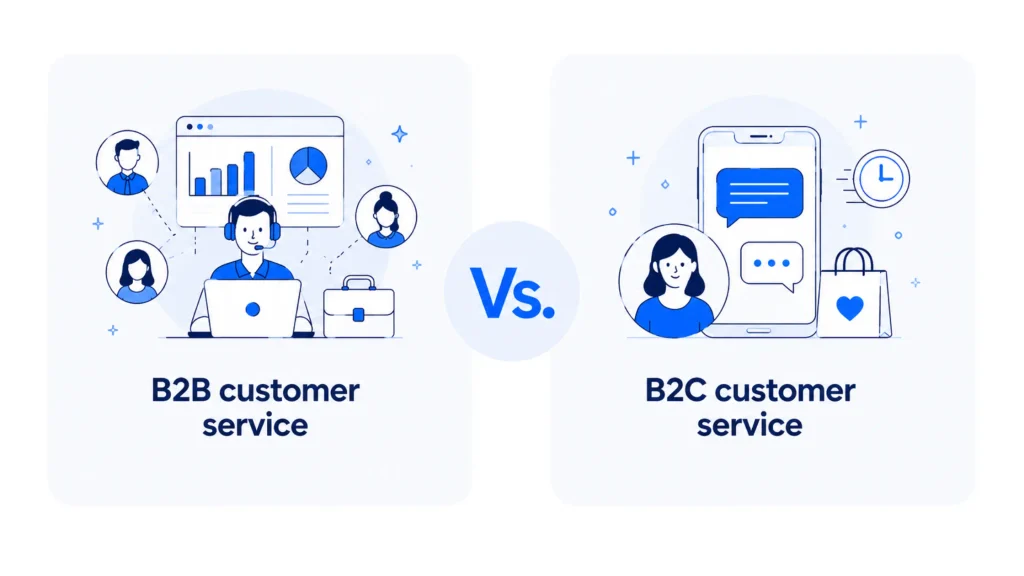
The important distinction between B2B and B2C customer service is structural. It sits in the relationship between the service team and the customer, well beneath any question of channel or tone.
| B2B Customer Service | B2C Customer Service | |
|---|---|---|
| Customer type | Organizations with multiple stakeholders | Individual consumers |
| Relationship length | Months to years, contract-based | Transaction-based, often one-time |
| Account value | High, often six to seven figures | Low to moderate per customer |
| Query complexity | Technical, product-integrated, often urgent | Generally simpler, process-driven |
| Response expectation | Dedicated account manager, SLA-bound | Fast first response, any agent |
| Decision maker | Multiple stakeholders, procurement teams | Usually the individual |
| Impact of service failure | Contract loss, referral impact, brand risk | Churn of one customer |
In B2C, customer experience is shaped mostly by speed, convenience, and how the brand feels. In B2B, it is shaped by trust, technical competence, and the quality of an ongoing relationship. A B2C customer who has a bad experience may leave a review. A B2B customer who has a bad experience may terminate a contract, tell ten industry peers, and affect the vendor’s pipeline for years.
Four structural differences drive most of that gap.
The gap between what B2B teams intend to deliver and what they actually deliver is wide. Research from Clarity cited in Fin’s 2026 B2B support guide found that only 14% of B2B decision-makers believe their organization delivers top-tier customer experience.
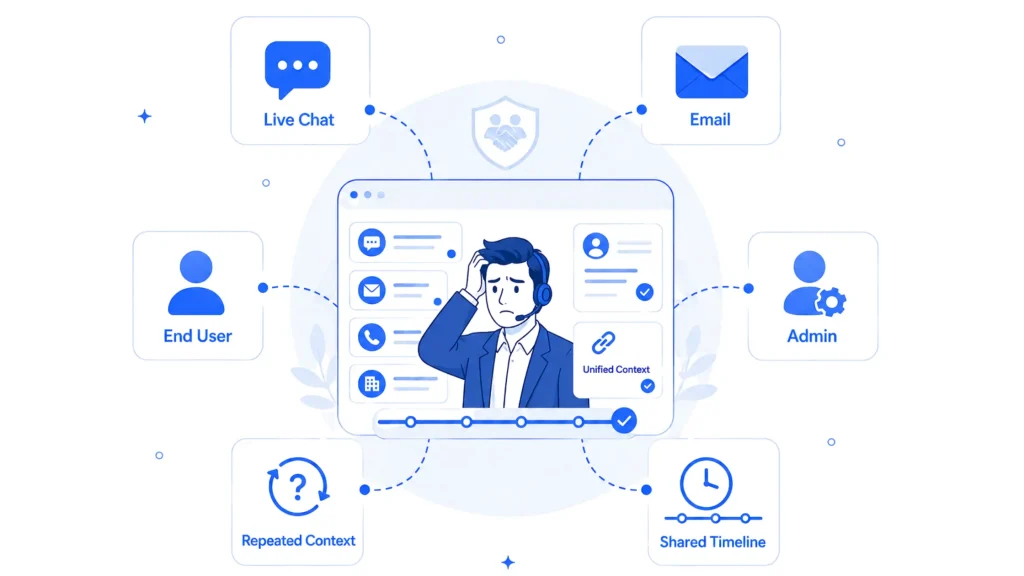
In B2B accounts, a support case rarely stays on one channel, and every switch is a chance to lose the context that came before it.
Closing the gap takes more than a chatbot that answers questions correctly. Most AI agents for customer service are architected for the individual conversation, and B2B accounts break that assumption on the second contact. The requirements below are what separates an AI agent for customer support that holds up in a multi-contact account from one that resolves single threads and loses the thread between them.
In a B2B account, resolving a request rarely ends with a correct answer. Someone still has to pull the right context, keep every stakeholder aligned, send the case to the right team, and follow up without being asked. That work looks less like a chatbot answering FAQs and more like an orchestration layer sitting on top of the account.
YourGPT’s AI Studio is built around that distinction, with a drag-and-drop canvas for multi-step agent logic and native nodes for API calls, conditional branching, and human handoff. Here is what each part of the workflow looks like in practice.
The full node and integration inventory covers the rest, including CSAT capture inside a flow, WhatsApp and SMS nodes, and custom Python or JavaScript execution for logic that does not fit a standard block.
SaaS customer support is where this plays out most often, since so much of the B2B economy runs on subscription software. Consider a mid-market account reporting that a nightly data sync has stopped running.
An end user notices missing data in a dashboard and opens a chat. The agent recognizes recent sync failures logged against that account’s integration, confirms the outage, and opens an internal ticket against the account itself, so the record outlives the individual chat.
Two hours later, the account’s admin emails asking whether the outage affects their weekly reporting deadline. Because the agent has account-level memory, it recognizes the same account, surfaces the open sync issue without asking the admin to re-describe it, and confirms the reporting deadline is not at risk based on the current fix timeline.
The next morning, the account’s finance contact asks through a different channel whether the outage affects their upcoming invoice given the SLA terms in their contract. Because this question touches a contractual and financial judgment, the agent pulls the account’s specific SLA data, confirms the outage falls within the allowed resolution window, and escalates to a human account manager with the full incident history, all three contacts, and the SLA calculation already attached.
No stakeholder repeated themselves, and the human who handled the SLA judgment call did not have to piece the story back together from three disconnected threads.
Published customer results are more useful than vendor averages, because the workload is at least described.
The same capability that makes an agent useful in B2B support, reading account data and acting across connected systems, also makes governance non-negotiable. A misconfigured agent can update the wrong record as easily as the right one, and the survey data suggests that happens often.
Four boundaries carry most of the load in mature B2B deployments:
Platforms differ in how much of this ships built in versus left to the implementation team. YourGPT builds role-based access, escalation rules, and human handoff into the Studio workflow layer, alongside allowed-domain restriction, access control lists, and chat and training loggers. Thresholds such as refund caps and writable CRM fields still need deliberate configuration. Teams can review the available channel and system integrations against their existing CRM and ticketing stack and check current plan limits before committing to a rollout.
It covers technical issues, billing questions, onboarding, account management, and SLA fulfilment across the life of a contract. The defining feature is that the customer is an organization with several contacts and a procurement process behind it.
Usually yes. Account-based ownership matters more than queue-based ownership, because a single account carries several contacts and a renewal date. Tiered routing that matches account value to support resource is the common pattern.
Independent 2026 benchmarking from Digital Applied puts median tier-1 deflection near 41%, with top-quartile programs around 59%. Structured intents such as password resets and status checks resolve at 65% to 80%, while sentiment-heavy and dispute-style queries rarely clear 25% to 30%. B2B escalations skew toward the second group, so vendor case studies built on high-structure consumer workloads are a poor forecast for a B2B queue.
Resolution rate measures whether the customer’s issue was solved. Deflection rate only measures whether the customer avoided reaching a human, which says nothing about outcome quality. In a multi-stakeholder account, deflecting one contact who then escalates through a second contact counts as a deflection and a failure at the same time.
YourGPT’s AI Studio connects agents to CRM, billing, and ticketing systems through an API Calling node, carries account and conversation history forward through persistent memory across channels, and hands the case to a human with the full account history already attached.
Most B2B accounts involve four kinds of contacts. End users work in the product daily. Admins or team leads manage configuration and permissions. Finance or procurement contacts track billing and contract terms. Executive sponsors form their view of the relationship from what filters up to them.
The most common failure is a right answer that reaches the wrong person, or a resolution that never gets communicated to every stakeholder tracking the issue. This usually happens when a request moves between contacts, channels, or teams and the context does not move with it.
Escalation should happen for anything touching contract terms, SLA judgment calls, financial adjustments, or actions that are hard to reverse, even when the agent is technically capable of resolving the case on its own.
Role-based access that limits what data an agent can read and act on, defined action limits such as refund or credit caps, mandatory human review for financial or contractual decisions, and full audit logging of what the agent read, decided, and changed.
B2B customer service is hard because the account, not the conversation, is the real unit of work. An agent that only remembers one thread will keep making the same mistake, treating the second and third stakeholder in an account as a stranger.
The published resolution rates make this easy to miss. Numbers built on password resets and subscription changes look impressive until the same agent meets a contested SLA credit with a finance contact, an admin, and an executive sponsor all reading the thread. Buying against those benchmarks is how a support program ends up in Gartner’s cancellation column.
The agents that hold up in B2B accounts combine persistent, role-aware context, grounded answers, controlled action-taking, and escalation that carries the full picture forward, all inside permission boundaries someone configured on purpose. Getting the account-level memory right solves more of the multi-stakeholder problem than any single feature added on top of it.
Learn how to judge Shopify AI resolution rates with clear formulas, a worked example, ticket-level checks and practical ways to improve support quality.
TL;DR A vector embedding is a list of numbers that represents meaning, placing similar concepts closer together in a mathematical space. AI chatbots use embeddings to match questions by meaning rather than exact wording, which is a core part of retrieval-augmented generation (RAG). Anthropic recommends Voyage AI for embeddings, while OpenAI, Google, and Cohere provide […]

TL;DR An FAQ chatbot answers repetitive questions by matching user queries with a knowledge base and returning grounded responses using rules, AI retrieval, or both. Modern FAQ chatbots use confidence checks to deliver instant answers for strong matches and fall back to broader retrieval or human handoff when confidence is low. Rule-based bots work well […]
TL;DR Multimodal chatbots let customers share photos, screenshots, documents, video, or audio directly in a conversation, giving AI more context than text alone. YourGPT’s Attachment Capture node in AI Studio can collect these files mid-conversation, while vision-capable AI models can analyze and understand their contents. Key use cases include ecommerce returns, insurance and warranty claims, […]
A customer asks where their order is. A traditional bot pastes a tracking link and calls it done. An agentic system checks the carrier API, sees the shipment stuck at a depot, applies a credit under the delay policy, updates the CRM, and messages the customer before they’ve had time to get annoyed. Same question. […]
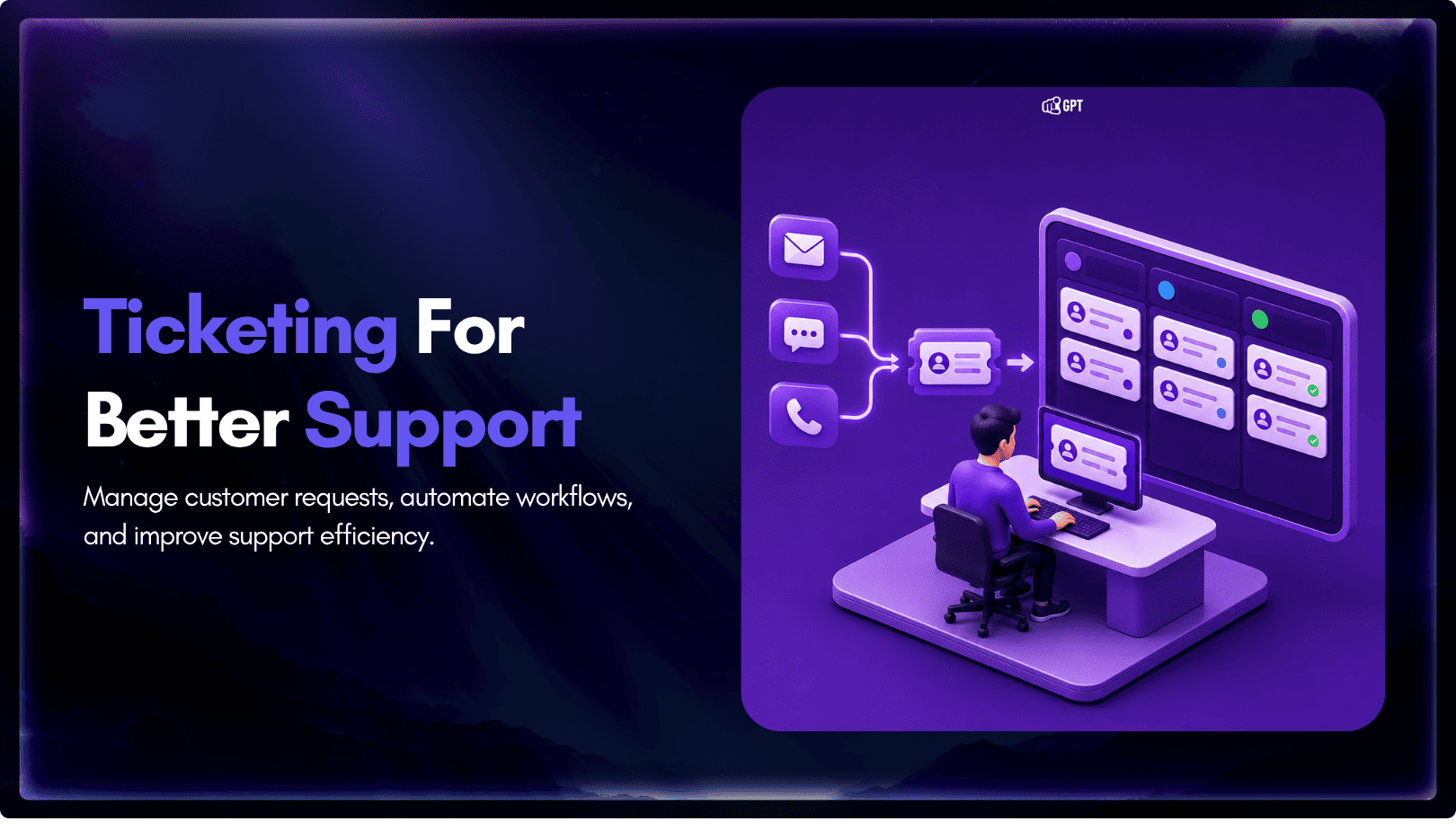
TL;DR A ticketing system converts requests that arrive by email, chat, phone, or web form into trackable records with an owner, a status, and a priority level. Centralizing requests this way cuts response delays, gives support teams visibility into backlogs, and creates a record useful for reporting and audits. Options range from lightweight help desk […]