Vector Embeddings Explained: How AI Chatbots Actually Understand Text

Shreya Sharma
September 1, 2026

A vector embedding is a list of numbers that represents meaning, placing similar concepts closer together in a mathematical space.
AI chatbots use embeddings to match questions by meaning rather than exact wording, which is a core part of retrieval-augmented generation (RAG).
Anthropic recommends Voyage AI for embeddings, while OpenAI, Google, and Cohere provide their own competing text-embedding APIs.
Chunking strategy can affect retrieval accuracy as much as the embedding model itself, and poorly structured chunks are a common cause of incorrect chatbot answers.
Raw embeddings also carry privacy risks, as research into embedding inversion shows that parts of the original source text may be reconstructed from stored vectors.
Vector embeddings are what let an AI chatbot understand a question even when it’s worded nothing like the source document. Instead of matching words, embeddings turn text into a list of numbers that captures what it means. Two phrases with the same meaning end up close together in that space, even if they don’t share a single word.
On its own, that fact doesn’t explain much. A chatbot can find the right answer, or the wrong one. What decides this happens in the steps between turning text into numbers and using those numbers to search. Three choices shape the outcome. How the pipeline splits a document into pieces, which model generates the numbers, and how many dimensions each piece carries.
The blog cover how embeddings get created. They also explain how a retrieval pipeline turns an embedding into a chatbot’s answer. They cover where the approach breaks down in production too. Finally, they cover a privacy risk around storing raw vectors that most introductions to this topic leave out.
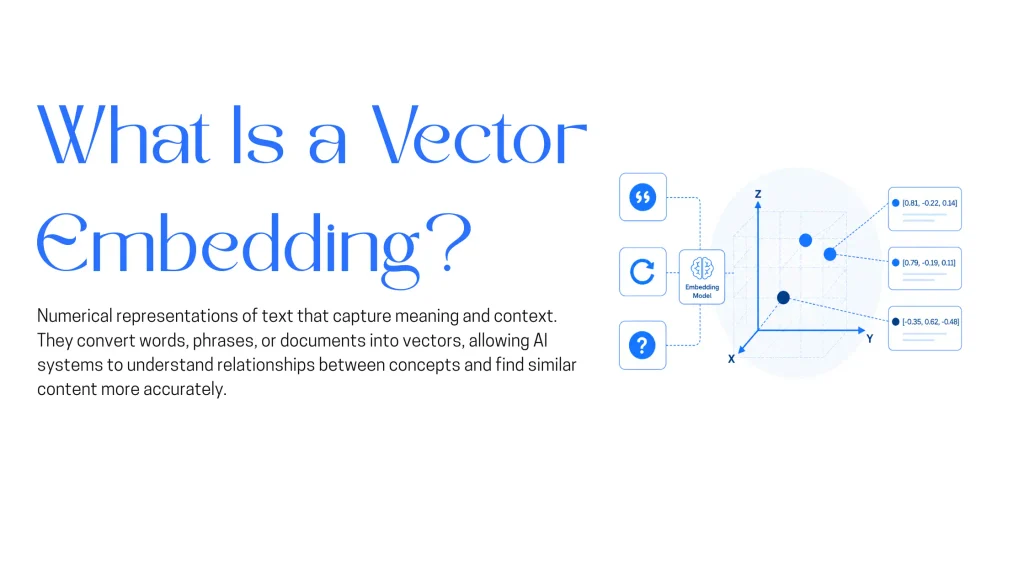
A vector embedding is a numerical representation of text (or an image, or audio). It is generated by a neural network trained to capture semantic meaning. Each piece of text becomes a list of numbers, typically hundreds to thousands of values long, called a vector.
The property that makes embeddings useful is spatial. Text with similar meaning ends up with vectors that sit close together in that numerical space, regardless of whether the wording matches. Text with unrelated meaning ends up far apart.
A simplified example, using just three dimensions instead of the hundreds a real model would produce, shows the pattern:
| Phrase | Simplified vector |
|---|---|
| “I can’t log into my account” | [0.81, -0.22, 0.14] |
| “Reset my password” | [0.79, -0.19, 0.11] |
| “What’s your return policy?” | [-0.35, 0.62, -0.48] |
Generating an embedding follows a consistent pipeline, regardless of provider.
Step 1. Text enters an embedding model as tokens. The input first gets broken into tokens, the small word-piece units language models process. Common embedding model options include:
Step 2. The model maps those tokens against what it learned during training. A trained neural network compares the input to the patterns of meaning it picked up from its training data. This places semantically related concepts near each other in vector space.
Step 3. The model outputs a numerical vector. OpenAI’s text-embedding-3-small produces 1,536 dimensions by default, while text-embedding-3-large produces 3,072. More dimensions generally mean more captured nuance, at the cost of storage and search speed. Some newer models use a technique called Matryoshka Representation Learning. It trains a single model to produce embeddings that stay useful even when truncated to a smaller size. OpenAI’s newer models support this through a dimensions parameter. It shortens a 3,072-dimension embedding to 1,024 or 256 dimensions with only a modest accuracy trade-off. This is useful when storage cost or query speed matters more than squeezing out the last percentage point of accuracy.
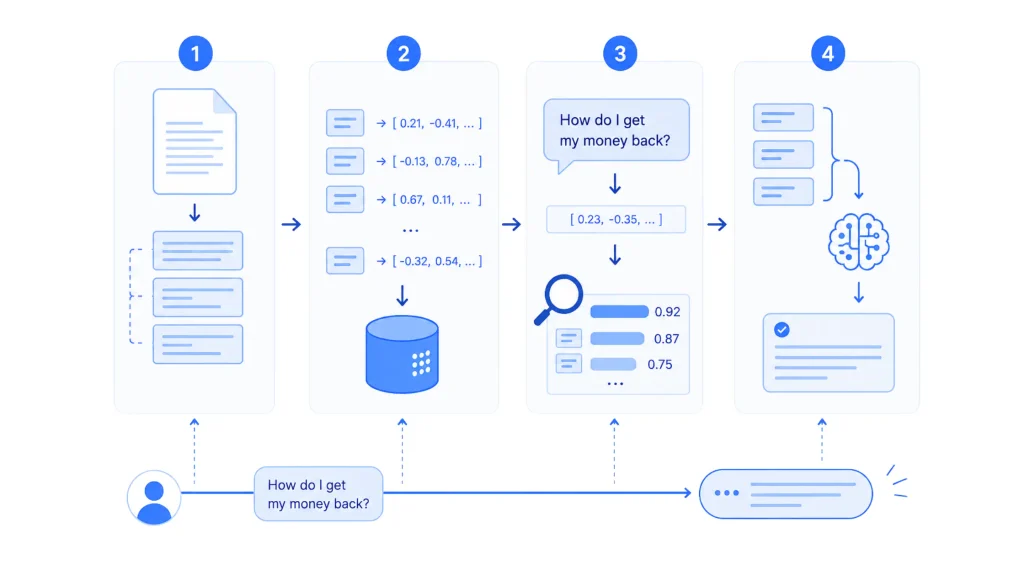
Embeddings alone don’t answer questions. They become useful inside a retrieval pipeline, most commonly retrieval-augmented generation, or RAG. Four stages connect a raw document to a chatbot’s response, and each one affects accuracy.
A language model on its own only knows what it learned during training. Ask it about a policy that changed last month, or a document it never saw, and it either says so or guesses. RAG closes that gap by giving the model access to a live knowledge base at the moment it answers, through the pipeline above.
In practice, that pipeline shows up in a few recurring jobs:
Embeddings find the right information for a given question. Generating the actual answer from that information is a separate job, handled by the language model itself.
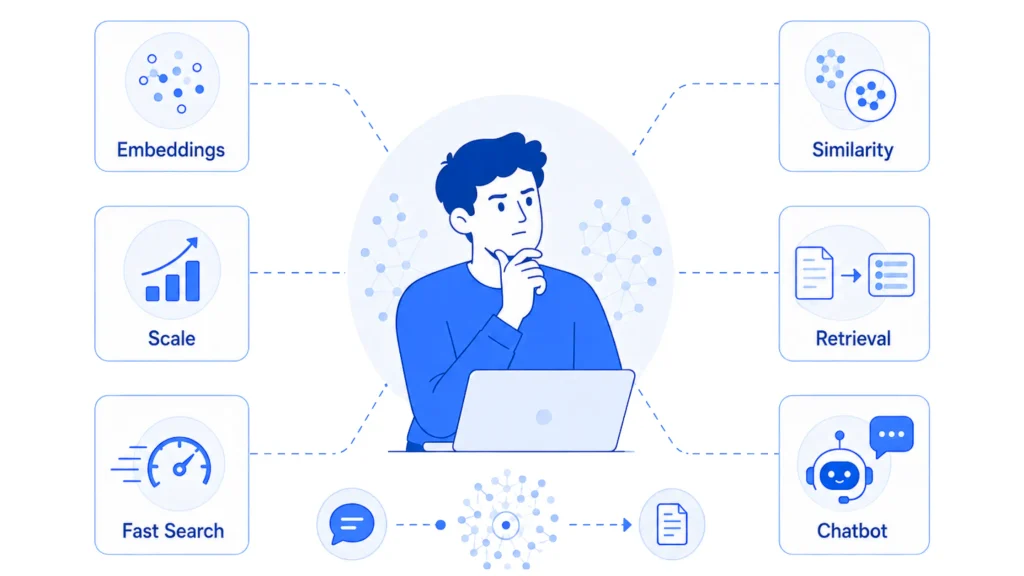
Generating embeddings solves half the problem. The other half of the problem is that millions of them must be searched fast enough for a live chatbot conversation, and that’s the job a vector database is built for.
The embedding model is a separate decision from the language model that generates the final answer, and the two don’t need to come from the same provider.
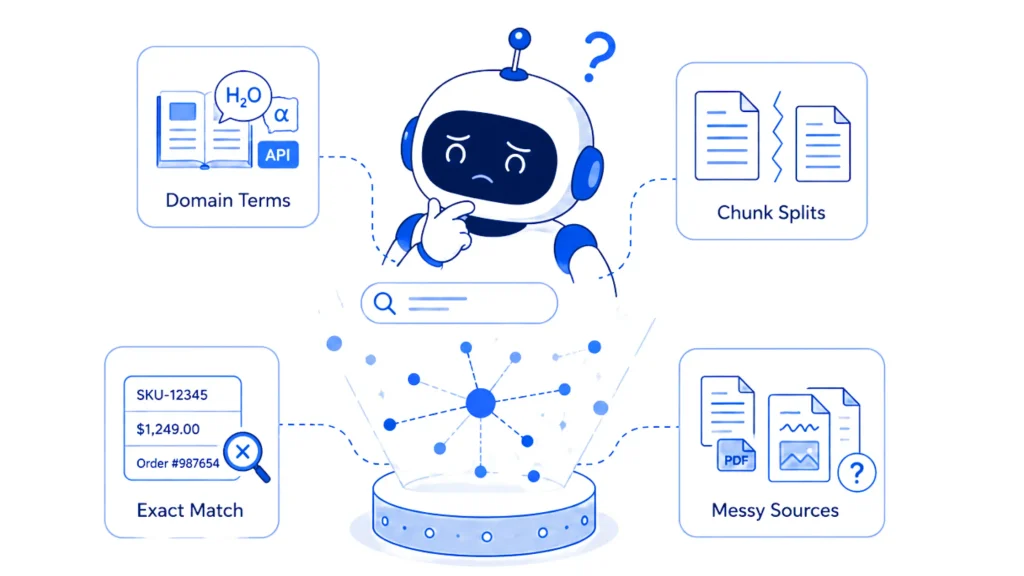
Embeddings solve the meaning-matching problem, but they introduce their own set of failure modes.
Embeddings are often treated as an opaque, privacy-safe stand-in for the original text, since a list of floating-point numbers looks unreadable on its own. That assumption doesn’t hold up under research.
A body of academic work, most notably the technique known as Vec2Text, has demonstrated that source text can be reconstructed from its embedding vector with meaningful fidelity, particularly for shorter inputs with distinctive vocabulary. An attacker with access to the raw vector and knowledge of (or query access to) the embedding model used to generate it doesn’t need the original document. The vector itself carries enough signal to partially rebuild it.
This matters directly for anyone storing customer support transcripts, internal policy documents, or other sensitive material as embeddings in a vector database. A few practical mitigations follow from the research:
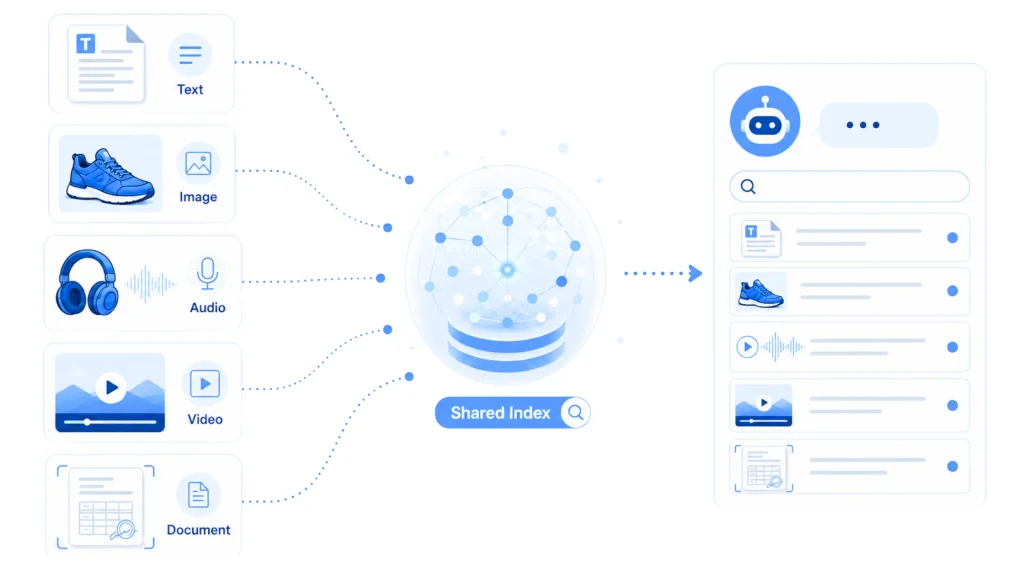
A vector embedding is a list of numbers that represents the meaning of a word, sentence, or document. Text with similar meaning ends up with numbers that sit close together, even when the wording is completely different.
Yes. YourGPT’s RAG pipeline uses embeddings to ground chatbot answers in a business’s own training sources, including website content, uploaded documents, and connected knowledge bases, instead of relying only on the model’s general training data.
Embeddings let a chatbot match a question to the right answer by meaning instead of exact wording. Without them, a chatbot only finds results when a customer’s question happens to share the same words as the source document.
An embedding model turns text into a vector for search and retrieval. A language model generates the actual response. They’re separate tools, and they don’t need to come from the same provider.
A regular database looks up exact matches, like an order ID or an email address. A vector database compares numerical vectors to find the closest meaning, which is why it can return a relevant result even when the search terms don’t match the stored text exactly.
Switching models usually means re-embedding the existing content, since vectors from one model aren’t directly comparable to vectors from another. It’s a one-time reindexing cost, not a full rebuild of the knowledge base.
Embeddings carry a real privacy risk. Research on embedding inversion shows that source text can be partially reconstructed from a vector, so raw vectors need the same access controls as the original documents, not fewer.
Yes. YourGPT supports ReIndex, a retraining step that runs manually or on a set schedule, so embeddings stay current as underlying content changes.
Vector embeddings let a chatbot match “I can’t log in” to a knowledge base article. That article can be titled “resetting your password” without either phrase sharing a word. That capability comes from a real pipeline with real failure points. Chunking decisions, embedding-model choice, and the quality of the source documents all shape whether retrieval works.
Introductory explanations often leave out the privacy risk tied to storing raw vectors. It deserves the same attention as the underlying technology’s benefits. Understood together, embeddings are less like magic and more like a well-defined, debuggable system. This is exactly what makes it possible to improve one.

Learn how to judge Shopify AI resolution rates with clear formulas, a worked example, ticket-level checks and practical ways to improve support quality.

TL;DR B2B customer service means supporting multiple people within the same account, including end users, admins, finance or procurement contacts, and executive sponsors, each with a different definition of a resolved ticket. Traditional support bots handle one conversation at a time and often lose account context when requests move between contacts, channels, or teams, forcing […]

TL;DR An FAQ chatbot answers repetitive questions by matching user queries with a knowledge base and returning grounded responses using rules, AI retrieval, or both. Modern FAQ chatbots use confidence checks to deliver instant answers for strong matches and fall back to broader retrieval or human handoff when confidence is low. Rule-based bots work well […]

TL;DR Multimodal chatbots let customers share photos, screenshots, documents, video, or audio directly in a conversation, giving AI more context than text alone. YourGPT’s Attachment Capture node in AI Studio can collect these files mid-conversation, while vision-capable AI models can analyze and understand their contents. Key use cases include ecommerce returns, insurance and warranty claims, […]

A customer asks where their order is. A traditional bot pastes a tracking link and calls it done. An agentic system checks the carrier API, sees the shipment stuck at a depot, applies a credit under the delay policy, updates the CRM, and messages the customer before they’ve had time to get annoyed. Same question. […]

TL;DR A ticketing system converts requests that arrive by email, chat, phone, or web form into trackable records with an owner, a status, and a priority level. Centralizing requests this way cuts response delays, gives support teams visibility into backlogs, and creates a record useful for reporting and audits. Options range from lightweight help desk […]