YourGPT or Tidio? Finding Your Best Customer Support Fit for 2026

Rajni
Last updated on July 14, 2026
Tidio is a good fit for small businesses that need simple website chat and basic automation without much setup. YourGPT is built for teams that need more than chat, with multi-channel support, AI workflows, voice, and deeper integrations. The main difference is that Tidio helps manage conversations, while YourGPT can also automate actions and reach out to users through campaigns. If you want a lightweight website chat tool, Tidio works well. If you want a platform that can support growth across support, sales, and operations, YourGPT is the stronger fit.
Customer service platforms are more than simple tools for answering questions. Choosing the right solution, such as YourGPT or Tidio, goes beyond comparing features or subscription costs. The real impact becomes clear once your team relies on the platform every day.
How well it integrates with your current systems, what AI capabilities it offers, how easily it adapts as your business expands, and how quickly issues are resolved by the support team all shape its real-world value. These factors can be the difference between a platform that strengthens customer relationships and one that creates constant frustration.
In this comparison between YourGPT and Tidio, we highlight their core capabilities, the flexibility each offers, the value they bring to businesses of different sizes, and how effectively they support ongoing operations. By the end, you will have practical insights to decide which platform best matches your customer service goals in 2026.

Tidio is designed for small businesses that want to add chat support to their websites quickly and affordably. Its main strength lies in providing live chat with chatbot automation so visitors get instant responses without long setup times.
For teams looking to answer FAQs, capture leads, and support customers with minimal complexity, Tidio offers a practical solution. It integrates with popular platforms such as Shopify, WordPress, and Messenger, making it easy to connect with existing tools.
Tidio also supports integrations that covering eCommerce platforms, CRM tools, and marketing systems. For more advanced use cases, businesses can extend functionality through APIs, allowing custom workflows and deeper system connections. While it can connect with external tools, its support for protocols like MCP (Model Context Protocol) or complex multi-system orchestration is more limited compared to AI-first platforms, making it better suited for simpler automation needs.
Tidio is a good choice for businesses with simple live chat needs. It delivers reliable website chat widget with basic AI automation, giving teams an affordable way to improve customer support without adding complexity.

YourGPT is an AI-first platform to build and run AI agents for customer support, sales, and operations across websites, apps, and messaging channels. It keeps humans in the loop while handling a large share of customer queries independently. It can resolve up to 78% of requests, ensuring fast and accurate support without human intervention. When a conversation requires personal attention or added sensitivity, the system smoothly escalates the chat to a live agent. This balance of autonomous resolution and seamless human handoff gives businesses both efficiency and reliability.
Companies can train YourGPT on a wide range of data sources, including documents, websites, spreadsheets, and knowledge bases. It can then automate workflows like updating CRM records, routing tickets, or sending follow-up emails. The platform also supports multiple AI models, including GPT-5, Claude, Gemini, and custom options, giving businesses flexibility based on their use case. The no-code workflow builder makes these setups accessible to both technical and non-technical teams.
YourGPT also connects deeply with business systems through integrations, covering tools like CRMs,Whatsapp, instagram, helpdesks, eCommerce platforms, and communication channels. For more advanced use cases, businesses can extend capabilities using APIs and MCP (Model Context Protocol) to connect external tools, execute actions, and unify workflows across systems. This ensures the AI doesn’t just respond it completes tasks across your stack.
The value of YourGPT comes from its adaptability. With regular updates, enterprise-level security, and user feedback shaping its roadmap, the platform grows alongside the businesses that use it.
When comparing YourGPT vs Tidio, the difference comes down to what each platform is built for. Both YourGPT and Tidio allow businesses to provide customer service, but they were designed with very different goals.
Tidio is designed for live chat with chatbot automation for websites, helping teams handle FAQs and basic queries. Its strength lies in being straightforward and affordable, making it a fit for small businesses that need quick setup and minimal complexity.
YourGPT is an AI-first automation platform built for businesses that need more than basic chat support. Unlike tools limited to answering FAQs, YourGPT is designed to handle complex processes and workflows.
It can:
Because it can be trained on diverse company data, YourGPT adapts to each organisation’s needs. It also works across multiple channels including websites, messaging apps, email, and phone so it fits directly into daily operations.
YourGPT goes beyond chat. It provides an automation layer that integrates with business tools and scales with enterprise requirements.
The difference is clear:
| Feature | YourGPT | Tidio |
|---|---|---|
| AI First | ✅ | ❌ |
| Advanced AI Capabilities | ✅ | Limited (basic chatbots) |
| Multi-channel Deployment | ✅ | ✅ |
| Integration Ecosystem | 150+ | 100+ |
| Customization & Workflows | Advanced, No-code Builder | Simple rule-based bots |
| Campaigns | ✅ (WhatsApp, Phone, Web) | ❌ |
| Voice AI | ✅ | ❌ |
| Email Integration | ✅ | ❌ |
| Mobile App | ✅ | ✅ |
| Data Training | Docs, sites, videos | FAQs, simple inputs |
| Human Escalation | ✅ | ✅ |
| Self-learning | ✅ | ❌ |
| AI Helpdesk | ✅ | ❌ |
| Image Understanding | ✅ | ❌ |
| Scalability | Enterprise Ready | Small Business |
Both platforms offer entry-level pricing, but the way costs scale is very different.
Tidio + Lyro AI Agent:
Tidio’s Starter plan begins at approximately $24.17/month (billed annually) for live chat and basic automation. However, key features like AI responses and advanced automation require add-ons such as the Lyro AI Agent, which starts around $62.50/month for just 100 conversations. As usage grows or more features are needed, costs increase quickly, making pricing less predictable over time.
YourGPT Professional Plan:
YourGPT starts at $129/month (billed monthly), with a discounted annual option. This plan includes core capabilities such as AI agents, multi-channel support, campaigns, workflows, integrations, and access to tools like AI Studio and API/Webhooks, along with 5 team seats and high usage limits.
Value comparison:
Tidio is more affordable at the starting point and works well for small businesses with basic chat needs. However, as soon as you add AI, automation, or scale usage, the total cost can increase significantly due to separate add-ons.
YourGPT follows a bundled approach, where most advanced features are included in one plan. For small to mid-sized businesses (SMBs) looking to manage support, sales, and automation across channels, this often results in better overall value and fewer additional costs as the business grows.
Tidio is ideal for quickly adding a simple chat widget for basic support. YourGPT is better for businesses needing advanced AI, automation, multi-channel communication, and scalability.
Yes, YourGPT supports simple use cases like FAQs and lead capture while allowing businesses to scale into automation and workflows as they grow.
Tidio is more affordable initially for basic chat. However, costs increase with added features. YourGPT includes more capabilities in one plan, which can reduce overall costs for growing teams.
Tidio mainly supports website chat. YourGPT supports multiple channels including WhatsApp, Telegram, Messenger, Instagram, and email.
Yes, YourGPT supports inbound and outbound voice AI, enabling it to manage customer calls. Tidio only supports text-based communication.
Tidio is faster to set up for basic chat. YourGPT requires more setup but provides greater automation, control, and long-term efficiency.
YourGPT offers deeper integrations with CRMs, helpdesks, and internal systems. Tidio integrations are more limited and suited to simpler use cases.
YourGPT follows enterprise-grade standards like SOC 2 Type II and GDPR. Tidio provides standard security suitable for small businesses.
Yes, businesses can transition as they grow. YourGPT allows you to train on existing data, making migration smooth without starting over.
YourGPT is designed for enterprises with advanced automation, integrations, compliance, and voice capabilities. Tidio is better for smaller teams.
Yes, YourGPT supports campaigns across channels like WhatsApp, email, and chat, enabling proactive engagement such as follow-ups and promotions.
Tidio and YourGPT are designed with different goals in mind, and the choice between them depends on how far you want automation to extend in your business.
Tidio keeps things simple. For small businesses, it is a fast way to add live chat and basic chatbots to a website without extra complexity. It is affordable, easy to configure, and useful for reducing repetitive questions so teams can focus on higher-value work.
YourGPT addresses a broader set of needs. Beyond answering FAQs, it supports reasoning across multi-step requests, integrates directly with CRMs and other systems, and automates actions across channels such as WhatsApp, Messenger, Telegram, email, and voice. Its campaigns and proactive messaging feature further enables teams to reach out to customers at the right moment turning support into a growth channel.
Its ability to train on diverse company data and hand off seamlessly to human agents means it can become part of sales, support, and operations not just conversations.
If your goal is limited to website chat, Tidio is a good choice. If you are preparing for growth and want AI automation that works across channels, campaigns, and teams, YourGPT offers a platform that delivers measurable efficiency while adapting to more complex requirements over time.
YourGPT gives you AI chat and voice agents that automate support, capture leads, and connect with your tools in minutes.
No credit card required • Full access • Limited time offer
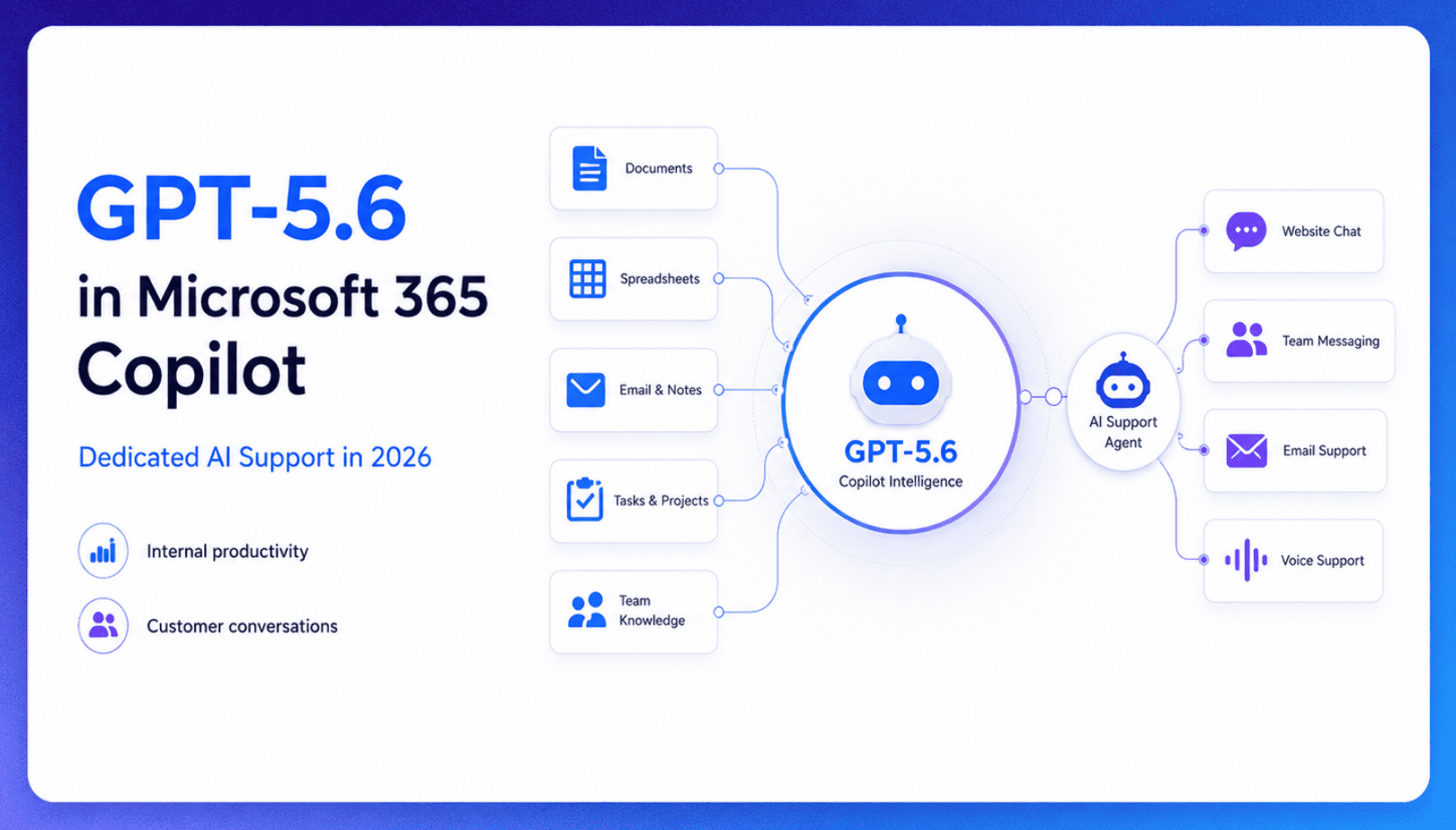
TL;DR Microsoft made GPT-5.6 the preferred model across Word, Excel, PowerPoint, Copilot Chat, and Cowork on July 9, 2026, focusing on internal workplace productivity rather than customer-facing support. Dynamics 365 Service Agent also reached general availability, but it mainly helps human support representatives manage cases within Microsoft’s existing permission structure and requires separate licensing. A […]

TL;DR Cheap frontier models now compete for the same high-volume support workloads, with DeepSeek V4 remaining the lowest-cost option in this comparison. Kimi K2.6 and GLM-5.2 are open-weight and self-hostable, while Qwen 3.7 Plus is proprietary and available only through an API. Claude Haiku 4.5 is the only model here that its developer explicitly recommends […]
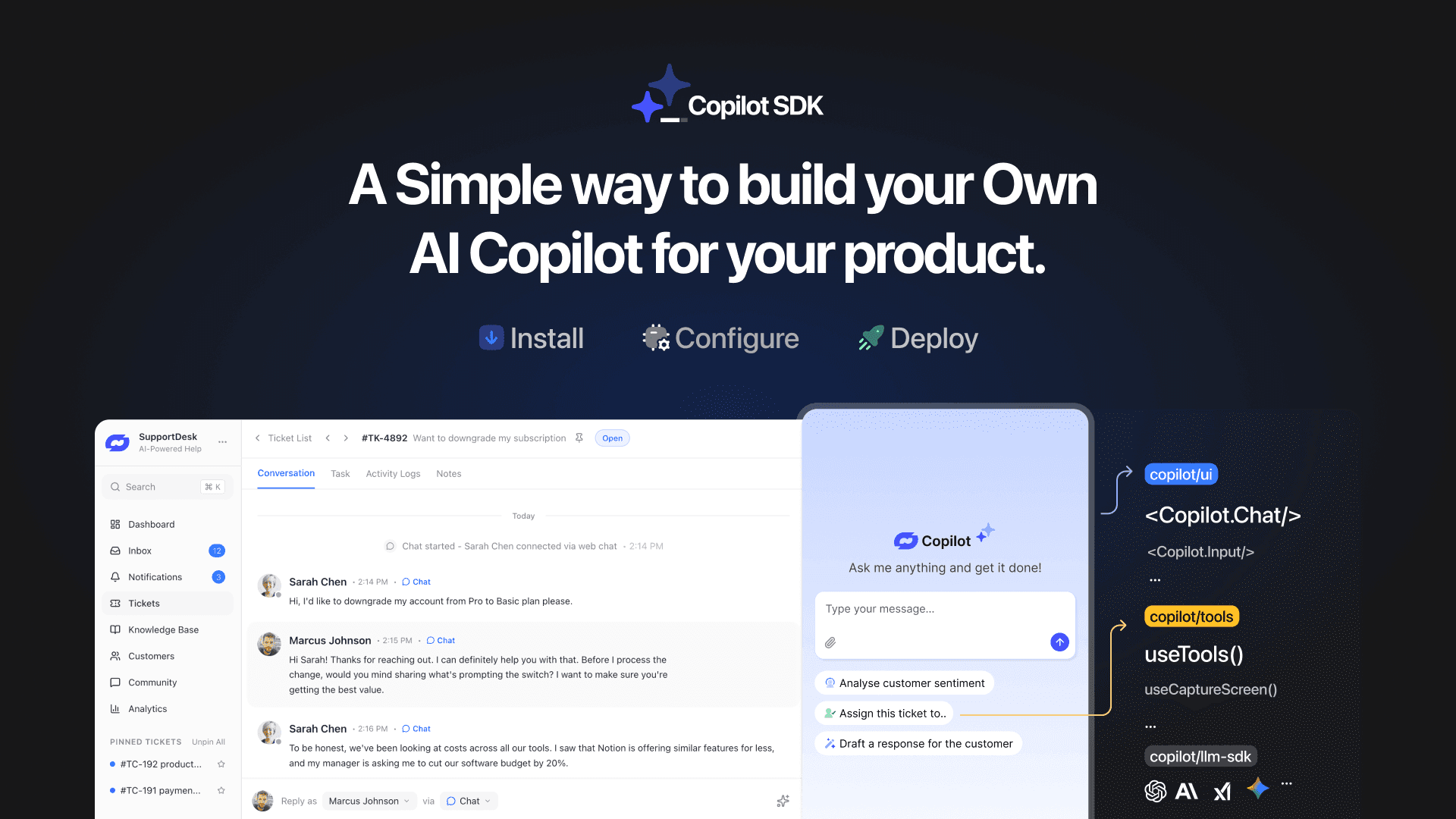
TL;DR YourGPT Copilot SDK is an open-source SDK for building AI agents that understand your application state, user context, and what is happening inside your product. Instead of working like isolated chat widgets, these agents connect directly with your product and can take real actions within existing workflows. This helps teams build contextual AI experiences […]
TL;DR YourGPT 2.0 adds AI Studio for building, testing, and debugging automated workflows. It includes native MCP integration for more than 100 tools, upgraded voice agents, and native SDKs for iOS and Android applications. With shared context across web, WhatsApp, Instagram, Telegram, and mobile, YourGPT turns conversations into real actions across support, sales, and operations. […]

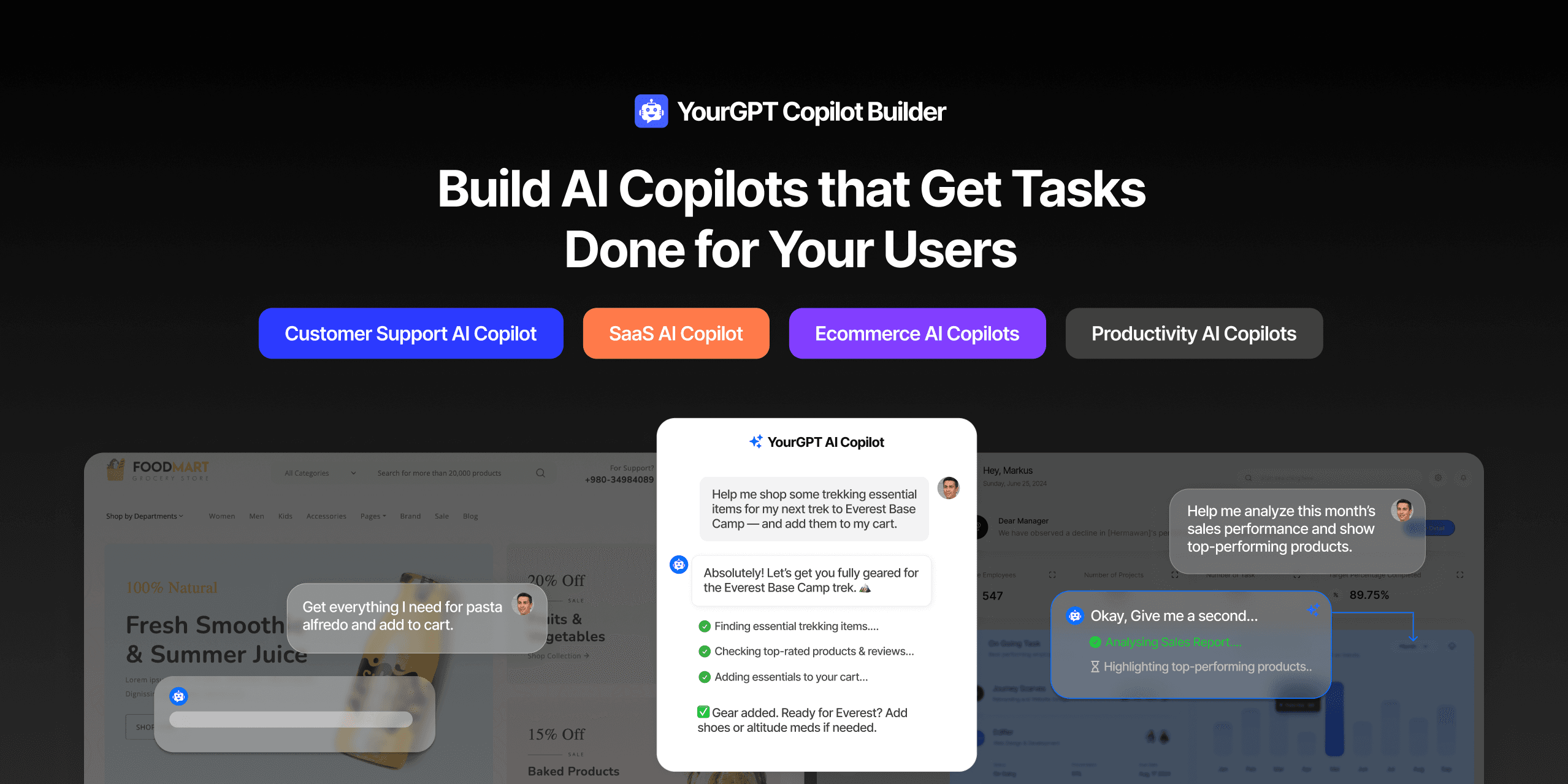
TL;DR Most AI tools provide answers but still leave users to complete the task through search results, settings pages, or checkout flows. AI Copilot Builder closes that gap by executing registered actions directly inside the product instead of only explaining what to do. Search, cart updates, account changes, and multi-step bookings can all happen within […]
TL;DR Building an AI-powered Telegram bot does not require custom development. BotFather provides the Telegram bot token, while a no-code platform like YourGPT handles AI training, free-form conversations, and the Telegram connection. This guide covers the full setup, from creating the bot in BotFather to connecting it with YourGPT and taking it live. Most Telegram […]
