8 Best AI Shopping Assistants for WooCommerce Stores

Rajni
Last updated on July 13, 2026
Getting shoppers to your WooCommerce store is only half the job. The real challenge is helping them find the right product before they lose interest and leave.
Many stores spend heavily on ads and social media, but the shopping experience itself often creates friction. Customers face too many product options, confusing filters, poor search results, and no instant support when they have a question. When that happens, even interested buyers abandon the site.
AI shopping assistants help solve this problem by guiding customers through product discovery in real time. Instead of forcing shoppers to browse endless categories, they let them ask natural questions like, “What are the best wireless headphones under $100 for working from home?” The assistant can then suggest relevant products, explain differences, answer questions, and help move the customer closer to purchase.
But not every AI shopping assistant works the same way. Some are built for product recommendations, some focus on customer support, and others can help with cart actions, follow-ups, and post-purchase questions.
In this blog, we’ll cover the 8 best AI shopping assistants for WooCommerce stores, what each one does well, where it falls short, and which type of store it fits best.
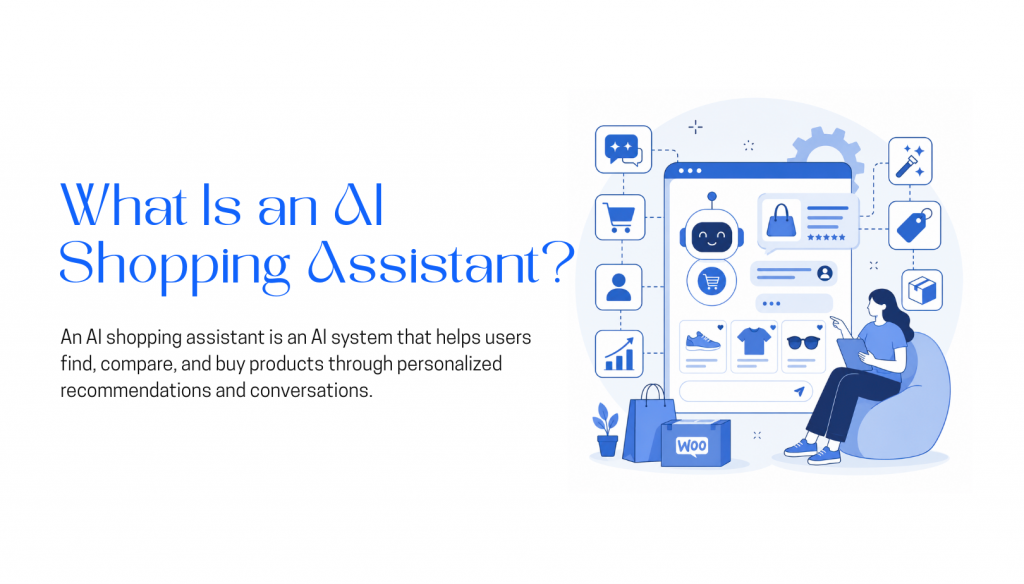
An AI shopping assistant for WooCommerce is a conversational tool that helps customers find, compare, and choose products using natural language instead of manual browsing.
Rather than clicking through categories, filters, and search results, a shopper can ask something like:
“What’s a comfortable office chair under $300 for long workdays?”
The AI Assistant then scans your WooCommerce product catalog and returns a few relevant options with simple explanations, such as price, key features, use case, or why each product fits the request.
At a basic level, these tools answer product questions and recommend items. More advanced AI shopping assistants can also connect with cart data, order history, checkout flows, CRM tools, and helpdesk platforms. This allows them to support more of the buying journey, from product discovery to cart assistance and post-purchase questions.
For WooCommerce stores with large or complex catalogs, this can have a direct impact on conversions. If you sell electronics, furniture, fashion, configurable products, or items with many specifications, helping shoppers find the right product faster can reduce friction and increase sales.
Most AI shopping assistants follow a similar process behind the scenes:
More advanced platforms go beyond product recommendations. They can help shoppers add products to the cart, answer checkout questions, recover abandoned carts, support returning customers, and connect with customer service tools.
That is the key difference between a simple AI product finder and a full AI shopping assistant for WooCommerce.
Standard search bars and category filters work well enough until a customer types something your store does not expect. A shopper might enter “something for sore feet” while every product title in your catalog uses the word “orthopedic.” The search returns nothing, and you lose a sale. AI shopping assistants fill this gap by guiding people through your inventory using normal conversation instead of exact keywords.
Here is where they add real value to a WooCommerce store.
Customers usually describe problems, not products. They search by occasion, symptom, or vague need rather than the precise terms in your product descriptions. An AI assistant interprets intent. If someone types “shoes for standing all day,” it maps that need to the right products even if your catalog never uses that phrase. You stop losing sales because of simple keyword mismatches.
WooCommerce stores with hundreds or thousands of SKUs become hard to browse no matter how good your filters are. Shoppers click through color, size, price, and material tabs until they lose patience. An AI assistant lets a customer type “show me winter coats under $200 that are not bulky” and receive a tight, relevant list. It turns an overwhelming catalog into something that feels curated.
Small doubts about sizing, shipping times, return policies, or product compatibility are enough to stop a purchase. If a buyer has to leave your site to check a FAQ or wait for an email reply, they usually do not come back. An AI assistant answers these questions inside the chat window while the customer still has the product page open. The purchase keeps moving.
Your team should not spend half the day answering “Do you ship to Canada?” or “Is this in stock?” An AI assistant pulls answers directly from your WooCommerce data and handles routine queries on its own. Your human agents then have space for complicated issues like damaged shipments, custom requests, or billing disputes. Support costs stay lower and service quality stays higher.
Static “You may also like” recommendations often feel random. An AI assistant can ask what a customer plans to do with a product, then suggest a relevant add-on based on the answer. If someone buys a camera, the assistant might ask if they shoot video, then recommend a specific memory card speed. Because the suggestion follows context, it feels helpful rather than pushy.
Many of your customers do not start on your website. They might message you on Instagram, WhatsApp, or Messenger first. A connected AI assistant carries your product knowledge and conversation history across these channels. A shopper can ask about sizing on your site at lunch and finish checkout through WhatsApp on the train home without starting the conversation over.
The real value comes from removing friction, not adding technology. An AI assistant helps shoppers find products faster, answer their own questions, and check out with fewer interruptions. But this only works if the foundation is solid. Your WooCommerce product data, attributes, stock levels, and shipping rules need to be clean and accurate. The assistant is a layer on top of that foundation. Get the data right, choose a tool that matches your actual workflow, and it becomes a practical filter that keeps people on your site.
| Platform | Best For |
|---|---|
| YourGPT | AI shopping assistance, customer support, and multi-channel WooCommerce automation |
| Gorgias | Support teams managing high volumes of order, shipping, and post-purchase queries |
| Zipchat AI | Pre-sale product discovery and conversion-focused shopping conversations |
| WoowBot | Small to mid-sized stores that want a WordPress-native chatbot with product search |
| Alhena AI | Shopping assistance, support automation, and AI search visibility tracking in one platform |
| Amio | Mid to large stores adding AI product conversations to an existing helpdesk setup |
| PurioChat | Small WooCommerce stores needing basic AI product Q&A without recurring SaaS fees |
| Clerk.io | Revenue-focused product discovery, AI search, recommendations, and personalization |
The tools below were selected based on how well they function specifically as shopping assistants inside WooCommerce environments, not on marketing claims or general popularity. The evaluation focused on shopping intent handling, catalog integration quality, recommendation relevance, and honest functional limits in real store usage. Here’s how they compare.
YourGPT is a no-code AI platform that helps businesses build AI agents for customer support, sales, and business operations. For WooCommerce stores, it can work as both a shopping assistant and a support agent by connecting directly with real-time store data.
Its biggest strength is its deep WooCommerce integration. The AI can access product details, inventory levels, order status, shipping information, and store-specific knowledge to give customers accurate answers instantly. This makes it more useful than a basic chatbot that only responds from static FAQ content.
YourGPT is best for WooCommerce stores that want an AI assistant for both shopping guidance and customer support. It is especially useful for stores with large catalogs, frequent customer questions, international audiences, or multi-channel sales operations across website chat, WhatsApp, Instagram, Telegram, and Messenger.
Gorgias is a customer support platform, not a shopping assistant. That distinction matters here because it’s frequently positioned alongside tools that handle product discovery, which it doesn’t do in any meaningful way.
What Gorgias does well is consolidate customer conversations, including email, chat, and social, into one inbox with WooCommerce order data pulled in automatically. Support agents answering product or order questions have full purchase context without switching between tabs.
Features
Limitations
Pricing
Best For
WooCommerce stores with a dedicated support team managing high volumes of order, shipping, and post-purchase queries. Not the right choice if product discovery or conversion improvement is the primary goal.
Zipchat AI is built specifically for pre-sale conversations and product discovery inside ecommerce stores. The tradeoff for that focus is a narrower functional range, but within product discovery, it performs well.
Where it earns its place is in the catalog connection. It pulls live WooCommerce product data and uses purchase intent signals from each conversation to surface relevant products and guide shoppers toward checkout.
Features
Limitations
Pricing
Best For
WooCommerce stores whose main gap is product discovery and pre-purchase conversation, particularly stores with well-structured catalogs where recommendation accuracy can be maximized from day one.
WoowBot is a WordPress plugin, which means setup, performance, and scalability are all tied to your hosting environment. For stores that prefer keeping everything inside WordPress without third-party SaaS dependencies, that’s an advantage. For stores expecting consistent performance under load, it’s a real ceiling.
The plugin handles product search inside the chat interface, supports add-to-cart actions, and can be connected to AI models like OpenAI or Dialogflow for more sophisticated responses.
Features
Limitations
Pricing
Best For
Small to mid-sized WooCommerce stores that want a self-contained, no-subscription chatbot with product search and basic cart functionality, and have the technical patience to configure the AI integration themselves.
Alhena AI covers more ground than most tools on this list by combining product discovery, customer support, and AI visibility tracking. The visibility feature monitors how your products appear in AI search engines like ChatGPT and Perplexity, which is genuinely different from what other platforms offer.
For WooCommerce stores, it functions as a shopping assistant grounded in live catalog data, with support automation running alongside it for post-purchase queries.
Features
Limitations
Pricing
Best For
Growth-stage WooCommerce stores that want shopping assistance, support automation, and AI search visibility in one platform rather than managing separate tools for each function.
Amio connects to WooCommerce product feeds, order systems, and existing helpdesk platforms to handle both pre-sale product conversations and post-purchase support through one interface.
Its helpdesk integrations, including Gorgias, Zendesk, and Freshdesk, make it a reasonable choice for stores that already have a support stack and want to add AI capability without replacing what’s already working.
Features
Limitations
Pricing
Best For
Mid to large WooCommerce stores with existing support infrastructure that want to add AI-driven product conversations without overhauling their current helpdesk setup.
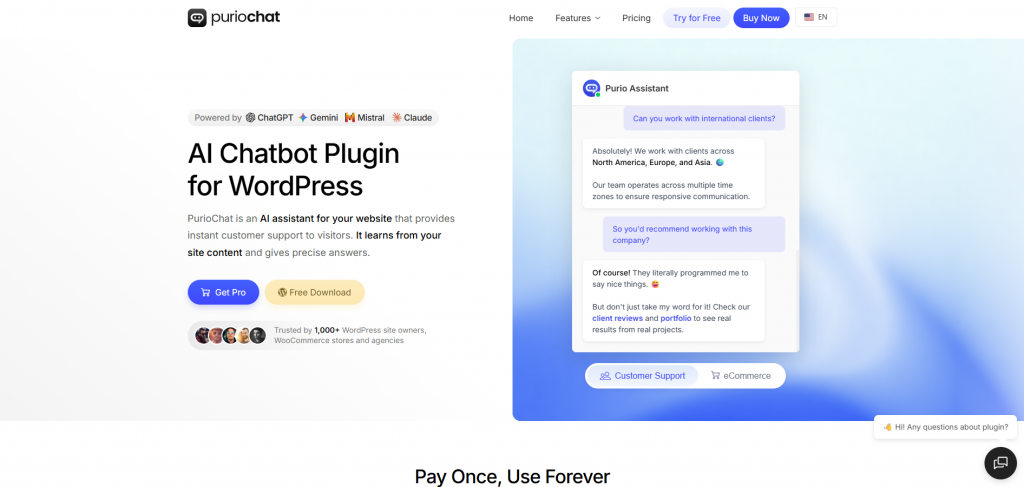
PurioChat runs entirely inside WordPress with no external servers and no recurring SaaS fees beyond the one-time license. It uses semantic search and LLM integrations to answer customer questions based on your site content, product pages, and uploaded documents.
For stores that want a lightweight AI chat layer without monthly fees or external dependencies, it’s one of the more practical options available.
Features
Limitations
Pricing
Best For
Small WooCommerce stores that need basic AI-powered product Q&A and site search, have well-maintained hosting, and want to avoid recurring SaaS costs.
Clerk.io connects to WooCommerce and 20+ other e-commerce platforms to deliver search, product recommendations, email personalisation, audience segmentation, and live chat through one platform. Its focus is revenue generation rather than support automation, helping stores convert more browsers into buyers across the customer journey.
Its modular setup means WooCommerce stores can start with a single product like search or recommendations and expand over time without disrupting existing marketing tools.
Features
Limitations
Pricing
Best For
WooCommerce stores looking to increase revenue through better search, personalisation, and product discovery, particularly those with larger catalogues who want data-driven recommendations without a custom build.
| Platform | Core Focus | WooCommerce Capabilities | Key Strengths | Limitations | Pricing | Best For |
|---|---|---|---|---|---|---|
| YourGPT | AI shopping assistant, customer support, sales, and business automation | Connects with WooCommerce product data, inventory, order status, shipping details, product recommendations, and store knowledge. | No-code setup, deep WooCommerce integration, 100+ languages, omnichannel support, proactive cart recovery, and unlimited simultaneous conversations. | Only a 7-day free trial. Advanced customization may require some technical understanding. | Essential: $39/month annually Professional: $79/month Advanced: $349/month Enterprise: Custom |
WooCommerce stores that need both shopping guidance and customer support across website chat, WhatsApp, Instagram, Telegram, and Messenger. |
| Gorgias | Customer support platform for ecommerce teams | Pulls WooCommerce order data into support conversations so agents can answer order, shipping, and purchase-related questions faster. | Strong shared inbox, AI-assisted replies, macros, automated responses, order-aware support view, routing, and performance reporting. | Not a true product discovery assistant. Workflow customization can feel rigid, and pricing jumps sharply between tiers. | Starter: $10/month Basic: $104/month Pro: $840/month Advanced: $3,000/month Enterprise: Custom |
Stores with dedicated support teams handling high volumes of order, shipping, return, and post-purchase questions. |
| Zipchat AI | Pre-sale product discovery and conversion-focused chat | Syncs with WooCommerce catalog data to recommend products, guide shoppers, and respond to purchase-intent queries. | Catalog-aware recommendations, intent-based shopping assistance, conversion-oriented flows, cart interaction, and direct WooCommerce sync. | Focused mainly on pre-sale use cases. Does not handle post-purchase support like order tracking, returns, or support automation. | Starter: $468/year Growth: $1,236/year Pro: $2,388/year Scale: $4,668/year |
Stores that mainly need better product discovery, guided recommendations, and pre-purchase conversion support. |
| WoowBot | WordPress-native chatbot with product search | Lets shoppers search products inside chat, browse results, and add products to cart through the conversation flow. | One-time license, WordPress-native setup, in-chat product search, cart actions, lead capture, and optional AI integrations. | Performance depends on hosting. Not ideal for very large catalogs. AI setup may require manual configuration with tools like OpenAI or Dialogflow. | Starter: $49 one-time Professional: $99 one-time Master: $189 one-time |
Small to mid-sized WooCommerce stores that want a self-contained chatbot without monthly SaaS fees. |
| Alhena AI | Product discovery, support automation, and AI visibility tracking | Uses live catalog data for product discovery and store data for support queries, returns, FAQs, and customer assistance. | Conversational product discovery, guided purchase assistance, support automation, multi-channel deployment, integrations, and AI search visibility tracking. | Broader feature set can require longer onboarding. Output quality depends heavily on clean catalog and product data. | Free plan: Limited usage Essentials: $199/month Growth: $499/month Scale: $999/month Enterprise: Custom |
Growth-stage WooCommerce stores that want shopping assistance, support automation, and AI visibility monitoring in one platform. |
| Amio | AI conversations for product guidance and after-sales support | Connects to WooCommerce product feeds, order systems, and helpdesk platforms to support pre-sale and post-purchase conversations. | Product feed-based answers, after-sales automation, conversational shopping guidance, multi-channel messaging, and helpdesk integrations. | Accuracy depends on structured product feeds and knowledge sources. Higher-scale plans can be expensive for smaller stores. | Starter: €150/month AI Expert: €350/month AI Scale: From €2,950/month |
Mid to large WooCommerce stores with existing helpdesk tools that want to add AI product and support conversations. |
| PurioChat | Lightweight WordPress AI chatbot for product Q&A | Runs inside WordPress and uses WooCommerce product data, pages, posts, PDFs, and site content to answer customer questions. | One-time license, WordPress-native setup, semantic search, WooCommerce product integration, multi-source training, and LLM flexibility. | Limited beyond Q&A. Not built for cart actions, conversion workflows, or advanced multi-step shopping assistance. | Pro: $59 one-time license for single site lifetime access | Small WooCommerce stores that need basic AI product Q&A and site search without recurring SaaS costs. |
| Clerk.io | AI search, recommendations, personalization, and revenue growth | Connects to WooCommerce through a native plugin and syncs live product and order data for search, recommendations, email personalization, and AI chat. | AI-powered search, personalized recommendations, AI chat, email personalization, audience segmentation, and cookieless WooCommerce tracking. | Not designed for post-purchase support or helpdesk workflows. Usage-based pricing can become harder to forecast as traffic grows. | Usage-based pricing across five modules. Each module is priced separately by monthly volume. | WooCommerce stores focused on increasing revenue through smarter search, personalization, and product discovery. |
The right AI shopping assistant depends on where shoppers are getting stuck in your store.
If customers struggle to find the right product, choose a tool focused on product discovery, search, and recommendations. If your team spends too much time answering order, shipping, and return questions, a support-focused AI assistant will be a better fit. If you need both, look for a platform that connects with WooCommerce product data, inventory, orders, and customer conversations.
Before choosing a tool, check how deeply it integrates with WooCommerce. A useful assistant should access product details, prices, stock status, variations, order updates, shipping information, and store policies. The more real-time data it can use, the more accurate and helpful its answers will be.
Also consider your store size. Small WooCommerce stores may only need a lightweight chatbot for product Q&A. Larger stores with bigger catalogs, multiple channels, or high support volume should choose a more advanced platform with automation, multilingual support, and stronger integrations.
Finally, clean up your product data before launching any assistant. Clear product titles, descriptions, categories, tags, and attributes will improve recommendation quality across every platform.
Choose based on the problem you need to solve first: better product discovery, fewer support tickets, cart recovery, or multi-channel customer engagement. The best tool is the one that removes the most friction from your buying journey.
AI shopping assistants usually fail because of poor setup, not because the tool itself is weak. Here are the mistakes WooCommerce stores should avoid:
1. Using messy product data
If product titles, descriptions, categories, tags, or attributes are incomplete, the assistant will struggle to recommend the right products. Clean product data is the foundation of accurate AI responses.
2. Choosing the wrong type of tool
A support chatbot is not always good at product discovery, and a product recommendation tool may not handle order tracking or returns well. Choose the assistant based on your main problem: discovery, support, cart recovery, or multi-channel engagement.
3. Relying only on default settings
Most tools need some configuration. Set up answers for common questions around sizing, compatibility, shipping, returns, product comparisons, and checkout concerns. Otherwise, the assistant may give generic responses.
4. Placing the assistant in the wrong area
A chat widget only on the homepage may not help much. AI assistants usually work better on product pages, category pages, cart pages, and other points where shoppers need help making a decision.
5. Measuring only support ticket reduction
Ticket reduction matters, but it is not the full picture. Also track assisted conversions, add-to-cart rate, cart recovery, average order value, and how often AI conversations lead to purchases.
A good AI shopping assistant needs more than installation. Clean your catalog, map common customer questions, and place the assistant where it can actually influence the buying journey.
It depends on the gap you’re solving. Zipchat AI and Add To Cart AI lead for product discovery and conversion. Gorgias and Amio are stronger for support at scale. YourGPT and Alhena AI cover both but require more setup.
It reads the customer’s query, identifies intent, searches your catalog using attributes and semantic matching, and returns relevant products or follow-up questions. More advanced platforms also take actions like adding items to the cart or routing conversations to a human agent.
Basic deployment typically doesn’t require coding. Connecting product feeds, configuring intent flows, and integrating with other systems usually takes more time and some technical familiarity, particularly on platforms that offer deeper workflow control like YourGPT.
Only if it addresses the right friction point. If customers are leaving because they can’t find the right product or get a question answered in time, a well-configured assistant can directly reduce that drop-off. Poorly configured tools with weak product data rarely move the needle regardless of the platform.
A traditional chatbot follows scripts and responds to trigger phrases. An AI shopping assistant understands intent from natural language, searches catalog data dynamically, and returns relevant results rather than matching input to predefined answers.
AI shopping assistants have become an important part of how WooCommerce customers discover products, ask questions, compare options, and decide what to buy.
The best choice depends on the problem you need to solve first. If shoppers struggle to find the right product, focus on product discovery and recommendation quality. If your support team is overloaded, choose a tool that can handle order updates, shipping questions, returns, and common support requests. If your store sells across multiple channels, make sure the assistant can support conversations beyond your website.
Choose a tool for the problem, not the feature list. A simple tool can work well for a small store with basic needs, while a growing store may need something broader that supports product recommendations, customer support, cart recovery, multilingual conversations, and omnichannel engagement.
Start by fixing the biggest friction point in your buying journey. Then choose an AI shopping assistant that can solve that problem today and still support your store as traffic, catalog size, and customer expectations grow.

Compare six Yuma alternatives by ecommerce capabilities, helpdesk compatibility, pricing and human handoffs to choose a replacement for your support team.


Move from Gorgias with a verified ticket archive, tested AI workflows, human handoff and a channel cutover plan before ending your subscription.

TL;DR The Gorgias AI Agent is the automation layer inside the Gorgias helpdesk, split between a Shopping Assistant for pre-purchase conversations and a Support Agent for post-purchase support. A connected Shopify store is required, and Gorgias documentation rules out platforms such as BigCommerce, Magento, and WooCommerce for the AI Agent. Billing runs on two separate […]

TL;DR Gorgias is the closest Richpanel alternative for Shopify stores that need native order actions directly inside support tickets. YourGPT fits stores that want one AI agent handling requests across web, WhatsApp, Instagram, and email, while Tidio and Re:amaze suit smaller teams looking for lighter, lower-cost options. Richpanel’s AI pricing starts around $500/month for two […]
TL;DR Shopify Inbox is a good free option for stores that only need basic storefront chat and simple customer conversations. Stores usually look for alternatives when they need multichannel support, stronger team workflows, or automated order actions. YourGPT is strongest for cross-channel AI automation, Gorgias for Shopify-native order workflows, and Tidio for smaller stores that […]

TL;DR Tidio recently restructured its top paid plan, and many 2026 reviews still describe the old pricing model. Confirm current pricing directly on Tidio’s site before budgeting. Lyro, Tidio’s AI agent, runs on Anthropic’s Claude rather than ChatGPT. Only the Premium tier carries a guaranteed resolution rate, well below the average Tidio advertises elsewhere. Billing […]