6 Best Decagon AI Alternatives for Customer Support Automation

Rajni
Last updated on June 30, 2026

Decagon is a powerful AI customer support platform, but its standalone architecture, complex setup, and unpredictable pricing can make it challenging for some businesses.
This guide covers the 6 best Decagon alternatives in 2026, including YourGPT, Intercom, Kore.ai, Yellow AI, and Ada.
YourGPT stands out with Agentic AI that performs real-time actions, offering self-learning intelligence, deep customization, and scalable automation for businesses of any size.
The Decagon platform is an enterprise AI solution designed to automate and scale customer support. It allows businesses to build, test, and deploy “AI concierges” that autonomously resolve customer inquiries across chat, email, and voice without generic chatbot limitations.
Decagon is built for customer support and customer experience teams that want AI agents to reduce manual workload, improve response speed, and handle customer conversations at scale.
While this approach can work well for enterprise support teams, Decagon may not be the right fit for companies that already rely heavily on existing helpdesks, CRMs, or internal workflows.
For many teams, Decagon’s standalone setup can create extra operational complexity. Businesses may need to manage Decagon separately from their existing support stack, rebuild workflows, or spend additional time connecting backend systems.
Some teams need more flexibility over how their AI agents are built, trained, updated, and connected to existing tools. Others may prioritize transparent pricing, faster setup, broader integrations, workflow customization, or easier deployment across channels such as web chat, WhatsApp, email, Slack, and CRM systems.
This is why Decagon AI alternatives are worth evaluating.
This blog compares the top 6 Decagon AI alternatives for customer support and CX teams across automation, integrations, deployment flexibility, pricing, and operational fit, so you can choose a platform that aligns with how your business actually works.
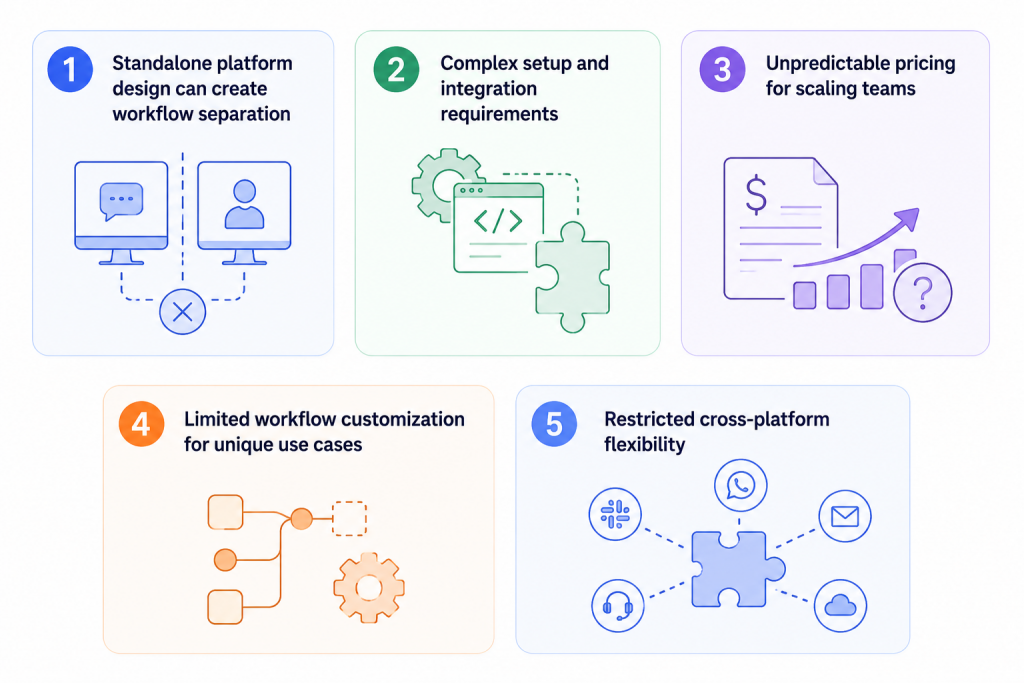
Decagon AI is a strong AI customer support platform for businesses that want autonomous agents to manage customer interactions. However, teams should evaluate the following limitations before committing:
Decagon AI functions as an independent support system. For businesses already using helpdesks, CRMs, or customer communication tools, this may mean managing two separate environments or rebuilding existing workflows inside Decagon. This can create friction for teams that want continuity across their current support operations.
Decagon is not always a plug-and-play solution. To make it effective, teams may need to import structured data, connect backend systems, configure workflows, and define detailed automation rules. This can require technical involvement, planning, and implementation time, especially for companies with complex support processes.
Decagon’s usage-based or variable pricing model can make budgeting harder for teams with changing support volumes. Costs may increase during seasonal peaks, product launches, outages, or periods of high customer activity. This can be challenging for businesses that prefer predictable monthly costs.
Some teams may find Decagon’s automation structure restrictive when adapting AI agents to specific support, sales, or operational workflows. Businesses with custom processes may need more control over how agents behave, when they escalate, and how they interact with internal systems.
Decagon is mainly focused on its own AI support environment. Teams that want to unify conversations across multiple tools such as Slack, WhatsApp, email, CRMs, helpdesks, and internal platforms may face integration limitations. This can reduce flexibility for businesses that need AI automation across a wider operating stack.
These platforms move beyond basic bots by connecting data, processes, and customer interactions in one place. They allow teams to modernise your customer support.

YourGPT is an AI-first platform designed to build and run autonomous AI agents across customer support, sales, and internal operations. Instead of stopping at answering questions, YourGPT agents complete tasks, trigger workflows, and resolve requests inside the conversation.
Teams can launch simple knowledge bots using the no-code builder, then scale into advanced automation using the AI Studio for structured workflows and system integrations.
Fin is Intercom’s native AI agent, built to work seamlessly inside its customer service platform. It learns directly from your Intercom knowledge base and past conversations to deliver instant, on-brand answers to customer questions.
Because Fin is deeply connected with Intercom’s inbox, tickets, and support workflows, teams can manage AI and human support in one place. It can resolve common queries, collect customer details, and escalate complex issues to human agents when needed.
Fin is also a good option for businesses already using Intercom, especially teams that want faster support automation without adding a separate AI platform.

Kore.ai is an enterprise conversational AI platform. It enables organizations to build advanced virtual assistants for over 35 different channels. These include voice. It delivers robust security controls and a library of ready-made templates for common use cases like IT and HR support.
It is best suited for large enterprises that need scalable automation across customer service, employee support, and internal operations. However, teams may need technical resources to fully customize and deploy complex workflows.

Yellow AI is an enterprise-grade conversational AI platform offering intelligent automation across chat and voice channels. It uses advanced Natural Language Understanding (NLU) and orchestration capabilities to handle complex customer journeys across multiple touchpoints.
It is a good fit for businesses that want to automate customer support, marketing, and commerce conversations across messaging apps, websites, and voice channels. However, advanced deployments may require careful setup to align workflows, integrations, and brand-specific use cases.
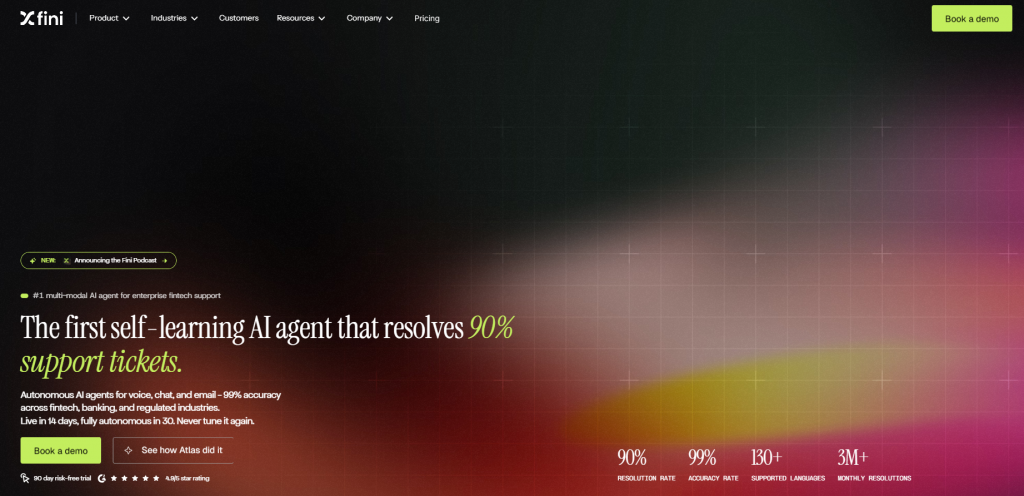
Fini is an autonomous AI customer support agent and a direct alternative to Decagon for teams that want resolution, not just responses. Like Decagon, it resolves customer queries with AI across channels, but it is built to sit on top of your existing help desk (Zendesk, Intercom, Salesforce) rather than run as a separate system, connecting in minutes with no migration.
It resolves up to 90% of voice, chat, and email queries end to end and takes real actions like refunds, cancellations, verifications, and subscription updates, on a retrieval-free architecture that holds 99% accuracy.

Ada is an AI-first automation platform focused on scaling customer service for high-volume enterprises. It empowers teams to create no-code chatbots that deliver personalized, automated support experiences while seamlessly integrating with existing business systems.
It is a good choice for support teams that want to launch AI automation quickly without heavy technical involvement. However, businesses needing advanced workflow control or deep agentic actions may find it less flexible than more customizable AI agent platforms.
The best Decagon AI alternative should fit into your existing support operations, improve automation, and give your team more control without adding unnecessary complexity. Instead of choosing a platform only by features, evaluate how well it connects with your tools, supports your workflows, and helps your team deliver faster customer experiences.
Use these key factors to compare the right Decagon alternative for your business.
A strong alternative should work smoothly with the tools your team already uses, including your helpdesk, CRM, ecommerce platform, ticketing system, and internal databases.
The goal is not to rebuild your entire support operation from scratch. The right platform should strengthen your current workflows by keeping customer data, conversations, and actions connected across systems.
When comparing Decagon alternatives, look for platforms that offer easy integrations, API flexibility, and reliable data sync across your existing business stack.
Your support and sales teams should be able to update AI workflows without depending on developers for every change.
A practical AI platform should include a no-code or low-code interface where teams can edit responses, adjust automation flows, train the AI, create handoff rules, and improve customer journeys independently.
This helps your business move faster, reduce technical dependency, and adapt quickly when customer needs, policies, or internal processes change.
Pricing clarity is important when selecting any AI customer support platform. Usage-based pricing can become difficult to forecast when support volume changes due to seasonal demand, product launches, outages, or business growth.
The best Decagon AI alternatives offer clearer pricing structures that make it easier to plan budgets and understand what you are paying for.
Look for platforms that clearly explain pricing by seats, usage, channels, automation volume, or feature tiers, so there are fewer surprises as your customer conversations scale.
Customers expect support across the channels they already use, such as web chat, WhatsApp, Instagram, Messenger, email, and voice.
The right alternative should bring these conversations into one unified workspace instead of forcing teams to switch between multiple tools. This helps agents see full customer context, respond faster, and maintain a consistent experience across every channel.
A unified inbox also improves collaboration between AI agents and human teams by making escalations, follow-ups, and conversation history easier to manage.
A modern AI support platform should do more than answer basic questions. It should help complete real tasks across your business systems.
Look for AI agents that can tag tickets, update customer records, qualify leads, book meetings, trigger workflows, process requests, collect information, and hand off complex cases to the right human agent.
This type of action-oriented automation reduces repetitive manual work and allows your team to focus on higher-value customer issues.
Cost should not be the only factor when choosing a Decagon AI alternative. A cheaper tool may look attractive at first, but weak integrations, limited automation, or poor workflow control can increase manual effort over time.
Instead, evaluate the total value each platform delivers. Consider how much repetitive work it can reduce, how easily it connects your customer channels, how well it supports your team, and whether it can scale as your business grows.
The right platform should improve response speed, reduce support workload, increase automation coverage, and support better customer experiences without requiring a larger team.
Choose a platform that integrates with your existing systems, gives your team control over automation, supports multiple channels, and enables AI agents to take meaningful actions.
A solution that combines flexibility, predictable pricing, and workflow automation will deliver stronger long-term value than a tool that only answers customer questions.
Many teams move away from Decagon because setup can be complicated, and pricing is unpredictable. Its standalone design often doesn’t connect well with existing tools, creating extra work for support teams. Businesses prefer platforms that are easier to manage and integrate smoothly with what they already use.
YourGPT is a no-code, AI-first platform that automates customer support, sales, and internal operations. Its Agentic AI performs real actions like booking calls or sending updates. With support for WhatsApp, voice, and multilingual chat, it’s ideal for growing and global businesses.
Each platform fits a different business need:
– Intercom (Fin) is best for teams already using Intercom.
– Kore.ai is ideal for enterprises needing advanced automation and voice AI.
– Yellow.ai helps deliver smooth, omnichannel conversations.
– Ada focuses on quick self-service automation and personalized support.
Yes. Platforms like YourGPT, Intercom, and Kore.ai integrate easily with tools such as Zendesk, Freshdesk, and HubSpot, allowing you to add AI automation without changing your current systems.
YourGPT (Enterprise Plan) and Kore.ai are excellent for enterprise use. Both offer advanced compliance features, analytics, and automation that scale across departments while keeping data secure.
Yes. YourGPT offers flexible pricing plans that suit different team sizes. Yellow.ai and Ada also provide simple and scalable plans that work well for startups wanting quick automation without heavy costs.
YourGPT can be up and running in just a few days using its no-code builder. Intercom (Fin) is nearly instant if you’re already using Intercom. Kore.ai, Yellow.ai, and Ada may take longer depending on integration needs.
Yes. Tools like YourGPT and Yellow.ai support workflows across departments like sales, HR, and IT. They help teams reduce repetitive work and improve overall efficiency.
YourGPT and Kore.ai offer advanced voice and IVR capabilities. They handle voice interactions, automate routing, and deliver natural conversation flows for better customer experience.
It depends on your goals:
– For real-time AI that acts and learns — pick YourGPT.
– For teams already on Intercom — use Fin.
– For voice AI and large-scale automation — go with Kore.ai.
– For omnichannel experiences — choose Yellow.ai.
– For quick self-service — Ada is a great fit.
Match your choice with your needs, tech stack, and budget.
Choosing a Decagon choice requires a clear-eyed assessment of your business’s operational goals. Many platforms tackle isolated needs. Nonetheless, the aim is not just to replace a tool. The goal is to adopt a system that enhances your existing infrastructure and reduces complexity.
For businesses that focus on scalable efficiency without requiring platform migration or developer dependency, YourGPT presents a definitive advantage. It is an AI-first, no-code platform. It works alongside your current tools. It centralizes customer and internal conversations across critical channels like WhatsApp, Slack, Instagram, and Messenger. This structure lets you automate support workflows, manage sales funnels, and handle internal operations from a single, intelligent dashboard.
Intercom offers the smoothest path for teams already invested in the Intercom ecosystem. It provides instant AI capabilities with minimal disruption. Kore.ai delivers enterprise-grade orchestration for organizations with complex, multi-channel requirements. Yellow excels for global enterprises needing sophisticated NLU and multilingual capabilities across diverse channels. Ada provides powerful no-code automation for high-volume support teams prioritizing ticket deflection and self-service.
Ultimately, if you need a Decagon choice that provides a unified system for growth, YourGPT is the most logical choice. It does not force you to abandon your existing tools. It is engineered to scale from small teams to enterprise-level demands. It delivers a measurable reduction in manual tasks.
YourGPT helps businesses build AI agents that answer from your data, automate customer support, connect with your tools, and work across web chat, WhatsApp, email, voice, and more.
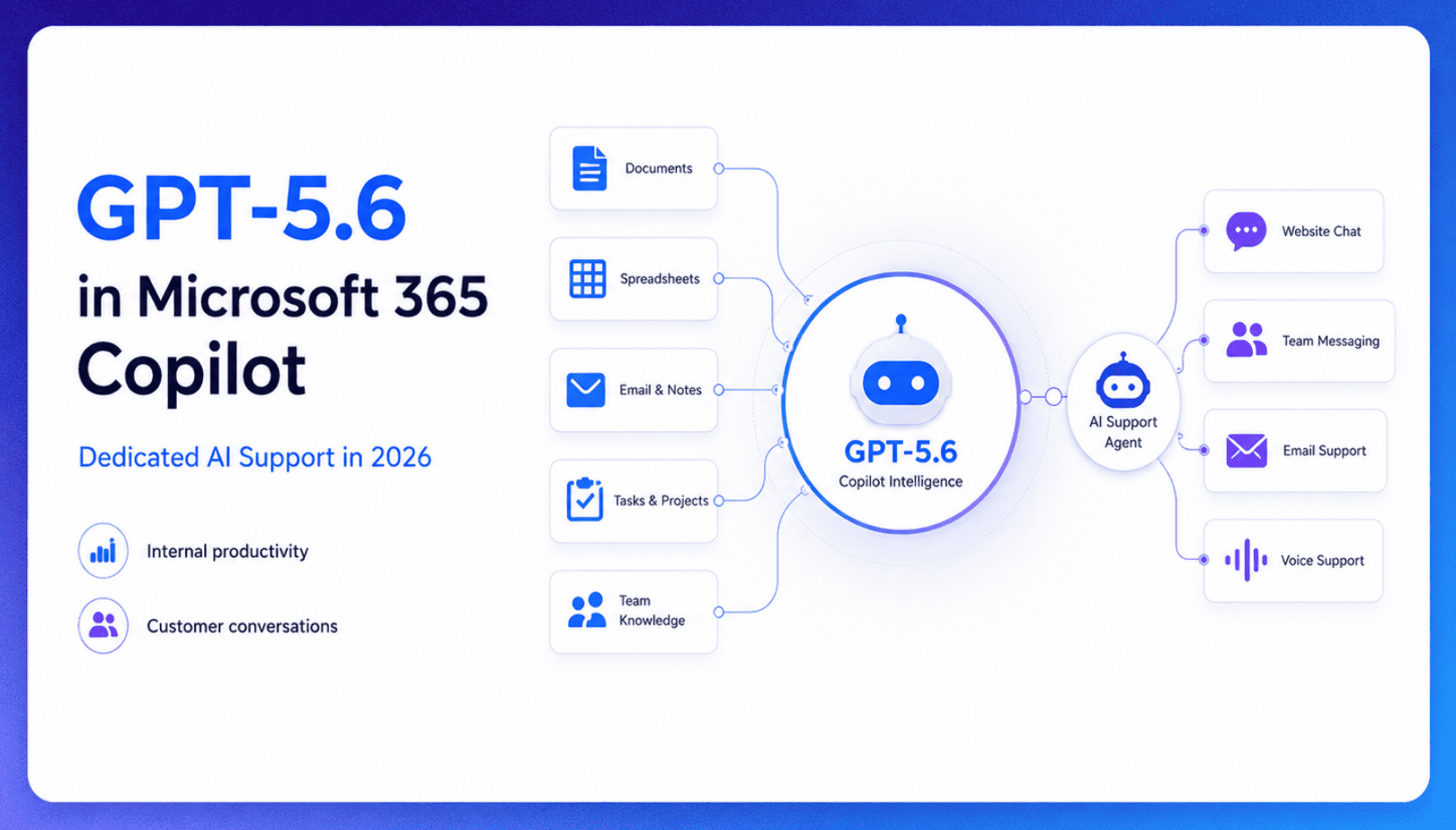
TL;DR Microsoft made GPT-5.6 the preferred model across Word, Excel, PowerPoint, Copilot Chat, and Cowork on July 9, 2026, focusing on internal workplace productivity rather than customer-facing support. Dynamics 365 Service Agent also reached general availability, but it mainly helps human support representatives manage cases within Microsoft’s existing permission structure and requires separate licensing. A […]

TL;DR Cheap frontier models now compete for the same high-volume support workloads, with DeepSeek V4 remaining the lowest-cost option in this comparison. Kimi K2.6 and GLM-5.2 are open-weight and self-hostable, while Qwen 3.7 Plus is proprietary and available only through an API. Claude Haiku 4.5 is the only model here that its developer explicitly recommends […]
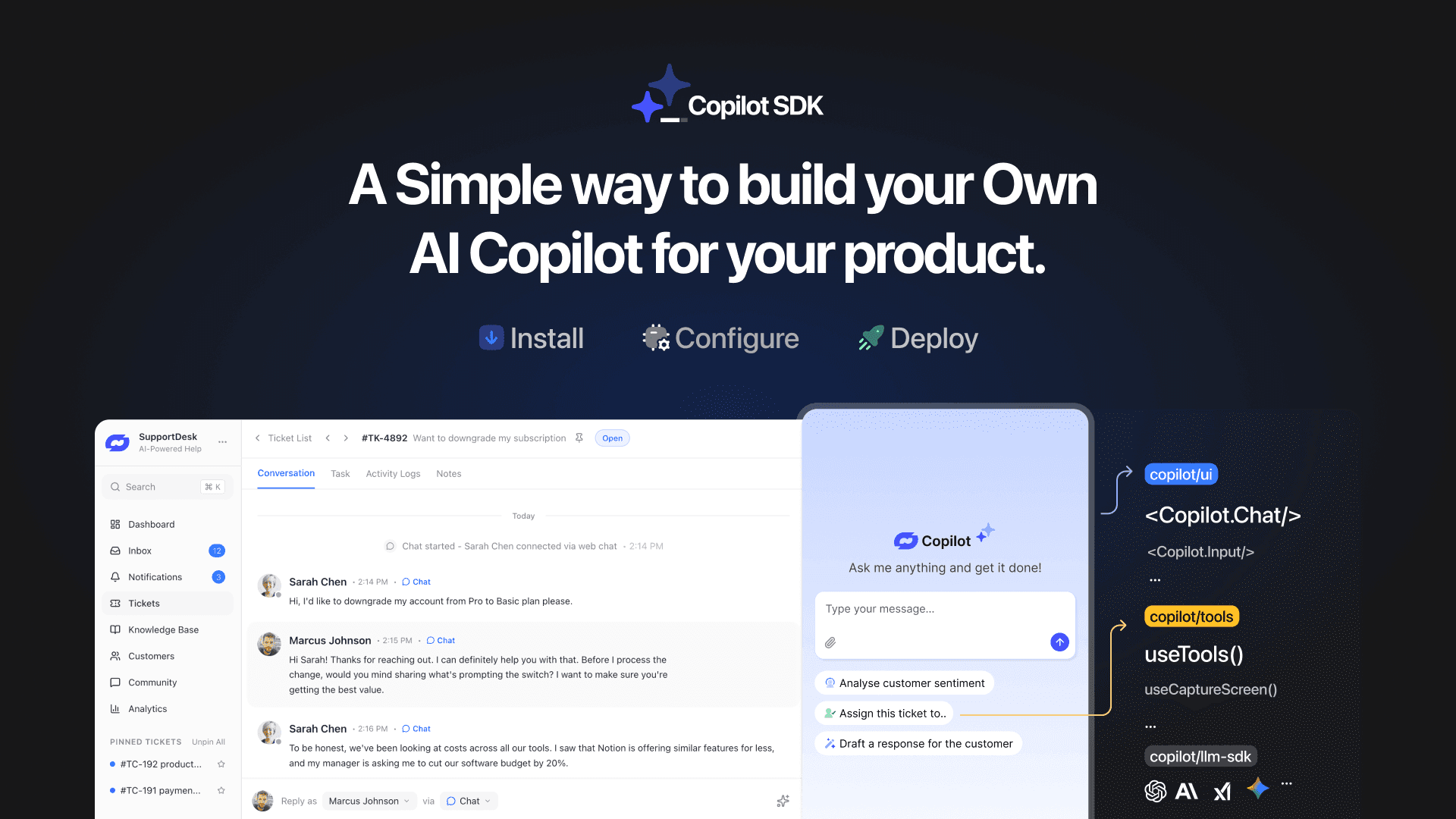
TL;DR YourGPT Copilot SDK is an open-source SDK for building AI agents that understand your application state, user context, and what is happening inside your product. Instead of working like isolated chat widgets, these agents connect directly with your product and can take real actions within existing workflows. This helps teams build contextual AI experiences […]
TL;DR YourGPT 2.0 adds AI Studio for building, testing, and debugging automated workflows. It includes native MCP integration for more than 100 tools, upgraded voice agents, and native SDKs for iOS and Android applications. With shared context across web, WhatsApp, Instagram, Telegram, and mobile, YourGPT turns conversations into real actions across support, sales, and operations. […]

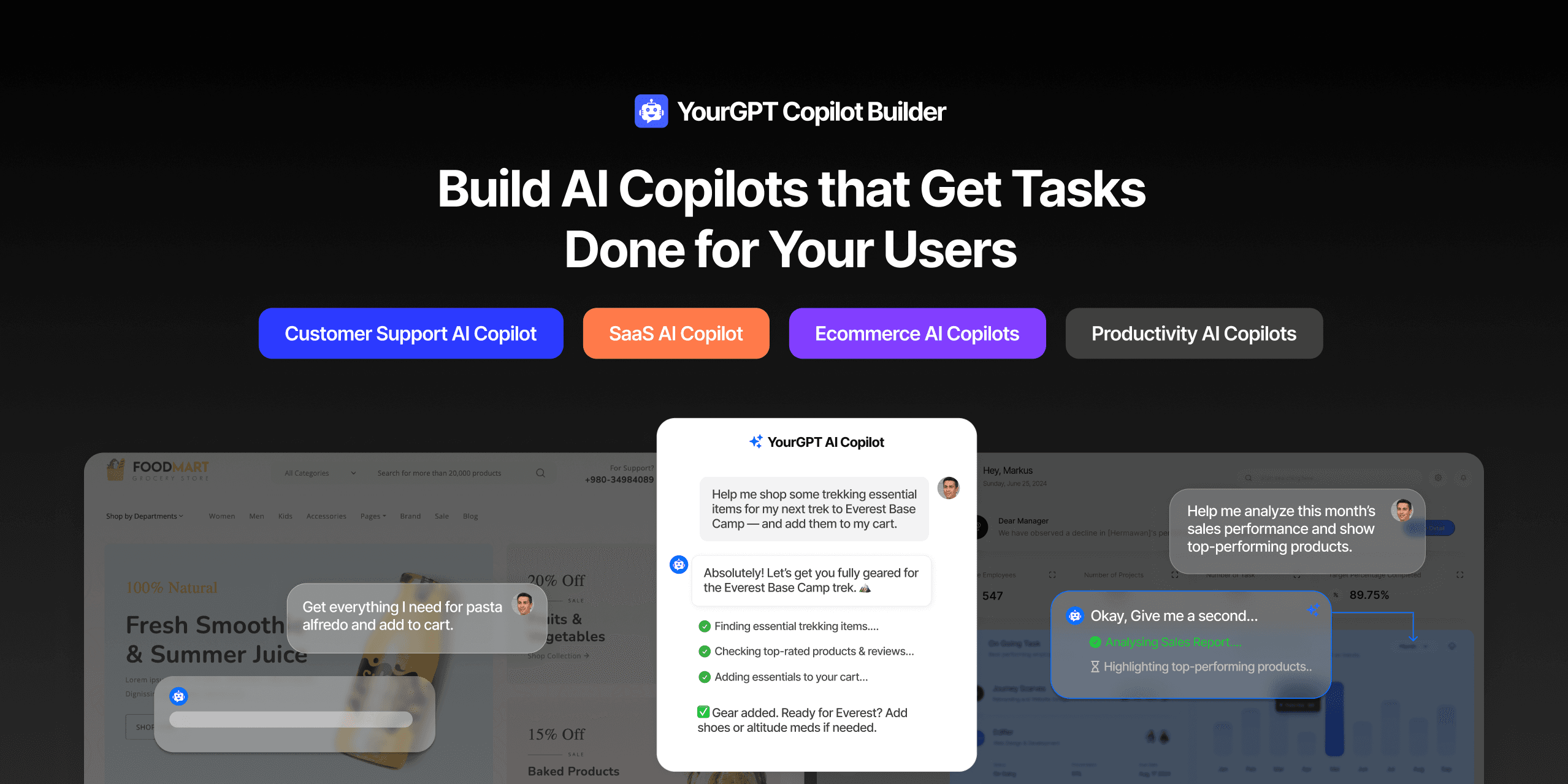
TL;DR Most AI tools provide answers but still leave users to complete the task through search results, settings pages, or checkout flows. AI Copilot Builder closes that gap by executing registered actions directly inside the product instead of only explaining what to do. Search, cart updates, account changes, and multi-step bookings can all happen within […]
TL;DR Building an AI-powered Telegram bot does not require custom development. BotFather provides the Telegram bot token, while a no-code platform like YourGPT handles AI training, free-form conversations, and the Telegram connection. This guide covers the full setup, from creating the bot in BotFather to connecting it with YourGPT and taking it live. Most Telegram […]
