12 Best Vapi Alternatives for AI Voice Agents in 2026

Rajni
Last updated on September 1, 2026
Vapi is flexible for building voice AI systems, but it often needs more setup, custom logic, integrations, and ongoing tuning before it works well in real use cases.
YourGPT is a strong alternative for teams that need AI agents across voice, chat, and messaging, while tools like Retell AI, PolyAI, Synthflow, and Telnyx fit more specific voice automation needs.
Choose based on your workflow: AI-first agents for task execution, voice platforms for phone automation, or speech infrastructure if you want to build a custom voice stack.
Voice AI is becoming part of real business operations. Teams use it to qualify leads, answer support questions, schedule appointments, route calls, and handle repetitive phone work more efficiently.
Vapi is one of the platforms teams evaluate when building AI voice agents. It provides the base layer for real-time calls, speech processing, model routing, and tool actions during conversations. This makes it useful for developers who want to design their own voice AI stack.
But Vapi is not always the easiest path for every team.
A working voice agent needs more than voice infrastructure. Teams still have to shape call logic, connect business systems, test failure cases, tune prompts, manage latency, and improve conversations after launch. For companies without dedicated engineering time, this can make deployment slower than expected.
The gap usually appears between what the platform makes possible and what the team can realistically launch, maintain, and improve.
In this blog, we review the 12 best Vapi alternatives in 2026 based on practical use cases. You will see which tools fit AI phone agents, multi-channel automation, outbound calling, voice generation, speech APIs, and enterprise call handling.
Vapi gives teams the core infrastructure for building AI voice systems, including real-time calling, speech processing, model routing, and live tool execution. That makes it useful for businesses that want deep control over how their voice stack is built.
But many businesses are not looking for infrastructure alone. They need a platform that is easier to launch, easier to manage, and better suited to real workflows after deployment.
| Platform | Best For |
|---|---|
| YourGPT | Voice, chat, and workflow automation |
| Retell AI | AI phone agents |
| ElevenLabs | Voice generation |
| Pete & Gabi | Automated voice outreach and appointment scheduling |
| Bland AI | High-volume calling |
| PolyAI | Enterprise contact centers |
| Synthflow | No-code voice agents |
| XBert AI | Inbound AI call automation |
| Lindy | Business task automation |
| Telnyx Voice AI | Custom voice systems |
| Deepgram | Speech processing |
| Cartesia | Real-time voice apps |
Vapi is useful for technical teams that want flexible voice AI infrastructure, but it can require heavy setup, custom call logic, and ongoing tuning. These 12 Vapi alternatives offer different paths for real-world voice AI needs, from AI-first agents and no-code call automation to enterprise contact centers and developer-grade speech infrastructure.
YourGPT is an AI-first platform for building and deploying autonomous AI agents for customer support, sales, and operations. Unlike tools that only handle conversation flow, YourGPT agents can execute tasks, trigger workflows, fetch data, update systems, and help resolve customer issues directly inside conversations.
Teams can start with a no-code builder to launch knowledge bots trained on documents, websites, FAQs, and internal content. As automation needs grow, AI Studio helps teams build advanced workflows using conditional logic, system integrations, and action-based automation across web chat, WhatsApp, email, voice, and other channels.
Best for: Teams that need voice or chat agents connected to real business actions for customer support, sales automation, and multi-channel workflows where task completion matters more than open-ended conversation.
Retell AI is a voice AI platform used to build, deploy, and manage AI phone agents that handle real-time inbound and outbound calls. It provides the infrastructure required to run conversational voice systems over phone channels, where the agent can process speech and respond during live conversations.
It is used to automate call-based workflows such as customer support, sales outreach, lead qualification, and appointment scheduling.
Best for: Teams building AI phone agents for inbound support, outbound calling, lead qualification, or appointment booking, especially when they have engineering capacity and structured call workflows.
ElevenLabs is an AI voice platform that focuses on generating natural-sounding speech from text using AI-generated voices. It is used to convert written content into spoken audio for applications such as voiceovers, narration, and voice-based interfaces.
It also provides tools for creating and using custom voices, which can be applied in content production and interactive voice systems where consistent and high-quality speech output is required.
Best for: Content teams producing voiceovers for videos, podcasts, ads, and audiobooks, or product teams that need consistent, natural-sounding voice output while handling conversation logic separately.
Olivia AI by Pete & Gabi is a voice agent platform., built to enable companies to perform outbound sales outreach activities, reactivate old potential clients, qualify leads, and schedule appointments. The Olivia AI platform combines automated follow-up call, conversation AI calling, live call transfer, and CRM sync in one complete workflow that has been designed specifically for the high-volume outbound sales process or business.
Best for: Sales teams and recruiting agencies looking for large-scale automated voice outreach, lead qualification, and appointment scheduling using conversational AI.
Bland AI is designed for teams running high volumes of structured phone calls. It automates both inbound and outbound conversations end to end, with a focus on call flows that can be defined, branched, and connected to external systems.
The platform assumes you know what the call should accomplish. You define the path, the conditions, and the actions. In return, you get consistent, scalable execution across large calling operations.
Best for: Developers and operations teams running high-volume outbound calling campaigns that need programmable, scalable phone infrastructure and have the technical resources to manage setup.
PolyAI is an enterprise conversational voice AI platform designed to handle customer service phone calls through natural, human-like interactions. It is used to automate inbound support conversations at scale within large organizations.
It replaces traditional menu-based phone systems with AI agents that can understand free-form speech, maintain context across the call, and manage full customer service interactions over the phone.
Best for: Large enterprises running high-volume contact centers that need natural, free-form phone conversations to replace legacy IVR systems and have the budget, time, and internal resources for deployment.
Synthflow is a no-code platform for building AI voice agents that handle phone calls, designed to let businesses deploy conversational call automation without engineering-heavy setup or infrastructure work.
That accessibility comes with real trade-offs. Synthflow works well for simple use cases like FAQs, appointment reminders, and basic lead follow-ups. When workflows get more complex, the no-code constraints start to show.
Best for: Non-technical users who need no-code voice automation for simple inbound or outbound calls, including FAQs, bookings, reminders, and basic lead follow-ups.
XBert AI is Nextiva’s AI employee for handling customer calls, texts, and live chat. It is designed to answer inbound conversations, qualify leads, book appointments, and hand requests to a human teammate with the full conversation context when needed.
Unlike developer-first voice AI platforms, XBert is built for non-technical teams. Businesses can configure it using their services, policies, FAQs, or website content and launch it with a dedicated phone number without building separate telephony infrastructure or complex call workflows.
Best for: Small and mid-sized businesses that want a ready-to-configure AI voice/chat agent for answering calls, booking appointments, and routing to humans without building call logic or a workflow stack from scratch.
Lindy is a no-code AI agent platform that lets users build autonomous assistants to automate tasks across tools like email, calendars, CRM systems, and messaging apps.
It is designed for creating agents that can trigger actions and move information between connected apps, allowing routine business workflows to run with minimal manual handling.
Best for: Sales, operations, and support teams that want quick no-code automation for email handling, scheduling, lead follow-ups, CRM updates, and repetitive workflows across multiple tools.
Telnyx Voice AI Agents is a developer-focused platform for building and deploying AI-powered phone agents directly on Telnyx’s global telecom network. It combines programmable voice infrastructure with conversational AI, allowing teams to handle real-time phone interactions within a single system.
The platform is designed for users who want more control over call handling, routing, and latency while keeping the entire voice stack integrated under one provider.
Best for: Engineering teams building custom voice systems that need full-stack control, specific compliance support, advanced routing logic, or a single telecom provider for voice infrastructure.
Deepgram is a developer-focused voice AI platform for adding speech and audio intelligence to applications through APIs. It helps teams process live or recorded audio, convert speech into text, generate voice output, and build real-time voice features inside larger systems.
The platform is designed for developers building custom voice pipelines, contact center tools, transcription systems, or AI-driven voice workflows where speech processing is one layer of a broader product or automation stack.
Best for: Developers building real-time speech processing systems such as call transcription, contact center workflows, and custom voice pipelines using speech-to-text, text-to-speech, and streaming audio APIs.
Cartesia is a developer-focused voice AI platform for adding real-time speech capabilities to applications. It provides models and infrastructure for converting text into speech, processing voice interactions, and enabling spoken input and output inside digital products.
The platform is designed for teams building voice-driven apps, AI assistants, real-time conversation tools, or speech-enabled products where the voice layer needs to work alongside existing logic, workflows, or AI systems.
Best for: Teams building voice-driven products that already have logic, workflows, or AI models in place and need a reliable real-time voice layer for speech input and output.
| Platform | Core Strength | Channels | AI Capability | Best For | Limitation |
|---|---|---|---|---|---|
| YourGPT | AI agents with workflow automation | Voice, Chat, WhatsApp, Messaging | Advanced AI agents | Support, sales, and multi-channel automation | AI Studio may need time to learn for complex flows |
| Retell AI | Real-time AI phone agents | Phone, Voice Calls | Advanced voice AI | Inbound calls, outbound calls, lead qualification | Requires prompt, telephony, and workflow setup |
| ElevenLabs | Natural AI voice generation | Voice, Audio, API | Advanced speech synthesis | Voiceovers, narration, and voice output | Not a full voice agent platform |
| Pete & Gabi | Automated voice outreach | Phone, Voice Calls | Conversational voice AI | Sales outreach, recruiting, and appointment scheduling | Best suited for outreach-focused workflows |
| Bland AI | Structured phone call automation | Phone, Voice Calls | Workflow-based voice AI | High-volume outbound calling campaigns | Works better with structured scripts than open-ended calls |
| PolyAI | Enterprise conversational voice AI | Phone, Contact Center | Enterprise-grade voice AI | Large contact centers and IVR replacement | Long implementation cycle and limited self-serve control |
| Synthflow | No-code voice agent builder | Phone, Voice Calls | Moderate voice automation | FAQs, bookings, reminders, and basic lead follow-ups | Limited for complex workflows and edge cases |
| XBert AI | Ready-to-configure AI customer agent | Phone, Text, Live Chat | Conversational AI with booking and handoff | SMBs needing call answering, booking, and routing | Usage-based pricing; deeper customization may require NEXT |
| Lindy | No-code business task automation | Email, Calendar, CRM, Messaging | No-code AI agents | Email handling, scheduling, CRM updates, and follow-ups | Can struggle with advanced multi-step workflows |
| Telnyx Voice AI | Telecom + AI infrastructure | Phone, Voice, APIs | Developer-grade voice AI | Custom voice systems with full telephony control | High technical complexity and heavy setup effort |
| Deepgram | Speech-to-text and audio processing | Audio, Voice, APIs | Speech AI infrastructure | Transcription, speech pipelines, and custom voice apps | Needs external tools for full agent logic |
| Cartesia | Low-latency voice layer | Voice, Audio, APIs | Real-time voice AI | Live voice apps and speech-enabled products | Requires separate reasoning and workflow systems |
The best Vapi alternative depends on what you want to build. Some platforms give you full control over the voice stack. Others give you a managed setup that helps you launch faster. The right choice comes down to how your calls work in real conditions.
Do not judge a platform only by a demo call. Test it with real conversations from your business. Try examples where a customer interrupts mid-sentence, gives unclear information, asks multiple questions, or needs an account lookup during the call.
A good voice AI platform should keep the conversation stable when the caller goes off script. If it only works in a clean demo, it may not hold up in production.
Some tools are closer to infrastructure. They give you telephony, speech-to-text, text-to-speech, LLM routing, and APIs, but your team must connect everything.
That works well if you have engineering resources. If your team wants faster launch, look for platforms with visual workflow builders, built-in voice and chat agent support, ready integrations, call monitoring, human handoff, and simple testing tools.
More control usually means more setup. Less setup usually means fewer customization options. Choose based on your team’s technical capacity.
A voice agent should do more than talk. For many teams, the real value comes when the agent can complete tasks during the conversation.
Check whether the platform can book appointments, update CRM records, check order status, trigger workflows, transfer calls with context, send follow-up messages, or pull customer data during the call.
If the agent only answers questions, it may reduce call volume slightly. If it executes actions, it can reduce manual work across support, sales, and operations.
A single test call does not show production performance. The real test starts when several calls happen at the same time.
Ask how the platform handles concurrent calls, response delay during peak volume, call transfers, tool execution speed, long conversations, noisy audio, and failed integrations.
What matters is not only low latency. Consistency matters more. A platform that responds fast once but slows down under load can create awkward pauses and broken conversations.
Voice AI systems depend on several moving parts. Speech recognition, model responses, API calls, telephony, and text-to-speech all need to work together.
Failure will happen. The question is how the platform responds when the caller says something unclear, the API takes too long, the agent misunderstands intent, the caller changes topic, the call needs human handoff, or the system loses context.
Strong platforms recover gracefully. Weak setups repeat the wrong answer, drop context, or end the call poorly.
Voice AI is not a one-time setup. Real call data will show where the agent performs well and where it needs adjustment.
Look for tools that make it easy to review call transcripts, spot failed conversations, update prompts or workflows, improve escalation rules, track call outcomes, and test changes before publishing.
If every small update needs developer time, iteration slows down. The best platform is one your team can improve as call patterns change.
Not every Vapi alternative solves the same problem. YourGPT fits teams that need AI-first support, sales, and workflow automation across voice, chat, and messaging. Retell AI works well for AI phone agents. Bland AI fits high-volume outbound calls. PolyAI is built for enterprise contact centers. Synthflow suits simple no-code voice agents. Lindy works better for business task automation. Telnyx Voice AI, Deepgram, ElevenLabs, and Cartesia are stronger for teams building custom voice, speech, or audio systems.
The right platform is the one that fits your call flow, team capacity, and automation goal. Do not choose based on feature count. Choose based on how well the platform handles real conversations, real actions, and real failure cases.
Vapi is infrastructure. It gives you the building blocks for real-time calls, speech processing, and model routing, but you still have to design the call logic, connect your systems, and tune it yourself. A managed platform like Retell AI sits a layer up, handling more of that setup for you, so you’re configuring a working agent instead of assembling one from parts.
It depends on which alternative you pick. Telnyx, Deepgram, and Cartesia still expect engineering resources since they’re infrastructure-first, similar to Vapi itself. No-code platforms like Synthflow, XBert AI, and Lindy are built so a non-technical team can configure and launch without writing integration code.
Most platforms let you port an existing number rather than forcing a new one, but call history and transcripts usually don’t transfer automatically between vendors. Export your call logs and recordings before you migrate, and confirm number porting with the new platform’s support team ahead of your cutover date rather than after.
Most bill per minute of connected call time, with rates roughly between $0.05 and $0.15 depending on the platform. Some, like Bland AI and Retell AI, add a monthly platform fee on top of usage. A few, like Pete & Gabi, price around a flat monthly minimum instead. Check whether telephony, speech-to-text, and the LLM are billed separately or bundled, since that’s where the real cost difference shows up at volume.
It depends on the platform. Pure speech tools like ElevenLabs and Deepgram handle voice generation or transcription only, with no task execution built in. Agent-first platforms like Retell AI and Bland AI can trigger real actions during the call itself, such as pulling a customer record, updating a CRM, or booking an appointment, not just responding in conversation.
Handling depends heavily on tuning, not just which platform you pick. Enterprise-grade options like PolyAI are built for free-form speech and topic shifts out of the box. No-code tools like Synthflow tend to work fine for simple, predictable calls but can feel rigid once a caller deviates from the expected path. Test with a caller who interrupts mid-sentence before you judge any platform off a clean demo call.
YourGPT is built for exactly that. It runs agents across voice, web chat, WhatsApp, email, and messaging from one platform, with shared context and the ability to trigger workflows or update systems mid-conversation. Most of the other alternatives here, like Retell AI or Bland AI, are voice-only, so you’d need a separate tool to cover chat and messaging channels.
Voice AI has moved from basic call handling into real workflows that support customers, qualify leads, book appointments, and reduce repetitive phone work.
Vapi works for technical teams that want control over voice infrastructure, but tools like YourGPT, Retell AI, PolyAI, ElevenLabs, and Cartesia offer different paths based on setup needs, workflow depth, and call volume.
YourGPT stands out because it connects voice, chat, WhatsApp, email, and messaging with real business actions. Agents can answer questions, fetch customer data, update systems, trigger workflows, and help resolve customer issues inside the same conversation.
Pick what matches your reality: your call flow, technical resources, channels, and automation goals. The right platform helps your team reduce manual work, keep conversations consistent, and turn voice AI from a test project into a reliable part of support, sales, and operations.
YourGPT helps teams automate support, sales, and operations with AI agents that answer questions, trigger workflows, update systems, and resolve customer issues across voice, web chat, WhatsApp, email, and more.

A practical breakdown of Gorgias Helpdesk and AI Agent pricing, including what counts toward each allowance, how to compare plans and how to budget with your own volumes.
Choose Halloween ecommerce campaigns that fit your products, with AI agent workflows, offer worksheets, launch tests and order measurement.
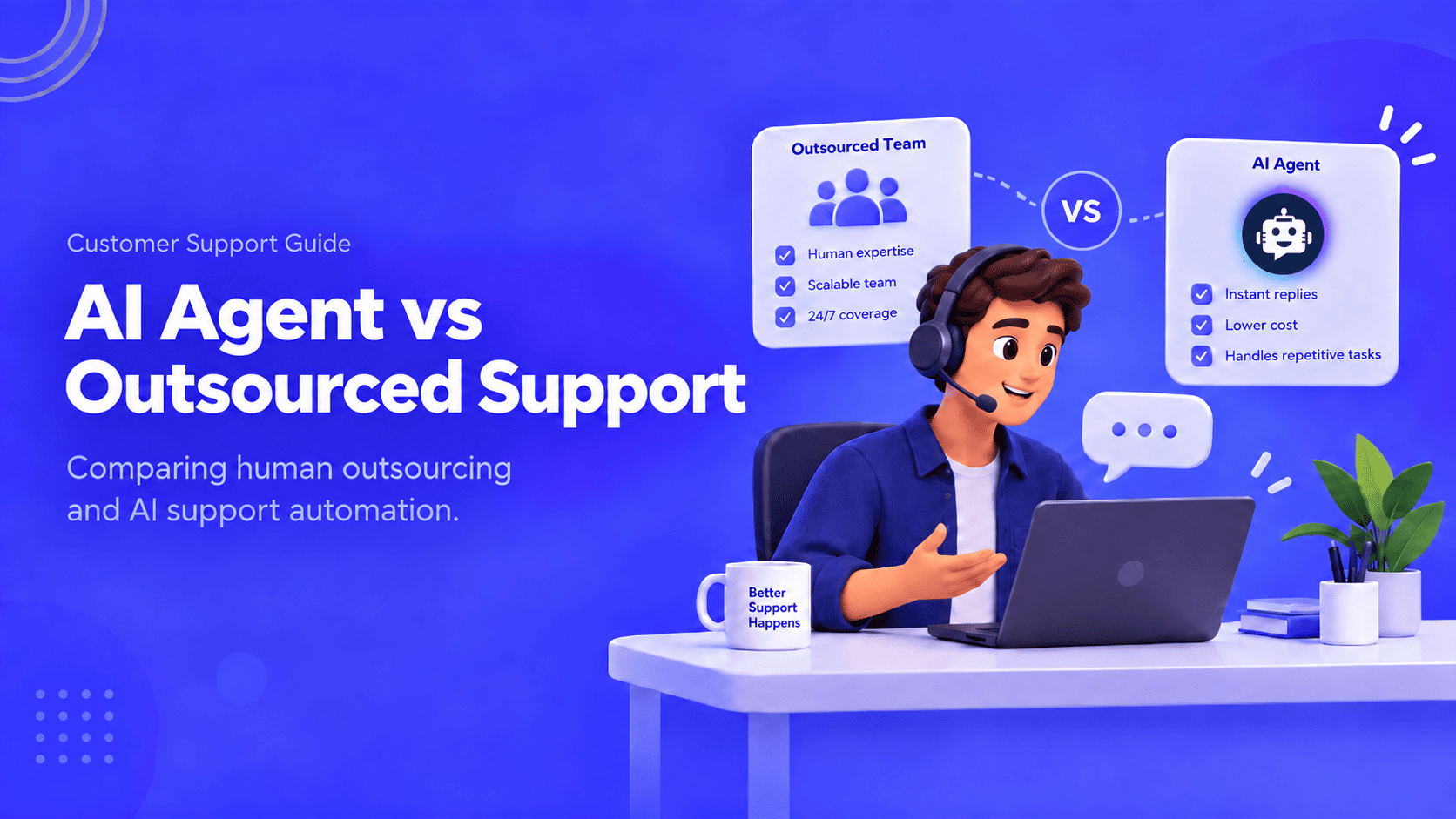
Compare outsourcing customer service with an AI agent using your own ticket mix, a cost model you fill in, and a clear rule for a hybrid split.
Export the Zendesk ticket archive, train an AI Agent on the help center, and test one real ticket before you stop the old queue.


Compare six Yuma alternatives by ecommerce capabilities, helpdesk compatibility, pricing and human handoffs to choose a replacement for your support team.


Move from Gorgias with a verified ticket archive, tested AI workflows, human handoff and a channel cutover plan before ending your subscription.