CustomGPT Review 2026: Pricing, Pros & Cons

Rajni
Last updated on August 27, 2026
CustomGPT.ai is a no-code RAG platform for building AI agents on business content. Pricing starts at $99/month for Standard and $499/month for Premium, with lower rates on annual billing. Enterprise typically ranges from $2,000 to $6,000/month.
The Standard plan includes 500 query credits, 2 AI agents, and 1 team member. These limits differ from older pricing pages and some 2025 reviews.
In 2026, CustomGPT added Plan & Act mode, Smart Tasks for code execution, and OAuth-connected MCP actions.
Review volume remains low, with only a small number of ratings across G2, Capterra, and Trustpilot.
CustomGPT markets itself as the “#1 anti-hallucination” platform based on a Tonic.ai benchmark from March 2024, a real study but one that predates the current OpenAI product line and hasn’t been repeated since.
CustomGPT.ai built its reputation on a simple pitch. Point it at a website, a SharePoint drive, or a pile of PDFs, and get back a chatbot that answers only from that content, with a citation attached to every response. That pitch still holds in 2026. What’s changed is less obvious from the marketing pages.
The Standard plan costs the same $99 a month it did a year ago, but what a new signup gets for that price has shrunk. The platform that many still-indexed reviews describe as a pure Q&A tool now ships Plan & Act mode, code execution, and native MCP actions. And the review platforms that most buyers check before signing up (G2, Capterra, Trustpilot) each carry fewer than ten published reviews for CustomGPT, thin enough that the star rating alone tells a buyer very little.
This review breaks down what CustomGPT.ai actually includes at each price point in 2026, what changed under the hood this year, and where the gap between its marketing claims and its current review record matters most.
CustomGPT.ai is a no-code, retrieval-augmented generation (RAG) platform for building AI agents trained on a company’s own content. A builder connects a website, a SharePoint or Google Drive folder, a Notion workspace, or uploads documents directly, and CustomGPT indexes that content into an agent that answers only from what it was given, with a citation linking back to the source on every response. The company is led by founder and CEO Alden Do Rosario and is based in Boston.
The product serves two overlapping use cases, an externally facing support or sales widget, and an internal knowledge-search tool for employees. Named customers span government (Bernalillo County), higher education (MIT’s Entrepreneurship Center, Lehigh University, Tufts), and professional services (Dlubal Software, BQE Software, TaxWorld). CustomGPT’s own anti-hallucination page states the platform is trusted by nearly 6,000 entities, a more specific and more recently updated figure than the rounder “10,000+” claim that circulates on some third-party listings.
What changed. The live pricing page, fetched in July 2026 and last updated by the vendor on June 4, 2026, lists Standard at 500 query credits per month, 2 AI agents, and 1 team member. CustomGPT’s own older pricing explainer, indexed from around September 2025, describes the same Standard plan as including 10 chatbots, 1,000 GPT-4 queries per month, and 3 team members at the identical $99 monthly or $89 annual-billing price. Several third-party reviews published as recently as early 2026 also repeat those older, larger limits.
What stayed the same. The headline price. Standard still costs $99 per month on monthly billing or $89 per month when billed annually, exactly where it was a year ago.
What’s actually unknown. CustomGPT hasn’t published a dated changelog entry explaining the move from a queries-and-chatbots model to the stricter credits-and-agents structure. That makes it difficult to identify one exact announcement date, leaving only before-and-after snapshots of the pricing page to show when the limits changed.
What to do about it. Re-check CustomGPT’s live pricing page immediately before signing up. Reviews, comparison articles, and even CustomGPT’s own older marketing pages may describe plan limits that no longer match what the same plan name and price include today.
CustomGPT sells three tiers. Prices below are verified directly against customgpt.ai/pricing as of July 2026.
| Plan | Price (Monthly) | Price (Annual) | Query Credits/mo | AI Agents | Team Members | Docs/Agent |
|---|---|---|---|---|---|---|
| Standard | $99/mo | $89/mo ($1,068/yr) | 500 | 2 | 1 | 5,000 |
| Premium | $499/mo | $449/mo ($5,388/yr) | 2,500 | 5 | 3 | 20,000 |
| Enterprise | Custom | Custom | Custom | Custom | Custom | Custom |
Annual billing saves $120/yr on Standard and $600/yr on Premium. Enterprise has no published number, CustomGPT’s own pricing page states it typically runs $2,000 to $6,000/mo, and includes a dedicated account team, forward-deployed engineering, custom security controls, and all-time analytics retention.
A single message costs 1 credit. Each agentic action inside a message (a Smart Task run, an MCP call, a Document Analyst pass) consumes additional credits on top of that, so a support bot that leans heavily on Plan & Act mode burns through its monthly allowance faster than a simple Q&A deployment would. Both paid plans include a 7-day free trial, but a credit card is required to start one, unlike platforms that offer a no-card sandbox.
Every add-on below is priced on annual billing and stacks on top of a Standard or Premium base:
Here’s a realistic scenario. A small team on Standard wants a second team member and expects to burn through the 500-credit allowance within the first couple of weeks given how many agentic actions its support bot runs. Adding one extra-credits block brings the monthly total to $389 ($89 base plus $300), already closer to Premium’s $449 while still capped at 2 agents and missing white-label branding removal, which is available only on Premium. CustomGPT’s own pricing page flags this directly. Once add-ons push a Standard bill past Premium’s price, upgrading is usually the better math.
CustomGPT ingests company documents and, through Smart Tasks and MCP actions, can now execute code and connect to outside systems, so the platform’s security posture and its newer action-level controls both matter here.
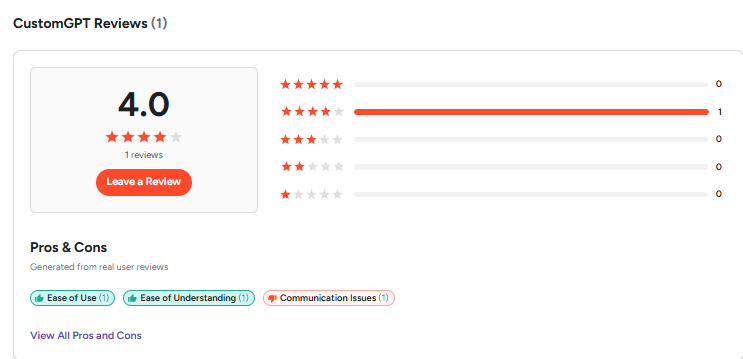
CustomGPT’s story across review platforms isn’t a wide gap between sources, it’s a shortage of data everywhere. G2 lists a single review at 4/5. Capterra shows 3.3/5 from 3 reviews, breaking down to 3.0 for ease of use, 3.0 for customer service, 3.7 for features, and 3.0 for value for money. Trustpilot rates the company “Average” at 3.3/5 from 6 reviews.
The reviews that do exist point in genuinely different directions. One Capterra reviewer called it the “most accurate chatbot answers I have ever seen, worth every penny,” while another described a “frustrating” experience getting account access restored after a former employee departed. A Trustpilot review calls support “a maze of red tape,” while a separate reviewer praised the design and ease of setup. With sample sizes this small, a single strongly negative or positive review shifts the aggregate score more than it would on a platform with hundreds of ratings, so the specific complaint pattern (account and billing friction, recurring across two separate platforms) is more informative here than any single star average.
This review draws on published sources instead of a hands-on trial account, so here’s exactly what informed each judgment:
No single weighted score is assigned. That would need a live test account run against real support traffic, not a desk-research pass across published sources.
CustomGPT fits best for teams with a genuine document-heavy knowledge base, legal, government, education, or research-adjacent use cases where citation-backed answers matter more than speed of setup, and that can tolerate a credit-metered budget. Outside that profile, a few alternatives come up often:
| If Your Priority Is | Choose | Why |
|---|---|---|
| Agentic workflows across support, sales, and operations, plus native voice | YourGPT | Visual Studio builder, PhoneAI voice agents, and more chatbots included per plan than CustomGPT’s current Standard tier |
| The fastest setup at the lowest entry price | Chatbase | Docs-to-bot in minutes, though still credit-metered with a single agent per plan |
| A website-only chatbot without CustomGPT’s broader connector library | SiteGPT | Lower starting price for a narrower, website-focused use case |
| Deterministic, developer-built conversation flows | Botpress | Full visual flow control instead of relying entirely on LLM judgment |
| The deepest document ingestion and citation-backed accuracy for a knowledge-heavy use case | CustomGPT.ai | 1,400+ file formats, real citations, and the strongest fit for legal, government, and research-heavy knowledge bases |
A broader roundup of CustomGPT alternatives and this buyer’s checklist for support AI agents are worth reading before committing budget, and a head-to-head comparison with Chatbase covers the closest adjacent option in more depth.
No. CustomGPT.ai offers a 7-day free trial on both Standard and Premium plans with full feature access, but a credit card is required to start, and the card is charged automatically once the trial ends unless canceled first.
Standard costs $99/mo ($89/mo billed annually), and Premium costs $499/mo ($449/mo billed annually). Enterprise pricing is custom, typically running $2,000 to $6,000/mo according to CustomGPT’s own pricing page. Add-ons for extra credits, storage, uploads, or agents can push the real monthly cost well past the headline price.
The Standard plan’s included allowance dropped from what CustomGPT’s own older pricing page described (10 chatbots, 1,000 GPT-4 queries/month, 3 team members) to the current live figures (2 AI agents, 500 query credits, 1 team member) at the same $99/$89 price. No dated changelog entry explains the change directly, so buyers should check the live pricing page directly before signing up, not an older review or blog post.
Yes, as of 2026. Plan & Act mode, Smart Tasks code execution, and MCP-connected custom actions rolled out across every plan between March and May 2026, letting an agent plan and execute multi-step tasks on top of retrieving and answering. Earlier reviews describing CustomGPT as a pure Q&A tool predate this rollout.
CustomGPT.ai holds SOC 2 Type II certification, is GDPR compliant, and states customer data is never used to train its models. PII anonymization is available from Premium up, and a formal Data Processing Agreement is reserved for Enterprise. The platform is cloud-only, with no private-cloud or on-premises deployment option at any tier.
CustomGPT.ai is built primarily around document-grounded question answering with citations, and has added agentic actions on top of that foundation through 2026. YourGPT starts from agentic workflows across support, sales, and operations, with a visual Studio builder, native voice through PhoneAI, and broader channel coverage including WhatsApp, Instagram, Telegram, and native mobile SDKs, at a lower entry price with more chatbots included per plan.
CustomGPT.ai is a weaker fit for teams that need a no-card free tier to test before committing, want deterministic conversation flows over LLM-driven judgment, or require private-cloud or on-premises hosting, since none of those are available at any published tier. Teams expecting the larger agent and query allowances described in older reviews should re-verify current limits directly before budgeting.
For a team with a genuinely large, messy knowledge base and a real need for citation-backed answers, CustomGPT.ai remains one of the more capable no-code options, and the 2026 addition of Plan & Act mode and MCP actions closes a real gap with more workflow-first competitors. The risk-analytics layer (fidelity, jailbreak, and prompt-leakage tracking) is a genuine differentiator most competitors in this price range don’t offer.
The harder part is budgeting accurately. The Standard plan’s real allowance is thinner than it was a year ago at the same price, the jump to Premium is steep, and the review record across G2, Capterra, and Trustpilot is too small to lean on without reading the individual complaints. Before committing to an annual plan, run the 7-day trial against real content, track credit burn under an agentic workload and not just simple Q&A, and re-verify the current Standard-plan limits directly on the pricing page. Don’t trust a number from an older review, including this one, since CustomGPT has shown it will change what a plan includes without necessarily changing what it costs. For a wider comparison, a head-to-head with YourGPT is worth reading before signing.
TL;DR The Gorgias AI Agent is the automation layer inside the Gorgias helpdesk, split between a Shopping Assistant for pre-purchase conversations and a Support Agent for post-purchase support. A connected Shopify store is required, and Gorgias documentation rules out platforms such as BigCommerce, Magento, and WooCommerce for the AI Agent. Billing runs on two separate […]

TL;DR Gorgias is the closest Richpanel alternative for Shopify stores that need native order actions directly inside support tickets. YourGPT fits stores that want one AI agent handling requests across web, WhatsApp, Instagram, and email, while Tidio and Re:amaze suit smaller teams looking for lighter, lower-cost options. Richpanel’s AI pricing starts around $500/month for two […]

TL;DR Shopify Inbox is a good free option for stores that only need basic storefront chat and simple customer conversations. Stores usually look for alternatives when they need multichannel support, stronger team workflows, or automated order actions. YourGPT is strongest for cross-channel AI automation, Gorgias for Shopify-native order workflows, and Tidio for smaller stores that […]
TL;DR Tidio recently restructured its top paid plan, and many 2026 reviews still describe the old pricing model. Confirm current pricing directly on Tidio’s site before budgeting. Lyro, Tidio’s AI agent, runs on Anthropic’s Claude rather than ChatGPT. Only the Premium tier carries a guaranteed resolution rate, well below the average Tidio advertises elsewhere. Billing […]
TL;DR Drift’s situation goes well past “post-acquisition.” Clari and Salesloft announced a formal sunset after a major OAuth breach pushed Drift offline for weeks. Two of the other usual “alternatives” are getting bought too. Salesforce closed its acquisition of Qualified and signed a deal to acquire Intercom, now Fin. The real split is budget and […]
TL;DR Ada CX is a no-code enterprise AI platform for automating support across chat, voice, email, and messaging. Pricing is quote-only, with no public plans or self-serve signup. Admin reviews are generally positive, while end-customer feedback is more mixed. Ada supports SOC 2 Type II, GDPR, HIPAA, PCI DSS, and AIUC-1 certification. Ada CX shows […]