AI in ecommerce: use cases and how to get started

Rajni
Last updated on April 14, 2026
Online shopping grows more competitive every year. Customers want fast answers, relevant suggestions, and experiences that feel made just for them. When used thoughtfully, AI helps stores deliver exactly that while making operations smoother and more efficient behind the scenes.
The global AI-enabled ecommerce market now stands at roughly 8.65 to 10.5 billion dollars in 2026. Adding a simple chatbot no longer gives you an edge. The real question today is how to build a store that AI agents can easily discover, understand, and buy from, and how to turn high-intent traffic from large language models into actual revenue.
This blog explains what AI in ecommerce really means right now, the benefits that matter most, the use cases delivering the strongest returns, and a clear step-by-step way to get started without wasting time or budget.
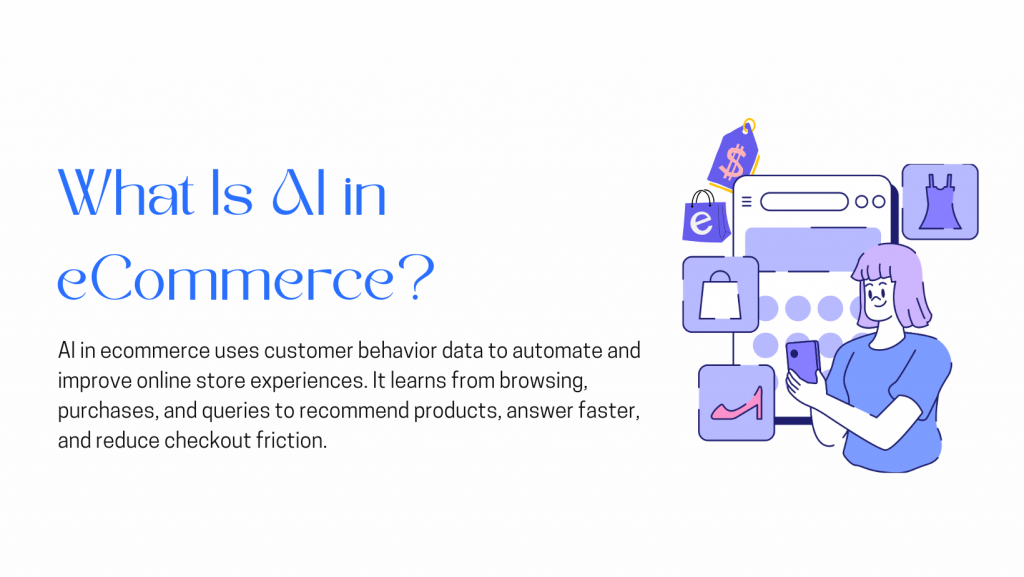
AI in ecommerce means your store stops relying on fixed rules and starts learning from real customer behaviour. Instead of following rigid if-then logic, it studies what visitors browse, what they buy, when they abandon carts, and what questions they ask. Then it uses that data to show better products, answer questions faster, predict stock needs, and reduce friction at checkout.
In simple terms, AI powers:
The biggest shift happening in 2026 is agentic commerce. AI assistants can now interpret complex requests, compare products across different stores, check live availability, and in some cases complete the purchase on the shopper’s behalf. Shopify has rolled out Agentic Storefronts and the Universal Commerce Protocol with Google. OpenAI and Stripe are making it possible to buy directly inside chat interfaces.
Stores that win in this new environment are the ones with clean, detailed, and well-structured product data. Those with thin descriptions, inconsistent attributes, or outdated inventory simply don’t appear in AI-generated recommendations.
Right now, AI-referred traffic makes up under 2% of sessions for most stores. But it often converts better than many paid channels because shoppers arrive with strong intent and clearer needs.
Modern ecommerce generates far more data than most teams can realistically act on. Every click, search, purchase, and support interaction adds to a growing stream of signals. At the same time, customer expectations keep rising. Shoppers want fast, relevant, and consistent experiences across every touchpoint.
AI gives retailers a practical way to turn this complexity into better decisions at scale. It improves how you price, market, support, and operate without needing to add headcount proportionally or slow down execution.
Here are the four core capabilities where AI creates the biggest difference:
AI systems process behavioural data, transactions, inventory signals, and external trends instantly. This lets retailers continuously adjust pricing, optimise promotions, trigger restocking, and update recommendations based on live inputs rather than outdated rules.
For example, a recommendation engine can refresh product suggestions after every click or cart action, steadily improving click-through and conversion rates without constant manual tuning.
Traditional demographic segmentation often misses the real drivers of behaviour. AI groups customers based on actual purchase patterns, browsing signals, intent, and churn risk.
This makes campaigns and offers far more relevant. Instead of broad assumptions, you can target users who are likely to buy now, at risk of leaving, or showing strong affinity for certain products. The result is higher engagement and better conversion because the messaging matches real customer behaviour.
A large part of daily ecommerce work is repetitive. AI handles tasks such as order classification, FAQ responses, product tagging, and return routing with minimal human input.
Support systems can understand incoming queries, identify intent, and route or resolve them automatically. This shortens response times and frees your team to focus on complex or high-value customer situations.
As order volume grows, maintaining consistency becomes difficult. AI makes it possible to deliver reliable, context-aware service across thousands of interactions daily.
Conversational tools, intelligent routing, and adaptive interfaces ensure every customer gets relevant support without long waits or having to repeat themselves. An AI assistant trained on your product catalog and policies can maintain brand tone even during peak traffic.
AI is starting to change how customers find products, not just how stores operate.
A growing share of ecommerce traffic now comes from AI platforms. These visitors usually arrive with clear intent. They have already compared options, refined their preferences, and are closer to making a decision. Because of that, this traffic often converts better than typical browsing sessions.
For most stores, the volume is still small today. It may account for only a small percentage of total sessions. But the growth trend is hard to ignore. Retail datasets show steady increases through 2025, with noticeable spikes during high-demand periods like major sales events.
This shift introduces a different kind of competition. It is no longer only about ranking on search engines or running better ads. Stores now need to make sure their products can be understood and evaluated by AI systems. If the data is unclear or incomplete, those products are less likely to be surfaced at all.
Teams that recognise this early are already seeing results. Better-structured product data leads to more accurate recommendations, stronger visibility in AI-driven discovery, and higher conversion from these interactions.
The takeaway is straightforward. AI is becoming part of the buying process itself. Stores that adapt to this layer early will have an advantage that compounds over time.
AI creates value where it directly impacts revenue, cost, and efficiency. These are not abstract improvements. Each one shows up in your day-to-day metrics and compounds over time.
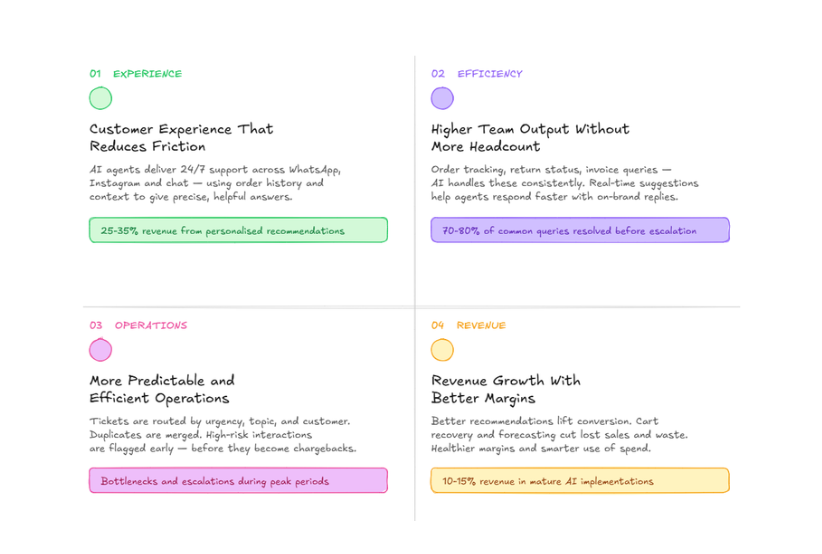
AI agents provide 24/7 support across chat and messaging platforms such as WhatsApp and Instagram. They use order history, product data, and context to give precise answers instead of generic replies.
This reduces decision friction and sets clearer expectations around product fit, delivery timelines, and policies. When customers get the right information upfront, they are more likely to complete purchases and less likely to return them. Fewer returns improve margins and reduce operational overhead.
In well-optimised stores, personalised recommendation systems can contribute 25 to 35 percent of total revenue, showing how much impact relevance has on buying decisions.
A large share of support workload comes from repetitive queries such as order tracking, return status, and invoice requests. AI handles these consistently, freeing your team to focus on complex cases that require judgment.
AI-assisted systems can manage a significant portion of initial conversations, often handling up to 70 to 80 percent of common queries before escalation. At the same time, real-time suggestions help agents respond faster while keeping communication consistent and aligned with your brand.
The result is a support operation that scales with demand without requiring proportional hiring.
AI improves how work moves across your systems. Support tickets are routed based on urgency, topic, and customer value. Duplicate inquiries are merged automatically, and conversations are tagged by intent and language.
High-risk interactions are identified early, before they escalate into chargebacks or public complaints. On the backend, demand and inventory models reduce uncertainty by improving stock availability while limiting excess inventory.
This leads to fewer bottlenecks, smoother workflows, and more stable performance during peak periods.
AI directly impacts revenue through better recommendations, timely assistance, and improved conversion across the customer journey.
Personalisation and targeted interactions often lead to 10 to 15 percent improvements in revenue performance, with stronger results in more mature implementations. At the same time, AI-driven cart recovery and forecasting reduce lost sales and unnecessary costs.
The combined effect is not just higher revenue, but healthier margins and more efficient use of inventory and marketing spend.
These gains do not happen in isolation. Better recommendations increase conversion. Faster support improves customer satisfaction. Efficient operations reduce costs. Together, they create a system where each improvement reinforces the next.
AI is transforming how online retailers operate from product discovery to fulfillment. These ten use cases represent high-impact applications where AI creates measurable improvements in both customer experience and backend operations.
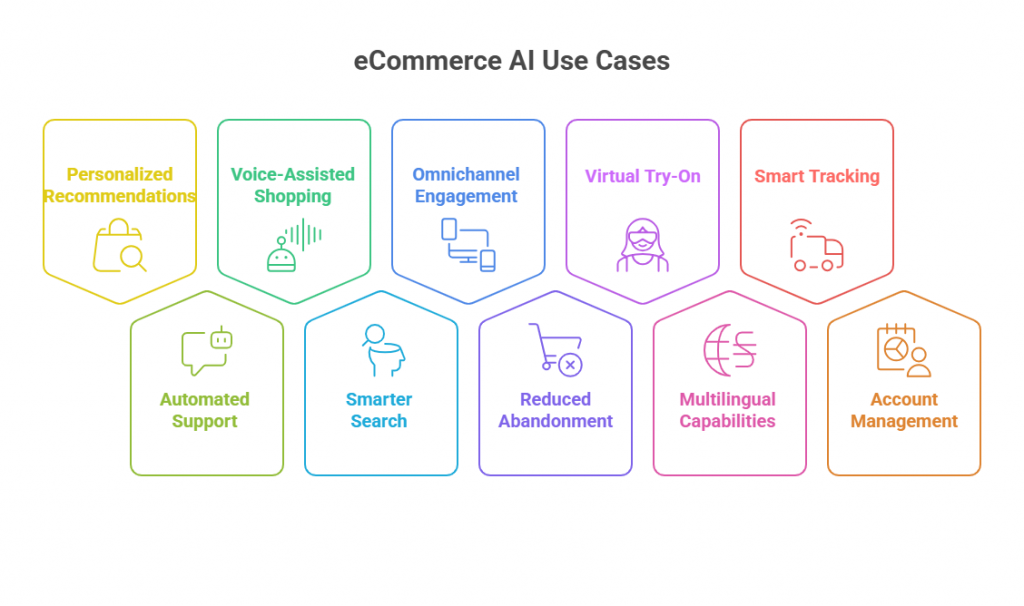
AI analyzes real-time user behavior clicks, cart actions, purchases, and browsing history to rank and display the most relevant products for each individual shopper. Algorithms like collaborative filtering and session-based modeling help optimize product visibility without manual rules.
Business impact:
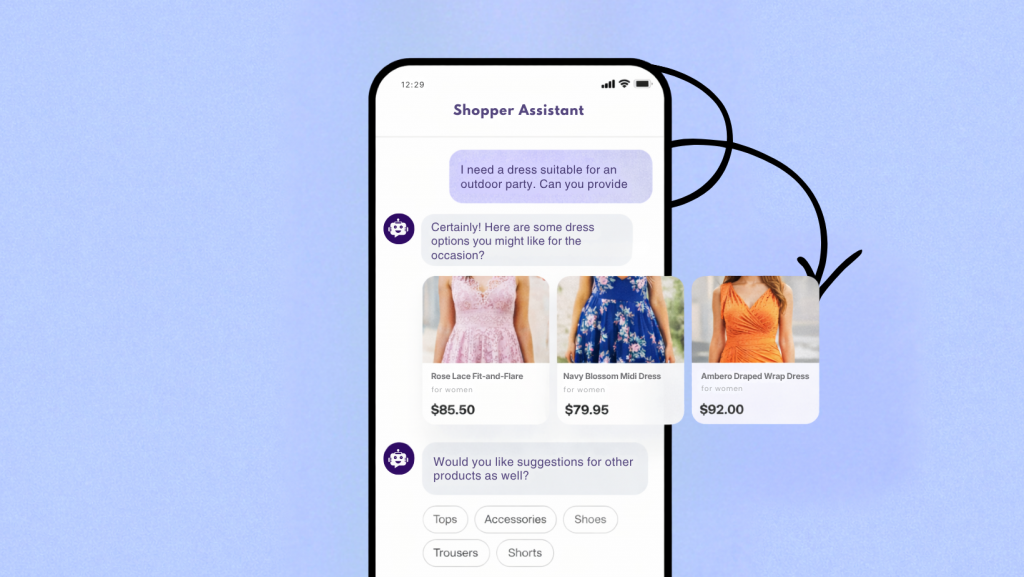
AI chatbots trained on product data, policies, and past interactions can handle repetitive queries such as order tracking, return eligibility, and product availability. Natural Language Processing (NLP) enables bots to understand user intent and provide accurate responses across channels.
Business impact:
Voice commerce integrates voice recognition and intent analysis, allowing users to shop by speaking. Shoppers can reorder items, search for products, or track orders through smart devices like Alexa or mobile voice-enabled apps.
Business impact:
AI search engines go beyond keywords to understand context and intent. Using semantic search, typo tolerance, and vector-based ranking, these systems return more relevant results. Visual search lets users upload images to find similar products using computer vision.
Business impact:
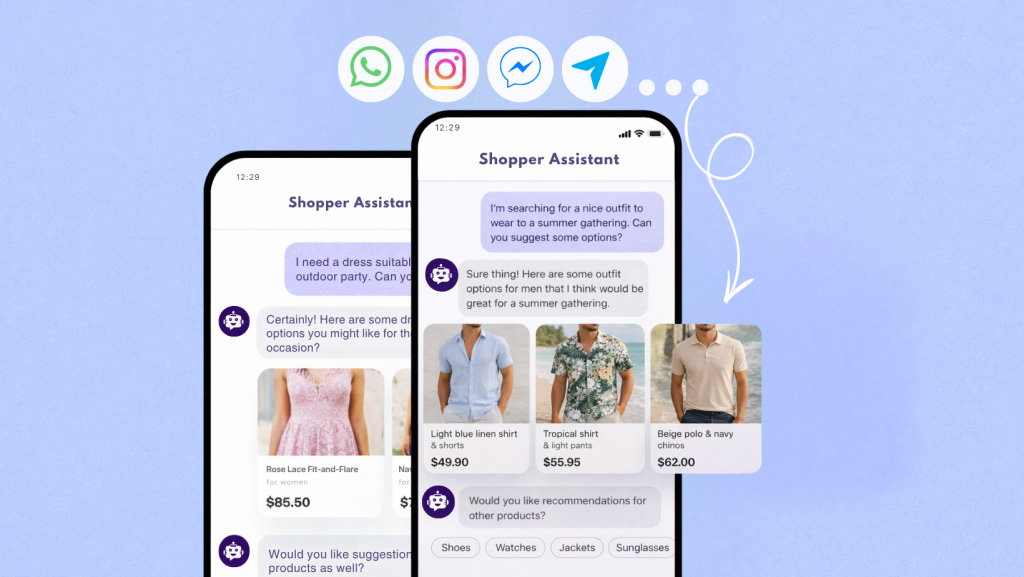
AI connects behavioral data across web, mobile, email, and social channels into a unified customer profile. It personalizes messages and offers based on real-time actions, purchase intent, and channel preferences.
Business impact:
AI tracks cart behavior, detects intent to leave, and triggers automated interventions such as timely email reminders, personalized discounts, or chatbot messages to bring users back to complete their purchase.
Business impact:
Augmented Reality (AR) and computer vision allow users to preview how products like clothing, glasses, makeup, or furniture will look on them or in their space. These tools use live camera input and 3D modeling for realistic simulation.
Business impact:
AI-powered translation and multilingual NLP models localize search, chat, and content for international users. These systems auto-detect language preferences and adapt the interface dynamically.
Business impact:
AI integrates data from logistics partners, GPS, and IoT devices to provide real-time delivery updates. Predictive models flag delays and trigger alerts to customers and fulfillment teams before issues escalate.
Business impact:
AI monitors account activity purchase cycles, frequency, value, and engagement to automate upsell opportunities, flag churn risk, and recommend relevant offers or loyalty actions. It powers lifecycle automation for repeat and high-value customers.
Business impact:
Most ecommerce teams don’t lack access to AI anymore. They lack a clear starting point.
You don’t need a large team or complex setup to begin. With the right focus, you can apply AI to improve support, conversion, and operations in a matter of weeks. This roadmap shows how to move from a specific problem to a working implementation without overcomplicating the process.
Start by pinpointing the specific areas where AI can make the most impact.
Knowing the exact problem helps you choose the right solution and avoid wasting time on tools you don’t need.
Once you know your goal, pick tools that align with your stack and team’s capabilities.
Don’t try to do everything at once. Start with a use case that’s simple to launch and easy to measure.
Recommended starting points:
The goal here is to validate impact quickly and gain confidence in the setup before expanding further.
Even the best AI needs the right context to perform well. Feed it relevant, store-specific information:
Training the AI on your actual data ensures it can respond accurately and deliver value from day one.
Roll out your AI feature to a limited audience or segment. Then use data not guesswork to refine it.
Small iterations during this phase can make a noticeable difference in performance.
Once your AI is working well in one part of your store, expand its reach.
Scaling in stages keeps everything manageable and helps you spot what’s working.
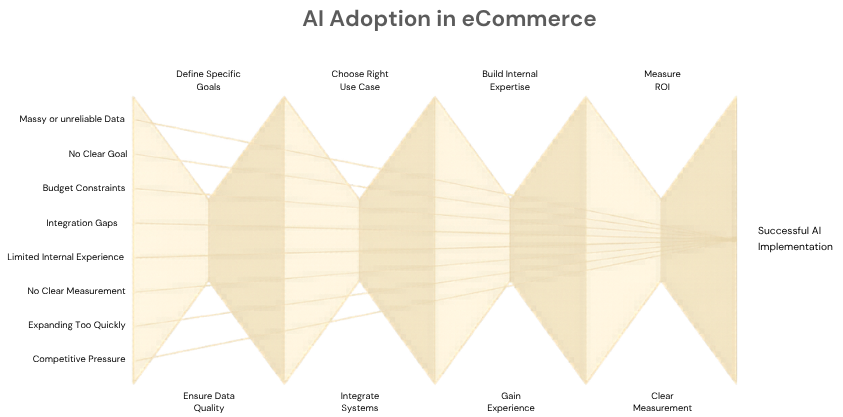
AI can deliver strong results in ecommerce, but outcomes depend on how it is implemented. Most issues come from unclear direction, weak data, or execution gaps. These problems are common, but they are also fixable with the right approach.
Many ecommerce teams have large volumes of data but limited trust in it. Orders come from multiple channels, tracking changes over time, and customer profiles are often incomplete. When this data is used as input, results become inconsistent.
Start by auditing where your core data lives across your backend, analytics tools, CRM, and support systems. Identify a single source of truth for orders, revenue, and customer records. Then standardize key elements such as product IDs, customer IDs, timestamps, and order statuses. Clean, structured data is the foundation for reliable outputs.
AI projects often begin without a defined objective, which makes progress difficult to measure. Without a clear outcome, it becomes hard to evaluate success or make decisions.
Focus on one measurable goal tied to business impact. This could be improving conversion rates, reducing support response time, or lowering out-of-stock instances. A clear target simplifies tool selection and keeps execution focused.
AI requires investment, whether through tools, integration, or data preparation. For many teams, this competes with other priorities such as marketing or expansion.
Treat AI as a sequence of controlled steps. Start with one use case that directly affects revenue or cost. Validate results, then expand gradually. This approach reduces risk and makes further investment easier to justify.
AI systems that cannot connect to your existing tools provide limited value. Without access to order data, inventory, or customer records, responses remain incomplete.
Choose solutions that integrate with your ecommerce platform and core systems. Where needed, use APIs or middleware to bridge gaps. Involving developers early helps avoid delays and ensures the system works as expected.
Many teams lack hands-on experience with AI, which can slow down adoption or lead to underused features.
Use platforms that simplify implementation and provide clear guidance. No-code or low-code tools allow faster setup without deep technical knowledge. Over time, teams build enough understanding to manage and improve these systems effectively.
Without proper tracking, it is difficult to understand whether AI is delivering value. Many teams skip baseline measurement, which makes comparison unreliable.
Define key metrics before launch, such as conversion rate, ticket volume, response time, or revenue impact. Track performance consistently and compare it with historical data. Clear measurement turns AI into a system that can be improved over time.
Trying to implement multiple use cases at once creates complexity and makes it harder to identify what is working.
Start with a focused rollout, validate results, and refine the setup. Once performance is stable, expand step by step. This keeps execution manageable and builds confidence with each iteration.
As more retailers adopt AI, expectations continue to rise. Features that once felt advanced are now standard. Stores that do not adapt risk falling behind.
Instead of chasing every trend, focus on areas where improvement will be noticeable. Review competitor experiences and choose one or two areas to strengthen. Consistent progress is more effective than scattered efforts.
These challenges are predictable and manageable. The teams that succeed with AI focus on clean data, clear goals, and steady execution. They measure results carefully and expand only after seeing real impact.
This approach turns AI from a one-time initiative into a system that continues to deliver value as the business grows.
AI should improve specific business outcomes revenue, efficiency, or customer satisfaction. To measure its return, you need a clear baseline, defined metrics, and a straightforward tracking approach.
Before deploying AI, record current performance metrics for the area you’re targeting.
Key baseline examples:
Without this step, it’s impossible to measure improvement accurately.
Every AI feature should serve a purpose. Tie each one to a specific outcome.
| AI Use Case | Metric to Track |
|---|---|
| Product recommendations | AOV, product views, conversion rate |
| Chatbots | Ticket deflection rate, resolution time |
| Demand forecasting | Inventory turnover, stockouts prevented |
| Cart recovery automation | Recovered orders, abandonment reduction |
This keeps performance aligned with business goals.
If your platform allows, test AI against a control group. This helps isolate the true impact.
Example:
Show AI-powered recommendations to one segment, and static alternatives to another. Compare purchase behavior between both.
AI adds value by increasing revenue and reducing manual work. Track both sides of the equation.
Revenue-related gains:
Cost-related savings:
Use this to evaluate the financial return:
ROI (%) = ((Total Benefit − AI Cost) ÷ AI Cost) × 100
Total Benefit = Revenue Gain + Cost Savings
Include all upfront and ongoing costs (software, training, data preparation).
Some improvements are instant (like faster support response), while others like higher customer lifetime value take months. Review results at regular intervals (monthly or quarterly) depending on the use case.
AI in eCommerce refers to the use of machine learning, natural language processing, and predictive algorithms to automate, personalize, and optimize customer interactions and backend operations. Common applications include product recommendations, chatbots, dynamic pricing, inventory forecasting, customer support, and fraud detection.
Start with a high-impact, easy-to-implement use case like AI chatbots (to reduce support load) or personalized product recommendations (to increase conversions and average order value). Choose based on your current pain points and available data.
Your store is ready for AI if you have clean, structured data (like product catalogs and transaction history), a clear business goal (e.g., reduce cart abandonment), and a willingness to use no-code or integrated AI tools.
Not necessarily. Many AI tools today offer no-code setup, pre-trained models, and drag-and-drop configuration designed for non-technical users. A developer may be useful for more advanced or customized implementations.
Some AI results—like chatbot resolution rates or product click-throughs—can be seen in days. More strategic metrics like customer lifetime value or return rate improvements may take 1–3 months, depending on the use case and configuration.
Yes, modern AI tools can detect user language automatically and deliver translated content across chat, search, and product pages—without requiring manual localization.
AI in ecommerce in 2026 is a practical way to create more helpful shopping experiences while running operations more efficiently. The shift toward agentic commerce and new discovery channels rewards stores that keep product data clean and well-structured.
Start with one clear problem, measure honestly, and expand only after you see real results. Stores that follow this approach build lasting advantages in customer satisfaction, revenue, and efficiency.
For teams looking to apply this without adding complexity, platforms like YourGPT can help bring these use cases into production using your existing data. This allows you to automate support, improve product discovery, and connect conversations to real outcomes without rebuilding your entire stack.
The window to prepare your store for better AI interactions is still open. Focus on what matters most to your business today, use your own data well, and grow steadily from proven outcomes. This turns AI from a buzzword into a reliable competitive edge.
YourGPT helps you automate support, guide buyers with smart recommendations, and turn conversations into conversions across your store and messaging channels.
Calculate cost per ticket with one formula and a free calculator, then compare it with the cost of a conversation an AI agent resolves.
Omnichannel support means every channel answers from the same knowledge. Train one AI agent, pick your first channel, and test that answers match.

Self-learning AI agents log the questions they miss. Learn how human review turns those gaps into trained answers and how to run the weekly loop.
Train an AI agent on your return policy, connect the Shopify template in AI Studio to check real orders, and route exceptions to your team.
WISMO means Where Is My Order. Measure your WISMO share from last month’s tickets, fix the tracking gaps, and let an agent answer order status.
Run WordPress customer service alone. Train a YourGPT agent on your help pages, test it on real tickets, install the plugin, and get only the exceptions.