ChatGPT for Customer Service in 2026: The Complete Guide

Rajni
Last updated on June 30, 2026
ChatGPT gives generic customer support answers because it has no knowledge of your business, but connecting it to your data with RAG lets it answer using your FAQs, documentation, policies, and live business information instead of guessing.
Platforms like YourGPT go beyond answering questions by enabling AI agents to take real actions such as checking orders, processing returns, and handing conversations to humans, helping teams resolve tickets faster with minimal setup.
Many businesses in 2026 want to use ChatGPT for customer service because conversational AI seems promising. But when you actually try to use ChatGPT directly for customer support, things don’t work as expected.
The reason is simple. ChatGPT does not know your business. It has no access to your FAQs, past customer conversations, product details, or order history. Without this context, it often produces vague or generic answers that frustrate customers.
To effectively use ChatGPT for customer service, you need to customise it for your business. YourGPT helps you build this customised solution.
YourGPT uses the powerful conversational AI of ChatGPT and adds your business’s own information to it. It learns about your products, knows your customers, and always gives you accurate, useful answers.
This blog covers how to fix that: what ChatGPT for customer service actually means once it is connected to your data, how Retrieval Augmented Generation makes the answers trustworthy, seven ways teams use it today, and how to set it up without writing code. We will also be honest about where it breaks and how to keep it accurate as your business grows.
Out of the box, ChatGPT is a brilliant generalist with no memory of you. It was trained on the public internet, not your help center, your policy docs, or your CRM. So when a customer asks “Can I return shoes I wore once?”, it produces a reasonable sounding answer based on how returns usually work. Usually is not your policy.
That gap creates three failure modes. The bot invents details that sound right but are wrong. It hedges so hard the customer learns nothing. Or it sends the person to “contact support,” which defeats the entire purpose of having a bot.
The result for your team: more tickets, not fewer. You added an AI layer and your agents are now cleaning up after it.
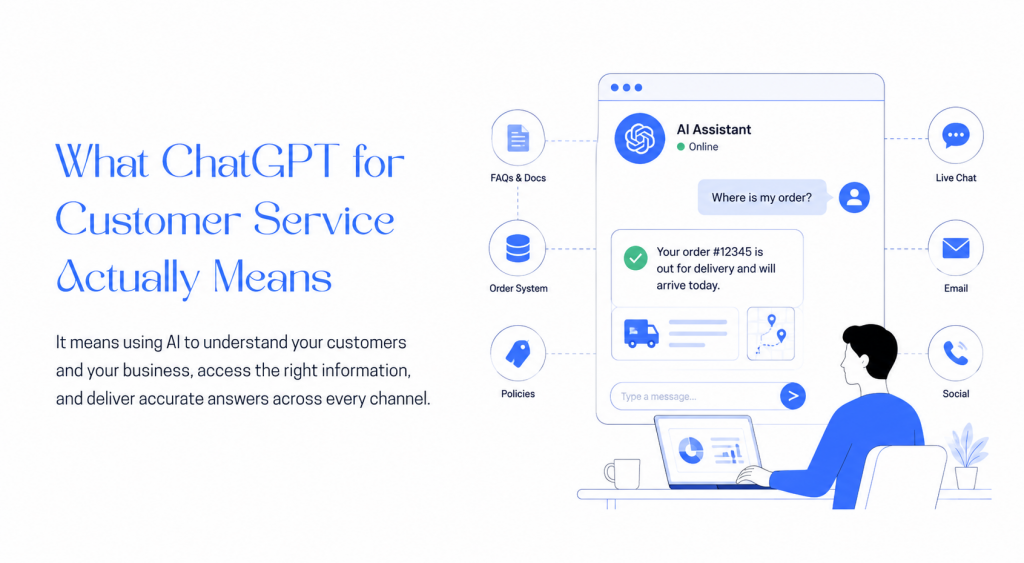
ChatGPT for customer service means connecting a large language model to your verified business knowledge so it answers from your sources instead of guessing. Rather than a standalone chatbot, it works as a support agent that pulls from your FAQs, product docs, policies, and order systems, then replies in plain language. The technology behind this is RAG, which retrieves the right passage from your data before the model writes a single word.
That distinction changes everything downstream. A standalone bot performs. A connected agent answers. One sounds helpful; the other is actually correct.
In practice, “connected” means four things working together:
Retrieval Augmented Generation is the difference between a bot that sounds confident and one that is right. Here is the loop. A customer asks a question. The system searches your indexed knowledge base, finds the passage that answers it, and feeds that passage to the model. Only then does the model write a reply, grounded in your source material.
Three quick examples of the same mechanism across industries:
Update the source document and the answer updates with it. No retraining cycle, no stale replies. When you change a policy on Monday, the agent is quoting the new one on Monday. With YourGPT you can also schedule a ReIndex so the knowledge base refreshes on its own, or hit it manually after a big change.answers sourced directly from your business knowledge.
Customer service is becoming one of the strongest drivers of customer loyalty. AI brings an advantage here by making support faster, more reliable, and easier to scale. It does not replace the human touch but strengthens it by removing repetitive work and ensuring accuracy across every interaction.
AI turns customer service into a proactive business asset by combining speed and accuracy. It assists teams in providing reliable support today while building foundations for future expansion.
When connected to company data and systems, ChatGPT works as a support assistant that provides answers based on your documents, policies, and workflows. This improves the experience for both customers and internal teams.
By grounding every answer in verified business information, ChatGPT improves accuracy, shortens response times, and frees teams to focus on complex issues that require human judgment.
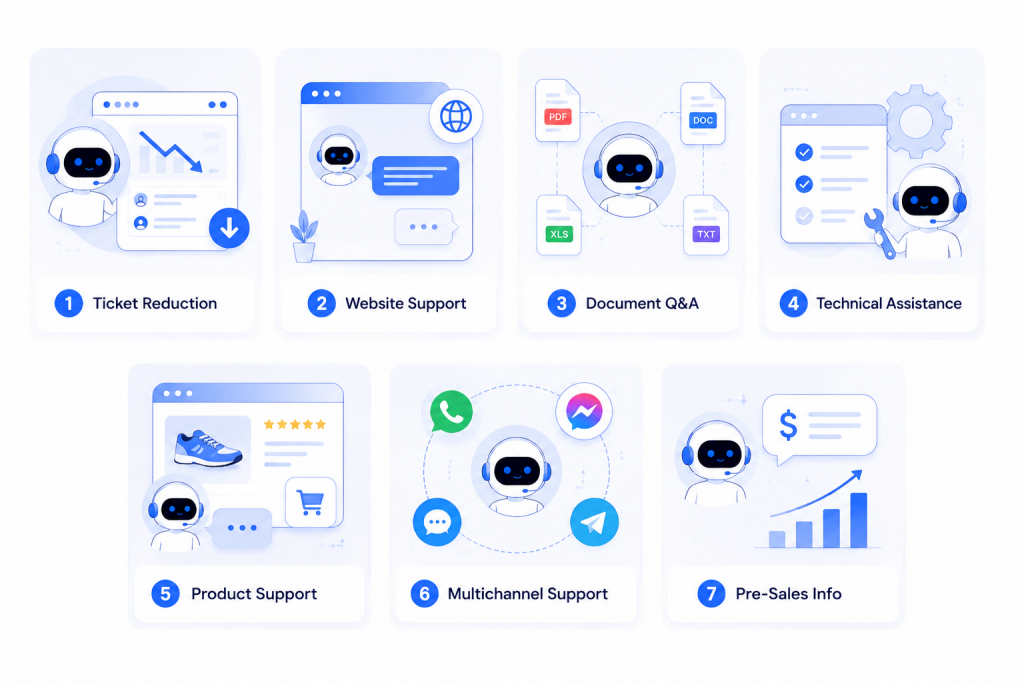
YourGPT helps businesses build custom AI assistants trained on their unique information. Here are specific ways a ChatGPT-powered YourGPT solution can assist customer service:
Building a ChatGPT-based customer support system is not just about adding a chatbot to your website. It’s about creating a reliable assistant that customers can trust every time they reach out. The process is straightforward if you follow it step by step.

Create your account. Sign up and land in the dashboard. The 7-day free trial needs no credit card, so you can build the whole thing before deciding to pay.

Train it on your business data. Upload your FAQs, policy docs, manuals, and guides. YourGPT accepts website links, sitemaps, Notion, Google Drive, Confluence, YouTube, and file types including PDF, DOCX, CSV, and TXT. This is the step that turns a generic model into your agent.
You can fully customise your AI agent. Choose colours and styling that fit your brand. Set a clear conversational tone, whether you want it professional or approachable. Adding a well-defined AI persona ensures that customers receive consistent answers that reflect your company’s identity.

Once the design is ready, place your chatbot where customers need it most. A small code snippet lets you embed it into your website, whether built on WordPress, Wix, Shopify, or another platform. You can also extend support to messaging apps such as WhatsApp or Messenger, so customers can connect on the channels they already use daily.
With setup complete, you can now launch the chatbot. From the moment it goes live, it starts handling queries, reducing waiting times, and offering round-the-clock support. Customers get immediate help, and your team gains more time to focus on complex issues.

After launch, keep improving the chatbot’s performance through analytics. Track metrics such as response accuracy, resolution rates, and customer satisfaction scores. Regularly refine its training material and persona based on these insights. This ongoing optimisation ensures the chatbot continues to deliver dependable support as your business grows.
By following these steps, you’ll create a smart and responsive assistant that’s tailored to your business. It will grow alongside your operations and ensure your clients always receive fast and reliable support.
Here is the honest part most vendors skip. Answer quality can slip when your knowledge base is large, messy, or contradictory. Reviewers say it plainly: responses get generic when the agent is not configured well. That critique is fair, and pretending otherwise costs you credibility.
The fix is control, not hope. A good platform gives you levers to keep the agent on track:
The takeaway: setup quality decides answer quality. The platform’s job is to hand you the controls to get it right, and YourGPT does. Flawless out of the box is a marketing claim. Controllable and improving is the real one.
A ChatGPT assistant trained on your business documents can improve service speed, consistency, and team efficiency. Here are six key benefits:
1. Accurate Answers at Scale : ChatGPT pulls information directly from your verified documents. It delivers consistent and correct responses, even when handling a high volume of questions.
2. Faster Resolution Times : Customers receive help in seconds. This keeps queues short and ensures support remains fast, even during busy periods.
3. Lower Support Costs : The AI handles common, repetitive queries without human involvement. This reduces the workload on agents and lowers your overall support spend.
4. Up-to-Date Information : When you update your documents, ChatGPT immediately uses the latest version. There is no delay or need for manual retraining.
5. Improved Customer Satisfaction : Clear and accurate responses reduce confusion. Customers get the answers they need without waiting, which builds trust and loyalty.
6. Stronger Team Productivity : By removing repetitive tasks from their day, ChatGPT allows agents to focus on complex issues that require human judgement and care.
To get the most out of AI in your customer support, follow these key practices:
A well-built agent recognizes its own uncertainty. It can ask a clarifying question or hand off to a human with the full conversation attached, so the customer never starts over. Confidence scoring and fallback rules keep people from hitting a dead end.
No. It absorbs the repetitive, high-volume questions and frees your agents for the complex, emotional, and high-stakes cases where human judgment wins. For most teams it cuts workload and speeds up replies rather than cutting headcount.
Strong on FAQs, order tracking, troubleshooting, and policy questions once it is trained on your data and grounded with RAG. Accuracy drops when the knowledge base goes stale, which is why scheduled retraining and monitoring matter.
Yes, when implemented properly. You control what data flows in, mask sensitive fields, and set retention rules. YourGPT configures model providers with privacy-first settings, including zero-day retention.
Yes. YourGPT handles 100-plus languages with automatic detection, so a customer in São Paulo and one in Seoul both get answered in their own language without separate teams.
Most setups connect to ticketing systems, CRMs, order databases, and live chat through built-in integrations or APIs. YourGPT integrates with Zendesk, Freshdesk, Salesforce, HubSpot, Shopify, and more, plus 100-plus tools through MCP.
Customer service plays a bigger role in business today than it did in the past. In 2026, it is not just about solving problems. It is about your response time, answer consistency, and how easily customers get help.
A personalised ChatGPT, trained on your company’s documents and powered by Retrieval Augmented Generation, helps you meet those expectations. It handles routine questions with speed and accuracy, giving your team more time to focus on issues that need a human response.
This setup improves how your support team works and how customers experience your brand. It shortens wait times, reduces daily workload, and keeps answers aligned with your policies.
YourGPT gives you the tools to build and manage this kind of support assistant. It keeps your data in your control and ensures responses match your business. When you prepare early and set it up well, AI becomes a reliable part of your customer service system. It helps you grow, scale, and support more people without losing quality.
Train ChatGPT on your content and improve customer service without adding headcount.
No credit card required • 7 days access
Tier 1 support handles first contact. See how Tiers 0 to 3 differ and what changes when an AI agent becomes your first line.
The 12 customer service metrics to track when an AI agent resolves tickets, with a formula for each and a baseline built from your own last month.

Calculate cost per ticket with one formula and a free calculator, then compare it with the cost of a conversation an AI agent resolves.
Omnichannel support means every channel answers from the same knowledge. Train one AI agent, pick your first channel, and test that answers match.
Self-learning AI agents log the questions they miss. Learn how human review turns those gaps into trained answers and how to run the weekly loop.
Train an AI agent on your return policy, connect the Shopify template in AI Studio to check real orders, and route exceptions to your team.