10 AI Customer Service Trends Businesses Must Know In 2026

Rajni
September 17, 2025
Customer service has shifted from a support role to a central driver of business growth. Zendesk reports that more than 70 percent of CX leaders plan to integrate generative AI into customer touchpoints within the next two years.
AI-powered agents are already managing real conversations, while copilots help human agents resolve queries faster. Omnichannel platforms reduce repeated explanations, and self-service is becoming a standard expectation. Based on our recent blog on AI Customer Service Statistics 2026 report, self-service resolves 54 percent of issues end-to-end, showing why companies now treat it as a foundation of modern support.
This blog covers ten essential AI customer service trends for 2026. Each section explains what is changing, how leading companies are responding, and the steps you can take to deliver experiences that build loyalty and support growth.
Customer service in 2026 is smarter, faster, and more personal. Here’s a quick summary of the top trends shaping the future of support:
Look for platforms that balance automation with empathy. YourGPT brings AI agents, copilots, omnichannel support, and seamless human handoff together in one system.
Customer service trends show an emerging pattern, how customer expectations and support technology are changing. Trends help businesses make decisions about training support teams using the right technology like customer service AI agents, Support Chatbots automating common tasks and choosing the right communication channels like WhatsApp Slack or email. By following trends closely companies can see what customers want next and improve their service proactively.
Customer service expert Shep Hyken explains trends clearly:
“Customer service is not a department it is a philosophy.”
Trends show businesses how to use technology to put that philosophy into action. For example with YourGPT users 87 percent of customer queries get solved automatically using AI agents.
In everyday business terms following customer service trends means giving customers what they actually want. It means answering questions faster solving problems without delay and using tools like AI chatbots that make support easier for customers and staff.
Companies that do this reduce support costs, improve customer experience satisfaction and keep people coming back. Instead of just using new technology because it is available successful businesses pick tools that clearly improve the customer experience.
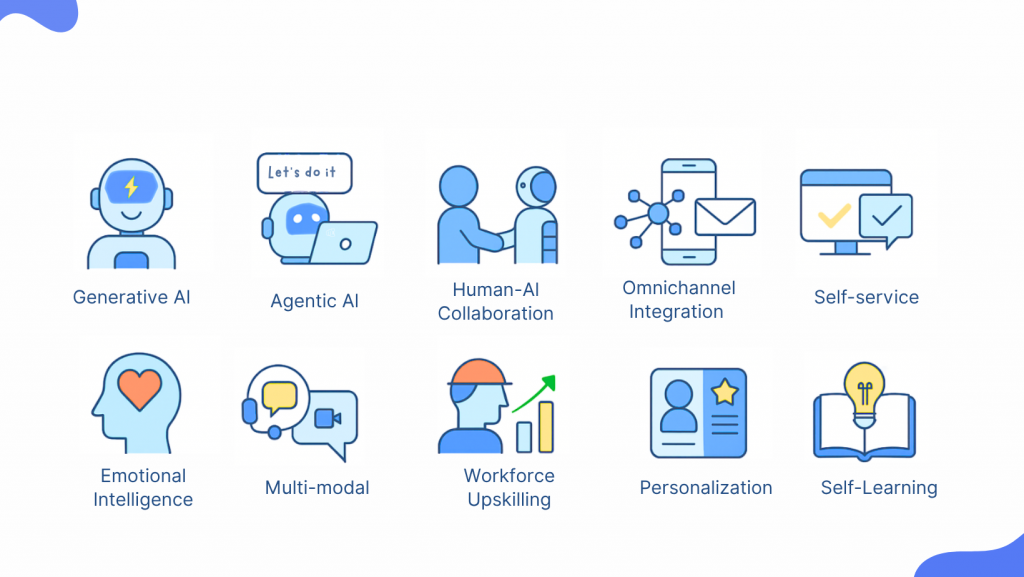
Customer service in 2026 is faster, smarter, and more personal than ever before. With AI advancing rapidly and customers expecting instant, connected experiences, businesses are rethinking how they deliver support. What was once considered cutting-edge has now become the baseline.
Here are the ten customer service trends defining 2026, along with how forward-thinking businesses are applying them to stay competitive.
Generative AI is the backbone of frontline support. AI agents can draft natural replies, summarize complex cases, and adapt tone to the customer’s mood. This allows businesses to respond instantly while keeping conversations human-like and context-aware.
Examples in action:
Smart businesses train these models on their own data, so answers are accurate and brand-specific. By blending generative AI with human oversight, companies cut resolution times without sacrificing quality.
Agentic AI has matured into a problem-solver. It does more than answer questions. It carries out end-to-end workflows. Refunds, subscription changes, appointment scheduling, and policy-driven tasks can all be resolved automatically.
With tools such as YourGPT AI Copilot Builder, companies are building AI copilots that not only respond but can perform multistep actions in realtime.
This shift frees human agents to handle cases where empathy, judgment, or negotiation are required.
AI will not replace human agents in 2026. Instead, it supports them as copilots. The best service models combine AI’s speed with human empathy.
AI copilots draft replies, suggest relevant knowledge base articles, and summarize long conversations. Agents then personalize and finalize the interaction. This collaboration reduces handling time while still maintaining warmth.
Examples in action:
Collaboration ensures that neither automation nor empathy is lost.
Customers no longer think about communication channels separately. They expect to move smoothly from Instagram to email or from live chat to a phone call without needing to repeat themselves. Losing context between these interactions creates frustration.
In 2026 companies solve this by adopting unified platforms that preserve customer context through Model Context Protocol (MCP). MCP ensures context follows customers seamlessly across every interaction.
Examples in action:
The takeaway is clear: being omnichannel is not about being everywhere. It means making every interaction connected, smooth, and frustration-free.
Today most customers prefer to solve issues themselves first rather than reaching out to support. By 2026 self-service will have become the first and most trusted option. Customers expect help centers, AI chatbots, and guides that match the effectiveness of speaking directly with an agent.
What this looks like in practice:
Smart businesses regularly update self-service content based on common customer questions. The result is fewer support tickets, lower costs, and higher customer satisfaction.
Automation by itself isn’t enough to earn customer loyalty. People remember interactions based on how they felt not just what got solved. Genuine empathy still matters.
At the same time, AI that’s built specifically for your industry delivers better answers. It understands the context, language, and unique challenges your customers face.
How emotional intelligence and specialized AI work together in real life:
When businesses pair human empathy with focused, specialized AI, customers get support that feels personal, trustworthy, and truly helpful.
In 2026 customer support includes more than written messages. Customers are starting to use voice images or even videos to clearly show their issues. AI can already understand and respond to voice or visual content but processing these different types of data takes significant resources. Because of this multimodal AI is possible but currently not easy to scale.
What multimodal support looks like practically:
Multimodal communication offers customers more natural ways to interact. As technology improves this approach will become more practical scalable and widely adopted.
Traditional training can’t keep up anymore. Customer service tools and AI systems change too fast now, often every few weeks. Teams need to learn continually rather than taking occasional courses.
How companies keep their agents updated:
Ongoing learning doesn’t just help teams perform better. It makes agents feel more confident in their jobs, happier at work, and less likely to leave.
Customers now assume businesses understand who they are and what they want. They don’t want to start from zero every time they talk to support.
Real-world personalization in customer support:
When support feels personal customers trust businesses more and come back more often.
In 2026 the most effective customer support doesn’t rely on fixed AI. Instead support systems continuously learn and improve by analyzing real customer interactions.
What self-learning support looks like in practice:
Self-learning AI means your support team spends less time manually updating systems. Instead your support grows smarter by itself keeping pace with customer needs.
AI usually makes customer service faster at first. Real improvement only happens when teams actively review and refine how AI performs in real conversations. Without that effort, businesses are simply scaling the same mistakes more quickly.
Yes, within defined limits. AI now handles tasks like order tracking, account updates, and even refunds. The key shift is its integration with backend systems, allowing it to complete actions instead of just providing instructions.
Many companies have layered AI on top of existing systems without redesigning the experience. Issues like disconnected tools, lack of context, and repeated information across channels still exist, leading to ongoing frustration.
For simple problems, yes. Customers prefer quick, accurate self-service over waiting. However, if the system fails or provides incorrect information, trust drops quickly and users turn to human support, often more frustrated.
Human agents are essential when judgment and empathy are required. Situations like complaints, disputes, or emotionally sensitive issues are better handled by people, while AI manages high-volume routine tasks.
Real personalization is about context, not just tone or names. When systems understand past interactions and customer history, conversations feel seamless. Without that context, responses feel generic and repetitive.
Support roles are evolving rather than disappearing. Repetitive tasks are reduced, but agents now focus more on complex cases, overseeing AI performance, and ensuring overall service quality.
The difference comes down to maintenance. Teams that continuously review conversations, identify failures, and update their systems see improvement. Those that treat AI as a one-time setup quickly fall behind.
Customer service in 2026 is shaped by two forces working together: AI systems that handle routine tasks with speed and accuracy, and people who bring empathy and judgement where it matters most. Generative AI, AI copilots, and omnichannel tools are no longer experiments they are now part of daily operations. Self-service has become the first step for many customers, while voice and visual interactions keep support human when complexity or reassurance is needed.
The organisations that will stay ahead are those that treat service as a relationship, not a transaction. Transparency, trust, and proactive care now carry as much weight as fast responses.
YourGPT helps you bring these practices into action. With AI agents that adapt to your business data, copilots that autonomous handle tasks for you, which usually requries human teams, and simple handoff when human support is required, YourGPT enables companies to deliver service that feels both reliable and personal. Businesses adopting this approach today are not just keeping up with trends they are defining what excellent service means in 2026.
Use YourGPT to cut response time keep conversations consistent across channels and hand off to human agents when needed. Try it today and see the difference in your support.
7 day free access • No credit card required • Works in multiple channel
TL;DR YourGPT Copilot SDK is an open-source SDK for building AI agents that understand application state and can take real actions inside your product. Instead of isolated chat widgets, these agents are connected to your product, understand what users are doing, and have full context. This allows teams to build AI that executes tasks directly […]
Businesses today expect AI to do more than answer questions. They need systems that understand context, act on information, and support real workflows across customer support, sales, and operations. YourGPT is built as an advanced AI system that reasons through tasks and keeps context connected across every interaction. This intelligence sits inside a complete platform […]

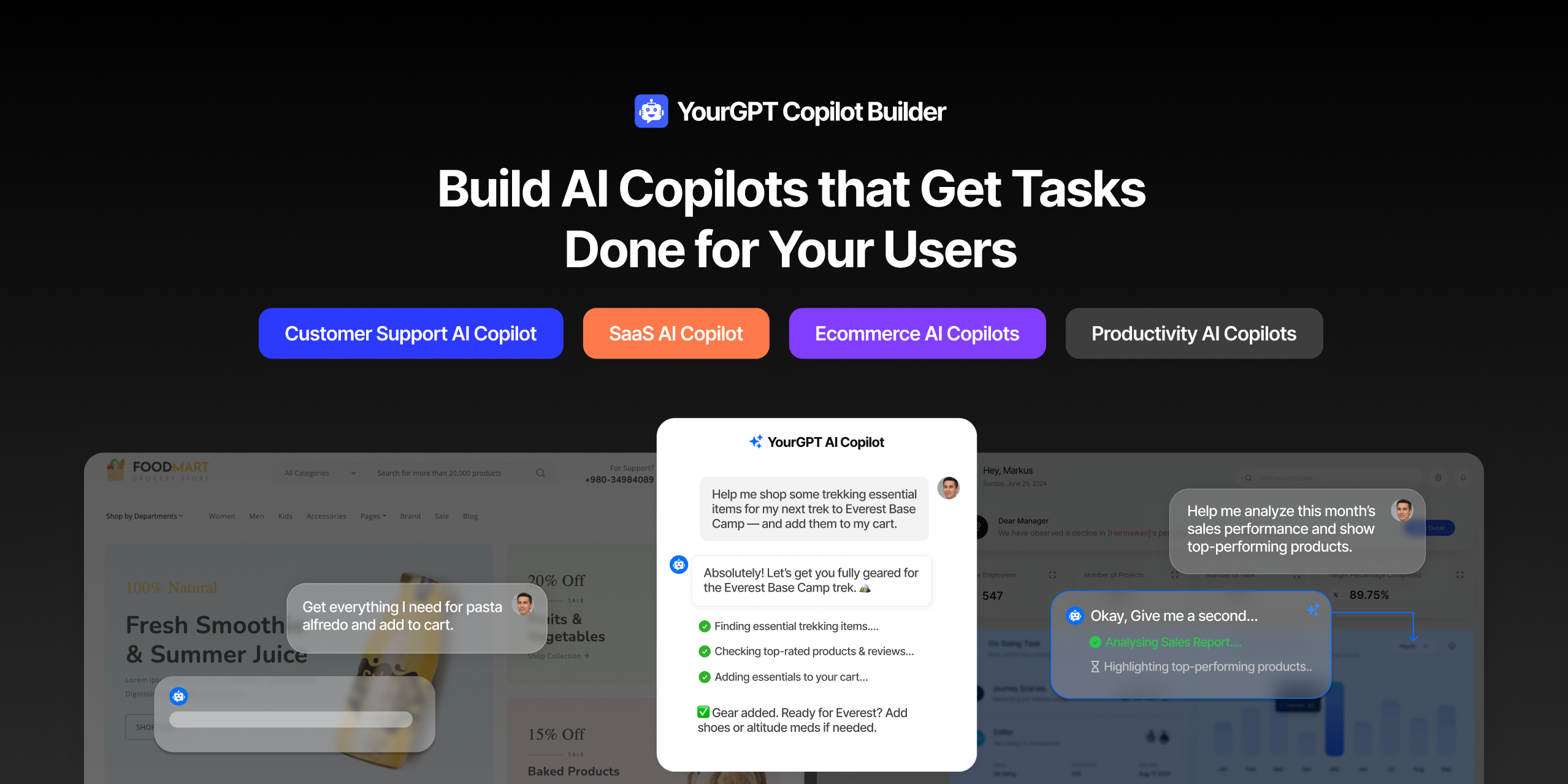
AI can help you finds products but doesn’t add them to cart. It locates account settings but doesn’t update them. It checks appointment availability but doesn’t book the slot. It answers questions about data but doesn’t run the query. Every time, the same pattern: it tells you what to do, then waits for you to […]

GPT-driven Telegram bots are gaining popularity as Telegram itself has 950 million users worldwide. These AI Telegram bots allows you to create custom bots that can automate common tasks and improve user interactions. This guide will show you how to create a Telegram bot using GPT-based models. You’ll learn how to integrate GPT into your […]


TL;DR The 10 best no-code AI chatbot builders for 2026 help businesses launch quickly and scale without developers. YourGPT ranks first for automation, multilingual chat, and integrations. CustomGPT and Chatbase are ideal for data-trained bots, while SiteGPT and ChatSimple focus on easy setup. Other options like Dante AI, DocsBot, and Botsonic specialize in workflows and […]

GPT Chatbot for Webflow: The Key to Exceptional Customer Service Providing great customer service is essential for any business, but managing a high volume of inquiries can be a challenge.If you use Webflow, integrating a webflow chatgpt can simplify this process. This AI-powered webflow chatbot offers consistent, personalised responses to customer queries, helping you manage […]