Top 6 Voiceflow Alternatives in 2026

Akansha
Last updated on July 3, 2026
Voiceflow is useful for building basic chatbots and voice flows, but teams often switch when they need deeper integrations, stronger AI capabilities, and broader channel support.
YourGPT stands out for AI-first automation with agents that can take real actions across chat, voice, and messaging, while Kore ai is a strong choice for enterprises needing advanced orchestration, voice systems, and secure integrations.
The right alternative depends on your needs choose AI-first platforms for automation and scalability, or enterprise tools if you require deep control, compliance, and complex workflows.
Voiceflow is a no-code platform for building and deploying AI agents, whether you need a support chatbot, a voice assistant, or an internal tool. It uses a drag-and-drop canvas, API connectors, and multi-platform exports to help teams design and launch conversational experiences quickly.
However, not every team finds it sufficient as requirements grow.
As businesses move toward AI that does more than respond, expectations shift toward systems that can understand context, connect with live data, and complete tasks end-to-end. Teams also look for better support across channels like WhatsApp, stronger voice capabilities, and tighter integration with their existing tools and workflows.
That’s where Voiceflow starts to feel limited for more advanced use cases.
In this blog, we’ve listed six Voiceflow alternatives for 2026, focusing on platforms that offer deeper flexibility, stronger AI capabilities, and the ability to scale as your business grows.
Voiceflow is a good platform for designing, testing, and launching chat and voice agents. Its visual canvas helps teams map conversation flows, create prototypes, connect knowledge sources, and move ideas into production faster than building from scratch.
It works well for product teams, agencies, and businesses that want a flexible builder for conversational experiences. But it may not be the right fit for every team.
Some businesses need a platform that is more focused on customer support, live agent workflows, ecommerce automation, helpdesk integration, or ready-to-use deployment across messaging channels. Others may want simpler setup, clearer operational workflows, or more control over how AI agents connect with business systems.
Below are the main reasons teams compare Voiceflow with other platforms in 2026.
Voiceflow is built for designing conversational agents, but support teams often need more than a strong builder. They may need a shared inbox, ticket routing, human handoff, customer history, SLA tracking, and helpdesk workflows built into the platform.
For teams focused on customer service, a support-first alternative can be easier to manage because it connects automation with daily agent operations.
Voiceflow gives teams a flexible canvas, but flexibility can still require planning, testing, and configuration. For simple support bots, lead capture flows, or website chat automation, some teams prefer tools that are more guided and easier to launch.
A simpler alternative can help marketing, sales, and support teams build useful chatbots without depending heavily on developers or conversation designers.
Many businesses need AI agents to work closely with tools like Zendesk, HubSpot, Salesforce, Freshdesk, Intercom, Shopify, or internal systems.
When the goal is to update customer records, create tickets, check order status, qualify leads, or sync conversation history, integration depth becomes important. Some alternatives are built more directly around these sales and support workflows.
Voiceflow supports chat and voice experiences, but businesses often want one platform to manage conversations across web chat, WhatsApp, Instagram, Messenger, email, Slack, and live chat.
If your team needs a central inbox, channel-specific routing, message history, and human handoff across all these channels, an omnichannel customer communication platform may be a better fit.
Large companies often need advanced governance, security controls, analytics, audit trails, deployment management, and compliance support.
Voiceflow can support larger teams, but some enterprises may prefer alternatives built specifically for contact centers, regulated industries, or large-scale customer service operations.
A chatbot is more useful when it can do more than answer questions. Teams may want agents that can verify account details, check product availability, update tickets, trigger workflows, schedule meetings, or hand over complete context to a human agent.
For these use cases, the best alternative is often the platform that connects automation, data, and human support in the simplest way.
| Platform | Best For | Voice Support | AI Capability | Channels |
|---|---|---|---|---|
| YourGPT | AI-first automation across support, sales, ops | Yes | Advanced (action-based AI agents) | Web, WhatsApp, Slack, Email, Voice |
| Botpress | Custom AI chatbot development | No | Moderate (LLM-based) | Web, APIs, messaging apps |
| UChat | Multichannel + voice automation | Yes | Moderate–Advanced | WhatsApp, SMS, Messenger, Voice |
| Kore.ai | Enterprise AI and voice systems | Yes | Advanced (enterprise AI) | Web, mobile, contact centers |
| ManyChat | Marketing automation | No | Basic (scripted) | Messenger, Instagram, WhatsApp |
| Front | Team collaboration and shared inbox support | No | Basic (rule-based automation) | Email, Chat, SMS |
Looking for better options than Voiceflow? These six tools offer no-code chatbot building, AI automation, and multi-channel support perfect for 2026 needs.
Here are the 6 best Voiceflow alternatives in detail designed to handle advanced workflows, voice agents, GPT integrations, and multichannel automation.

YourGPT is an AI-first platform for building and deploying conversational agents across support, sales, and business operations. It gives teams a no-code editor, advanced AI capabilities, and flexible integrations to create agents that can answer questions, automate workflows, and support customers across websites, messaging apps, email, and voice channels.
Its modular setup makes it easy to adapt agents to different use cases, from customer support and lead qualification to internal automation and voice-based assistance.
Discover how YourGPT AI chatbot can streamline your customer service

Botpress is an AI platform used to build and deploy conversational agents. It provides a visual development environment where teams can create chatbots and AI assistants using large language models (LLMs). Its modular structure and integration support make it adaptable for different business needs and industries.
It is a good choice for technical teams that need flexibility, custom workflows, and control over how their conversational agents are built. However, teams without developer support may find setup and maintenance more complex compared to simpler no-code alternatives.

UChat is a no-code chatbot platform that helps businesses automate conversations across websites, messaging apps, and voice channels. It offers a drag-and-drop builder, multilingual support, and ready-to-use automation tools, allowing teams to create chatbots without programming knowledge.
It is a practical option for businesses that want to manage customer communication across multiple channels from one platform. UChat works well for lead generation, customer support, appointment booking, and simple workflow automation.

Kore.ai is a conversational AI platform built for automating interactions across voice and digital channels. It’s designed to support both customer-facing and internal use cases, such as virtual assistants, contact centre automation, and workflow support.
The platform offers no-code and low-code tools, pre-built industry models, analytics, and enterprise integrations, making it suitable for large teams that need scalable automation. It is a strong fit for businesses in industries like banking, healthcare, retail, and IT that require secure, structured, and high-volume conversational AI.

ManyChat is a chatbot platform that helps businesses automate interactions on messaging channels such as Facebook Messenger, Instagram Direct Messages, WhatsApp, SMS, and email. It allows users to build chatbots for marketing, sales, and customer support without writing codes.
The platform is especially useful for social media automation, lead generation, broadcasts, and campaign-based customer engagement. It is a good fit for creators, ecommerce brands, and small businesses that rely heavily on social messaging channels.

Front is a customer communication platform that combines email, chat, and messaging into a shared inbox, enabling teams to manage all conversations from one place. It is designed to improve team collaboration, giving support, sales, and operations teams full visibility into customer interactions without switching tools.
Unlike traditional helpdesks, Front focuses on team coordination around conversations rather than ticket-first workflows. It helps teams respond faster, maintain context, and stay aligned through shared ownership of messages, making it a strong fit for organizations that rely heavily on email and collaborative communication.
Here’s a side-by-side comparison of the top Voiceflow alternatives—highlighting voice support, AI capabilities, multichannel deployment, and usability to help you choose the right platform faster.
| Platform | AI Chatbot Type | Voice Agent | Multilingual | Channels | Live Data / API | Human Handover | Custom Logic |
|---|---|---|---|---|---|---|---|
| YourGPT | Generative AI | Yes | 100+ languages | WhatsApp, Telegram, Slack, Messenger, Web | API, Webhooks | Yes | Yes |
| Botpress | Generative + Scripted | No | ~40 languages | Web, messaging apps (custom) | Action Server, API | No | Yes |
| UChat | Generative + Scripted | Yes | Yes | WhatsApp, Facebook, SMS, Telegram, Web | API, Dialogflow | Yes | Yes |
| Kore.ai | Generative + Scripted | Yes | Yes | Contact Center, Messaging, Web, Mobile | API | Yes | Yes |
| ManyChat | Scripted | No | Limited | Messenger, Instagram, WhatsApp | Keywords, API | Limited | No |
| Front | Rule-based (workflow automation) | No | Limited | Email, Chat, SMS | API, CRM integrations | Yes | Limited |
Selecting the ideal Voiceflow alternative hinges on matching platform capabilities to your core objectives—whether that’s faster support, richer engagement, or streamlined operations. Focus on these six criteria:
Use these criteria to evaluate each candidate. Building a shortlist of two or three platforms and running a hands-on pilot will reveal which alternative aligns best with your technical needs and business goals.
Most alternatives offer native AI integration, capabilities, and broader multichannel deployment—including WhatsApp, and advanced voice agents.
Yes. Platforms like YourGPT, Manychat, and UChat are designed for non-developers. They offer drag-and-drop builders, prebuilt templates, and intuitive flows without needing any coding knowledge.
YourGPT and Kore.ai offer full support for both voice bots (including IVR) and messaging platforms like WhatsApp, Telegram, and Slack, making them ideal for multichannel use.
It depends on your audience. If your customers expect call-based interaction or you’re replacing traditional IVR systems, voice support (input and output) is critical. If you’re only using web or messaging, it’s optional.
Track chatbot KPIs like resolution rate, session length, drop-offs, CSAT, and cost per interaction. Most alternatives offer built-in analytics dashboards to monitor and improve performance over time.
YourGPT, Kore.ai, and Chatling offer strong multilingual support (85+ to 135+ languages) and global channel deployment, making them ideal for scaling across regions.
Choosing a Voiceflow alternative starts with understanding what your business really needs.
Begin by outlining your requirements: the channels to support, your team’s technical level, and projected usage. Run a targeted pilot based on your most important use case to evaluate setup speed, performance under real-world workloads, and the platform’s ability to retain accuracy as demand grows.
YourGPT is intended to fill these gaps. Non-technical teams can also easily start and train AI agents, while developers have full access to APIs and webhooks to expand functionality as business needs change. YourGPT provides many channels right out of the box, including chat, voice, and messaging, which removes setup hurdles and reduces technical complexity.
Switching to the right Voiceflow alternative allows you to provide improved customer experiences while also focusing your team’s energy on high-value tasks. Continuous review and improvement will ensure that your conversational AI remains dependable and effective as your organization grows.
Join thousands of businesses using AI-powered chatbots to automate support, boost engagement, and drive growth.
No credit card required • Full access • Cancel anytime
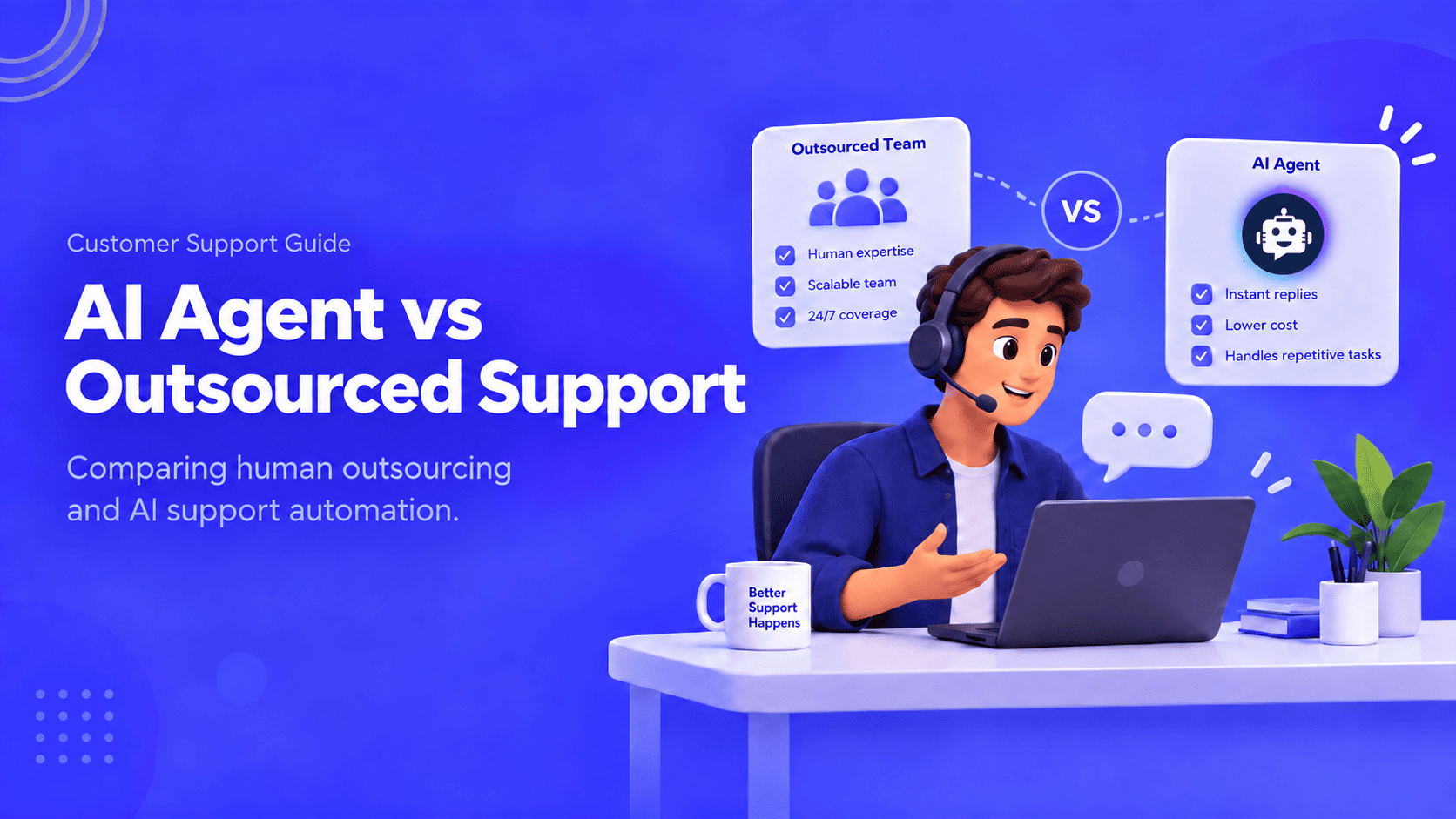
Compare outsourcing customer service with an AI agent using your own ticket mix, a cost model you fill in, and a clear rule for a hybrid split.

Export the Zendesk ticket archive, train an AI Agent on the help center, and test one real ticket before you stop the old queue.


Compare six Yuma alternatives by ecommerce capabilities, helpdesk compatibility, pricing and human handoffs to choose a replacement for your support team.


Move from Gorgias with a verified ticket archive, tested AI workflows, human handoff and a channel cutover plan before ending your subscription.
TL;DR The Gorgias AI Agent is the automation layer inside the Gorgias helpdesk, split between a Shopping Assistant for pre-purchase conversations and a Support Agent for post-purchase support. A connected Shopify store is required, and Gorgias documentation rules out platforms such as BigCommerce, Magento, and WooCommerce for the AI Agent. Billing runs on two separate […]

TL;DR Gorgias is the closest Richpanel alternative for Shopify stores that need native order actions directly inside support tickets. YourGPT fits stores that want one AI agent handling requests across web, WhatsApp, Instagram, and email, while Tidio and Re:amaze suit smaller teams looking for lighter, lower-cost options. Richpanel’s AI pricing starts around $500/month for two […]