AI Customer Service Pricing (2026): Cost per Resolution Compared

Shreya
November 19, 2026
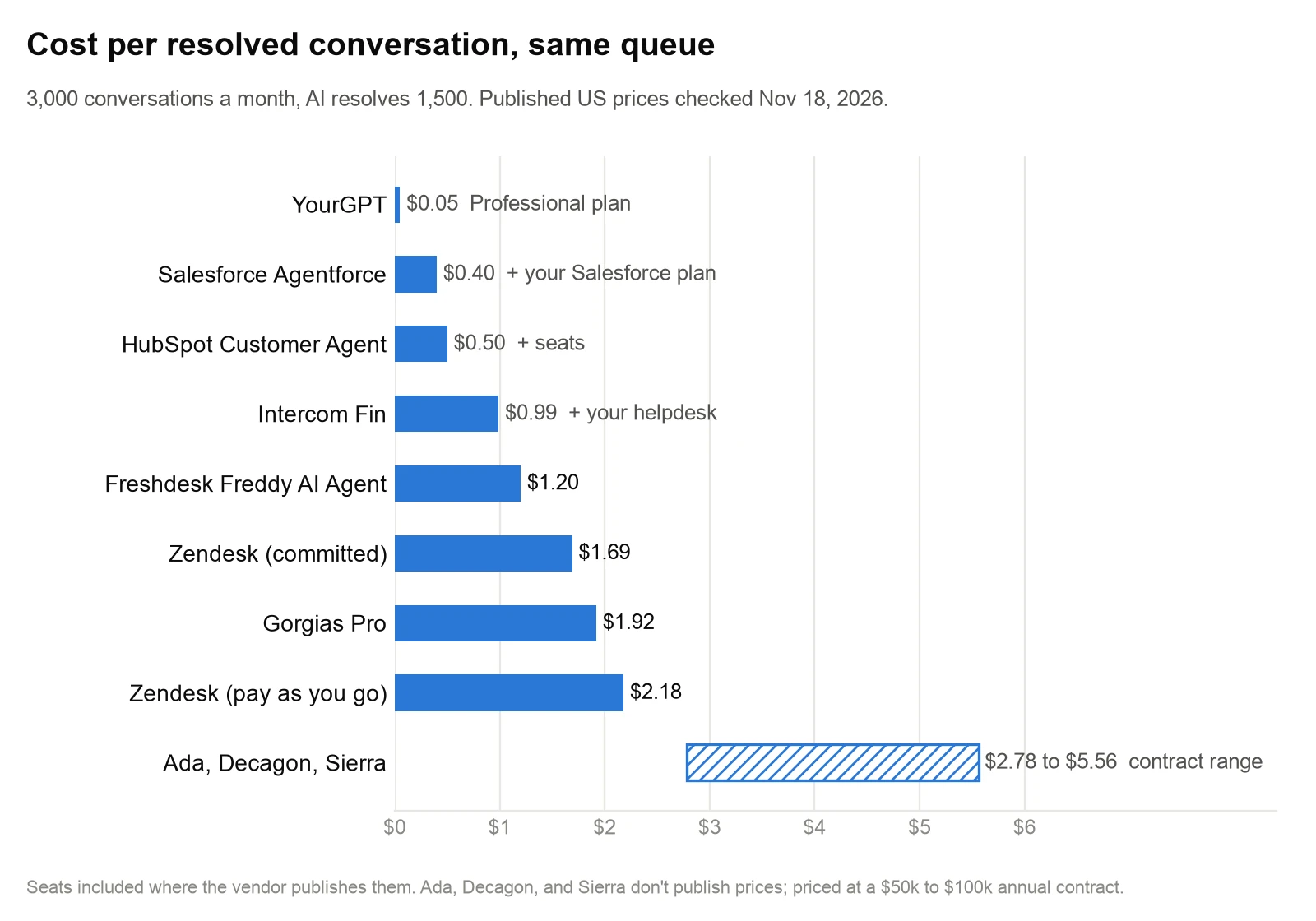
Published AI support rates in 2026 run from $0.10 per action (Salesforce Agentforce) and $0.49 per session (Freshdesk) to $0.50 to $2.00 per resolution (HubSpot, Intercom, Gorgias, Zendesk). The number to compare is cost per resolution: on the same 3,000-conversation queue, it runs from about $0.05 on YourGPT Professional to $2.18 on Zendesk pay as you go once seats and bundles are counted. Ada, Decagon, and Sierra sell by quote, so we price them at a $50,000 to $100,000 annual contract.
A customer asks where their order is. The AI agent checks the shipping status, sees the package is late, and hands the conversation to a support rep. Depending on the platform, the lookup, session, or handoff can trigger a charge. Your team still has to resolve the issue.
That’s what makes AI support pricing hard to estimate from a pricing page. How often will you pay for an attempt your team still has to finish? And what will seats, subscriptions, or minimum commitments cost before the first conversation starts?
This blog compares 11 platforms using the same support queue. It shows what triggers a charge, which costs sit outside the advertised rate, and how to estimate what you’ll spend for each issue the AI resolves on its own. YourGPT publishes this guide and is one of the platforms included.
To run the comparison with your own numbers, start with the AI chatbot pricing calculator. For a baseline on what your team spends today, use the guide to calculating cost per support ticket.
Public pricing pages show automated support rates across five distinct billing units, from individual outcome fees to session meters and pooled credits:
| Vendor | Billing unit | Published AI rate | What triggers a charge | What you pay underneath |
|---|---|---|---|---|
| Intercom Fin | Per outcome | $0.99 per outcome | Customer confirms resolution, asks for no more help, completes a Procedure handoff, or qualifies as a lead | Free with existing helpdesk subject to minimum monthly commitment, or Intercom seats from $29 |
| Zendesk | Per automated resolution | $1.50 committed or $2.00 pay as you go | Request resolved without escalation to human staff, evaluated by automated verification review | Staff seats ($19 to $115 annual per agent per month) with 5 to 10 included resolutions per seat |
| Gorgias | Per automated interaction | $1.00 monthly ($0.90 annual) in bundles; $1.50 overage | Interaction resolved with no human agent contact required within 72 hours | Monthly ticket plans ($10 to $900) plus standard ticket fees on AI-resolved tickets |
| HubSpot Customer Agent | Per resolution | $0.50 (50 credits at $0.01) on text | Reply from content or completed action with no human handoff within 72 hours, or lead qualification | Service Hub Professional or Enterprise subscription plus $1,500 to $3,500 one-time onboarding |
| Freshdesk Freddy AI Agent | Per session | $0.49 ($49 per 100 sessions) | Unique interaction between an end user and an AI agent, regardless of whether it resolves | First 500 sessions free once per account, plus staff seats ($19 to $89 annual per agent per month) |
| Salesforce Agentforce | Per action (Flex Credits) | $0.10 per standard action ($500 per 100,000 credits) | Each action the agent runs, such as a lookup or a record update; per-conversation pricing through sales | Your Salesforce plan; Agentforce user add-ons from $125 per user per month |
| Tidio Lyro | Per conversation (pay-per-resolution on Premium) | Core from $32.50 for 50 conversations; Plus from $300 plus usage | Any conversation receiving at least one AI reply; multiple replies within the chat count once | First 50 conversations free for the life of the account |
| YourGPT | Flat monthly plan with AI Credit pool | Essential $39, Professional $79, Advanced $349 (annual billing) | AI tasks draw credits from the pool; draw depends on the model | 10M to 100M credits included; team member limits (3 to 20); extra credits via add-on plans |
| Ada | Quote based (per conversation default, resolution option) | Custom quote | Every conversation the AI conducts, or unescalated automated resolutions for enterprise contracts | Not published; pricing through sales |
| Decagon | Quote based (per conversation or per resolution) | Custom quote | Total conversations handled or resolutions depending on contract terms | Not published; pricing through sales |
| Sierra | Quote based (outcome based) | Custom quote | Achieving agreed customer service outcomes defined in contract | Not published; pricing through sales |
Read the rate alongside two details in the table: what triggers the charge and which fees apply regardless of AI usage. Together, they show what lands on your bill when the AI solves an issue and when a support rep has to take over.
With session or conversation pricing, you can pay for an interaction even if the customer leaves after one reply. With outcome pricing, the vendor’s definition determines what you pay for. Some vendors count a completed handoff as a billable outcome. Base subscriptions and seat fees still apply wherever the plan requires them.
To compare them, turn every bill into one number:
Effective cost per resolution = (platform fee + seats + AI usage) / resolutions the AI actually completed
A per-resolution price is a fraction. The vendor publishes the numerator. Your queue sets the denominator.
When a vendor bills by the session or conversation, the headline rate tells you almost nothing about what a solved ticket costs. To convert a session rate into a cost per resolution, divide the session price by your actual resolution rate. If Freshdesk Freddy AI Agent charges $0.49 per session and resolves 50% of your incoming volume, you get $0.49 / 0.50 = $0.98 per resolution.
Drop the resolution rate to 25%, and that same $0.49 session jumps to $1.96 per resolved issue ($0.49 / 0.25). That’s the intro’s math. Freshdesk’s $0.49 and Intercom’s $0.99 are one cent apart at 50%, and Freshdesk costs twice as much per solved ticket at 25%.
Don’t plug your deflection rate into that formula. A deflected customer didn’t reach a person, which can also mean they gave up. A resolution means the problem got solved without a human, and that’s the event most of these vendors bill for.
Then put your human number next to it. If a ticket handled by your team costs more than the AI’s cost per resolution, every extra resolution saves money. If it costs less, the AI is buying you speed, not savings. The chatbot ROI calculator takes your agent count, yearly cost per agent, and minutes per ticket, and you can calculate AI ROI by hand with the same inputs.
Every vendor gets the same queue and the same rules:
To rerun all of this with your own volume and team size, use the free chatbot cost calculator, and set the automation rate to the one you’ve measured, not the default.
| Tool | Plan priced | Per month | Per year | Per conversation | Per resolution |
|---|---|---|---|---|---|
| Intercom Fin | Fin on your existing helpdesk | $1,485 | $17,820 | $0.50 | $0.99, plus your helpdesk |
| Zendesk (committed) | Suite Team, annual, 6 seats | $2,535 | $30,420 | $0.85 | $1.69 |
| Zendesk (pay as you go) | Suite Team, annual, 6 seats, no commitment | $3,270 | $39,240 | $1.09 | $2.18 |
| Gorgias | Pro with AI Agent, monthly | $2,875 | $34,500 | $0.96 | $1.92 |
| HubSpot Customer Agent | Service Hub Professional | $750 plus seats | $9,000 plus seats and $1,500 onboarding | $0.25 plus seats | $0.50 plus seats |
| Freshdesk Freddy AI Agent | Pro, annual, 6 seats | $1,800 | $21,600 | $0.60 | $1.20 |
| Salesforce Agentforce | Flex Credits, 2 actions per conversation | $600 plus your Salesforce plan | $7,200 plus your Salesforce plan | $0.20 | $0.40 |
| Tidio Lyro | Plus or Premium at this volume | On request | On request | $0.65 on Core’s entry tier | On request |
| YourGPT | Professional, annual | $79 | $948 | about $0.03 | about $0.05 |
| Ada | $50,000 to $100,000 contract | $4,167 to $8,333 | $50,000 to $100,000 | $1.39 to $2.78 | $2.78 to $5.56 |
| Decagon | $50,000 to $100,000 contract | $4,167 to $8,333 | $50,000 to $100,000 | $1.39 to $2.78 | $2.78 to $5.56 |
| Sierra | $50,000 to $100,000 contract | $4,167 to $8,333 | $50,000 to $100,000 | $1.39 to $2.78 | $2.78 to $5.56 |
shorten it little bit
Zendesk costs more without a usage commitment. Agentforce comes to $0.40 per resolution in AI usage at two actions per conversation. At 3,000 conversations a month, a $50,000 annual contract works out to $2.78 per resolution if the AI resolves half.
These four only charge for the AI when it gets something done, so a failed attempt costs nothing on the AI line. The differences hide in what each one counts as done, and in the seats, bundles, and allowances that sit around the rate.
On our queue: $1,485, or $0.99 per resolution (your helpdesk bill sits on top)
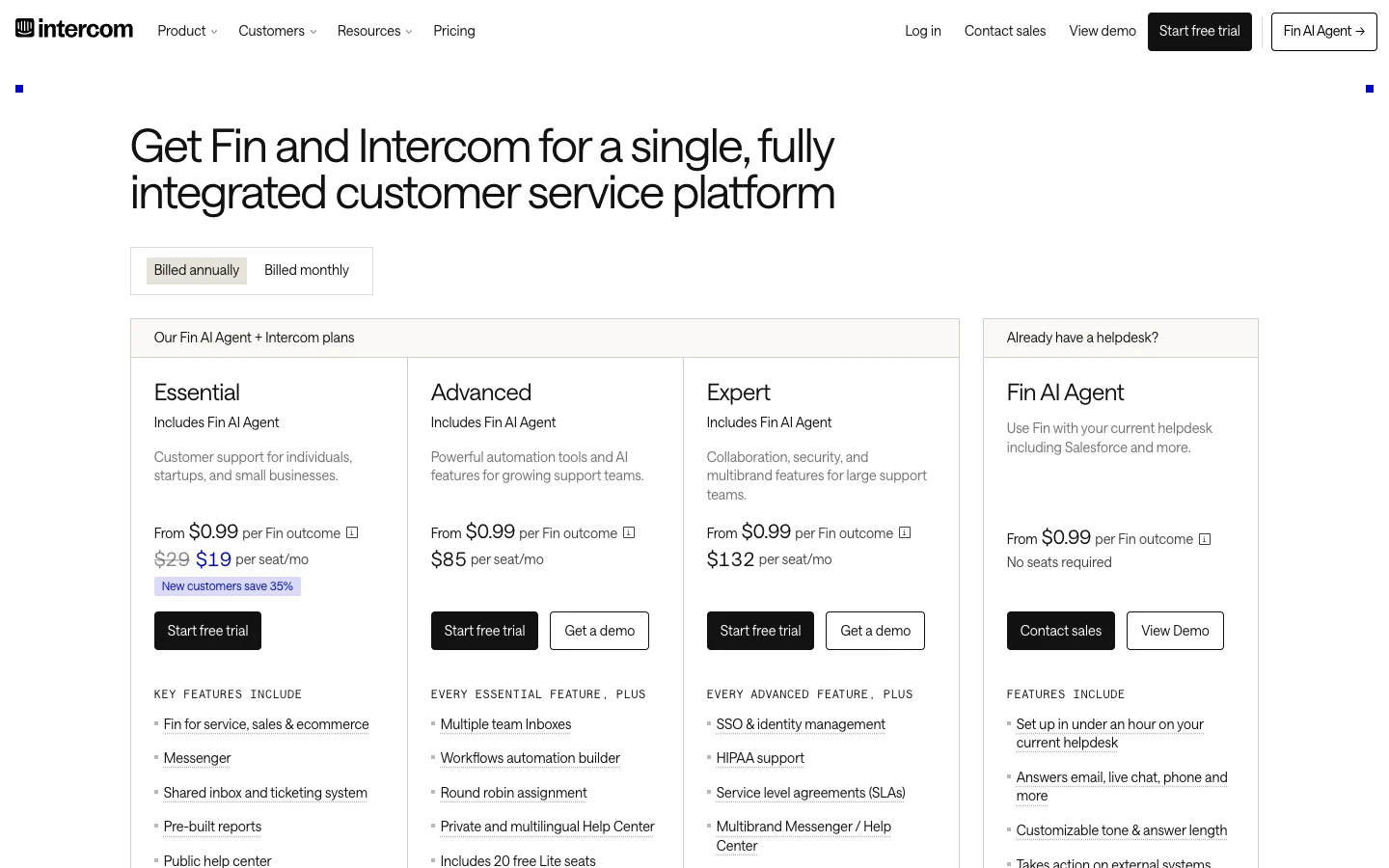
Intercom charges $0.99 per outcome for Fin. On our queue, Fin resolves 1,500 conversations, totaling $1,485 a month or $17,820 a year. If you connect Fin to a helpdesk you already use, such as Zendesk or Salesforce, you pay no Intercom seat fees. That keeps your cost at an even $0.99 for every solved issue, with your current helpdesk bill sitting unchanged underneath.
Read the word “outcome” carefully, because it covers more than resolutions. Since March 12, 2026, billable outcomes include a resolution, a completed Procedure handoff, and lead qualification or disqualification. A resolution occurs when the customer confirms the answer or asks for no more help after Fin responds. Intercom charges at most once per conversation.
You don’t pay if a customer explicitly asks for a human agent, if default workspace rules escalate the chat, if a Procedure fails, or if a visitor goes silent after a clarifying question.
External helpdesk connections carry a minimum monthly commitment, such as Intercom’s example of 50 outcomes, and unused resolutions don’t roll over. If you run your team on Intercom, seats start at $29 per seat per month on annual billing for Essential (which currently shows a $19 new-customer promo), while Advanced costs $85 and Expert costs $132. You can try your own team size in our Intercom pricing calculator.
Further reading: Intercom Review 2026: Pricing, Pros & Cons
On our queue: $2,535, or $1.69 per resolution
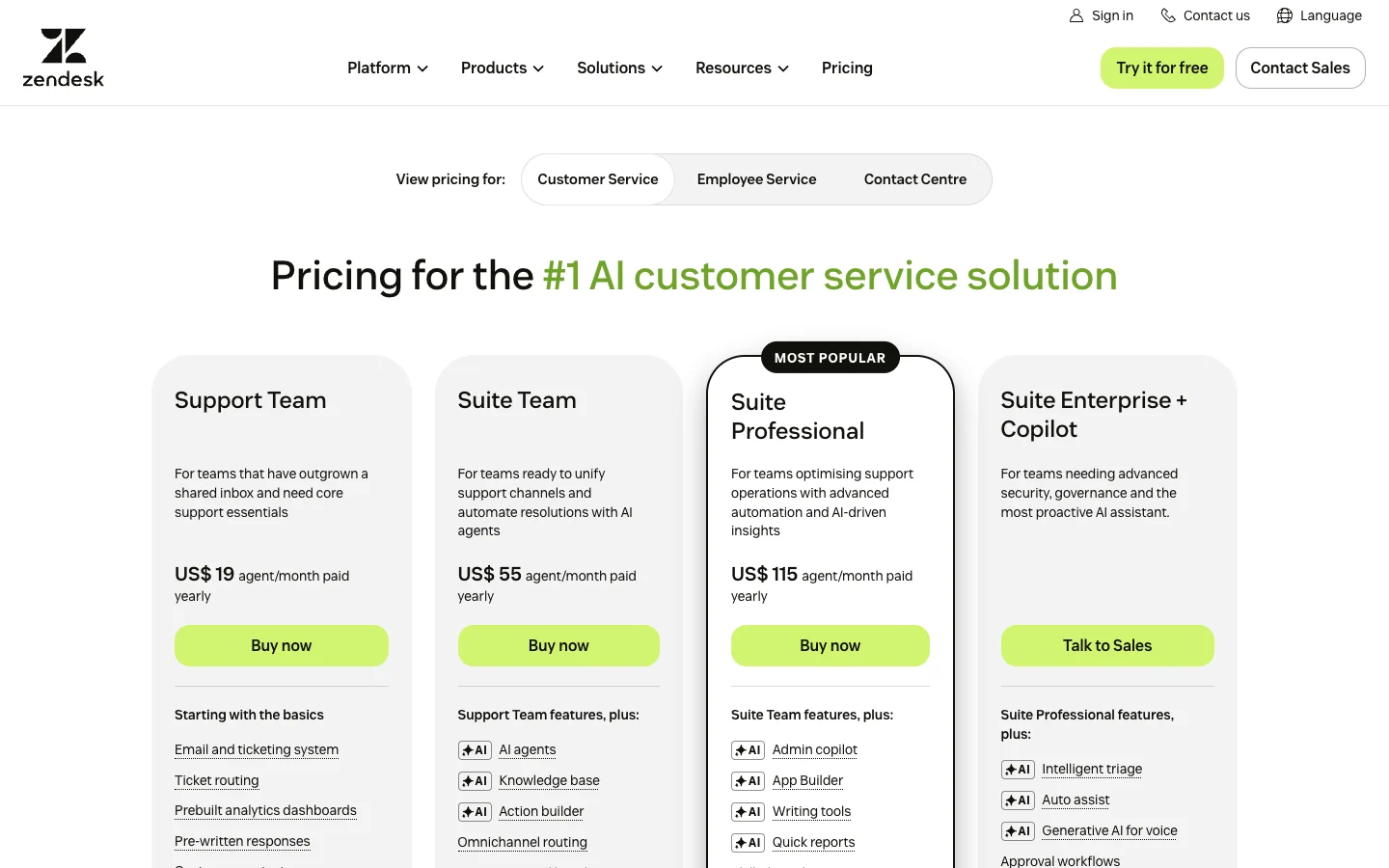
Zendesk is the one where the seats do most of the talking. You pay $55 per agent on Suite Team (annual billing), and each seat includes five automated resolutions. Six agents get you 30. Our queue needs 1,500.
Everything past the allowance costs $1.50 if you commit up front or $2.00 if you don’t. On this queue, that’s a $735 a month difference for signing the commitment, so ask for the committed rate before you sign anything. Skipping the commitment pushes your monthly bill to $3,270, which raises your unit cost to $2.18 per resolution.
Zendesk splits automated outcomes into three tiers: assisted escalations, contained resolutions, and verified resolutions. Its tier article indicates that only verified resolutions, the ones that pass an LLM review of the conversation, draw on your allowance. That’s stricter than a plain no-handoff rule, which works in your favor.
Our Zendesk AI agents review goes through the allowance rules, and the Zendesk cost calculator lets you change the seat count.
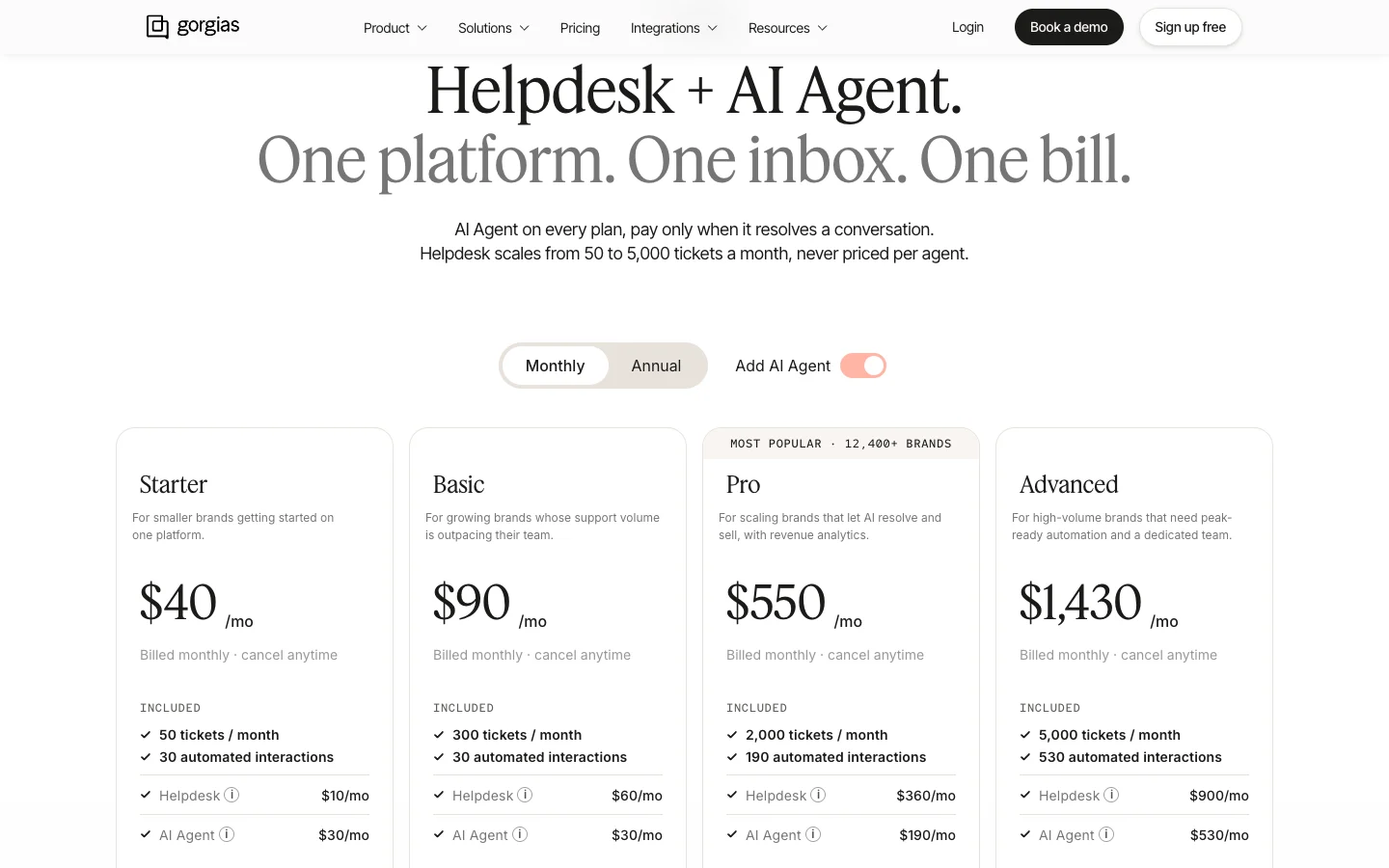
On our queue: $2,875, or $1.92 per resolution
Gorgias doesn’t charge per seat. It charges by ticket volume, then adds a fee each time the AI resolves an interaction on its own. On monthly billing, the Pro plan costs $360 for 2,000 tickets and includes an AI bundle of 190 automated interactions for $190. Processing 3,000 customer inquiries pushes your volume 1,000 tickets beyond the plan allowance, adding $360 in ticket overages at $0.36 each.
The AI side is where the bill grows. The bundle covers 190 interactions, which leaves 1,310 billed at the $1.50 overage rate. That adds $1,965 in AI overage fees, lifting your monthly total to $2,875, or $34,500 a year. Spread over the queue, that’s $0.96 per conversation and $1.92 per resolution.
Most of this invoice ($1,965 out of $2,875) comes from AI overage fees because the included bundle is tiny. Gorgias also applies a double charge: an automation fee and a standard ticket fee apply to the exact same ticket when the AI resolves it completely. If the AI hands off to a human, you pay only the standard ticket fee. An interaction only counts as automated if no human is needed within 72 hours.
One warning: Gorgias’s live pricing page shows two conflicting sets of annual prices, so we budgeted on monthly figures. Get the annual rate in writing.
Further reading: Gorgias Pricing (2026): Ticket Plans, AI Agent Cost per Interaction and Calculator
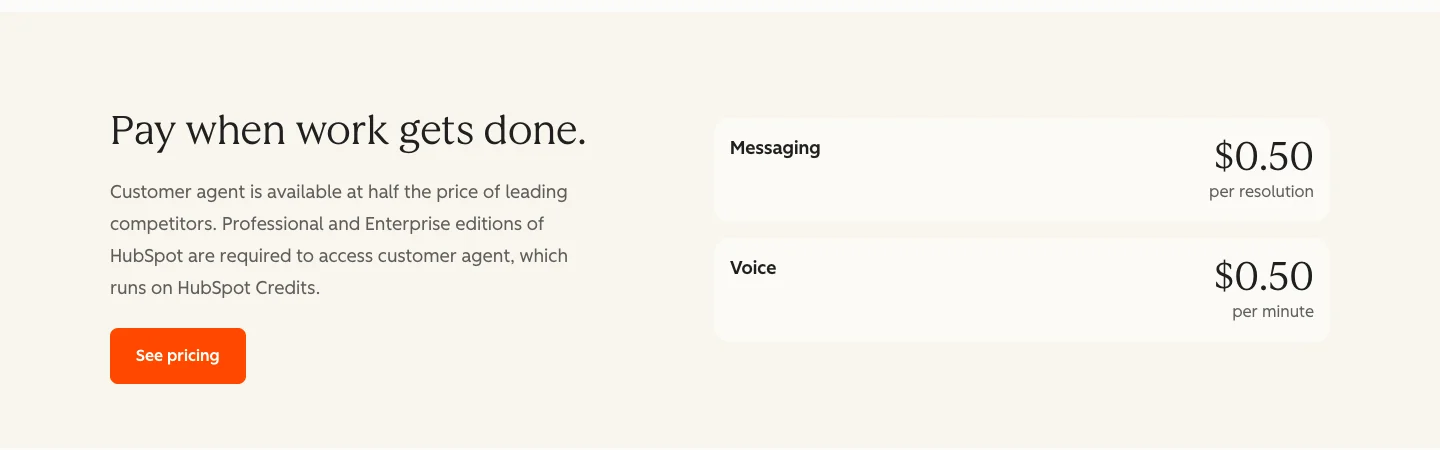
On our queue: $750 plus human seats, or $0.50 per resolution plus seats
HubSpot Customer Agent charges 50 HubSpot Credits for each resolved text conversation. At $0.01 per credit, that equals $0.50 per resolution, the lowest published per-resolution fee here. For our 1,500 resolved conversations, 75,000 credits cost $750 a month, or $9,000 a year, before factoring in human agent seat costs. That comes to $0.25 per conversation across the full queue and $0.50 per resolution for the AI alone.
That low rate requires Service Hub Professional or Enterprise. Those subscriptions include 3,000 or 5,000 credits, and list a one-time onboarding fee of $1,500 for Professional or $3,500 for Enterprise. We left seat prices out because we didn’t verify them, so add your own seat spend to get the full number. Voice support (currently in beta) consumes 50 credits per minute.
HubSpot counts a resolution when the agent answers from connected content or runs an action without a qualifying human handoff within 72 hours of the visitor’s last response, or when it marks a lead qualified, partially qualified, or not qualified. It charges per resolution, not per message. Watch the balance, because when credits run out, Customer Agent stops taking new conversations. You can test your team volume using our HubSpot pricing calculator.
Further reading: HubSpot Review 2026: Pricing, Pros & Cons
These three charge when the AI shows up, not when it succeeds. A chat where the agent fails on the first reply costs the same as one it solves, so your spend follows volume and your cost per resolution follows accuracy.
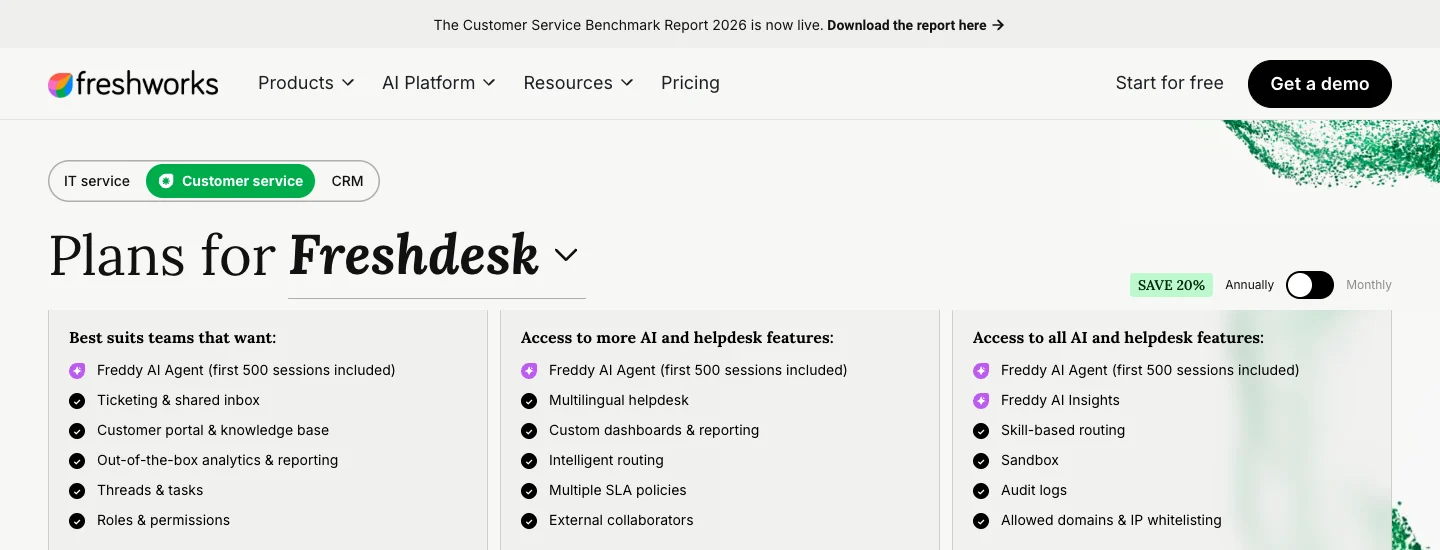
On our queue: $1,800, or $1.20 per resolution
Freshworks bills Freddy AI Agent by the session: $49 per 100 sessions, or $0.49 for each interaction. Freshworks defines a session as a unique interaction between an end user and an AI agent, with email sessions bounded by a 72-hour window from the first message. The meter counts sessions, not resolutions. If an agent greets a customer and fails to answer the question, you still pay $0.49 for the session.
Handling 3,000 monthly sessions costs $1,470 in usage. Adding six Pro human agent seats at $55 per agent per month on annual billing ($330) brings the monthly total to $1,800, or $21,600 a year. At a 50% resolution rate, that comes to $0.60 per conversation and $1.20 per resolution.
Freshdesk includes 500 free sessions, once per account. After those, your costs tie directly to incoming chat volume rather than solved tickets. If your queue handles complex technical questions that frequently escalate to staff, paying per attempt creates a steady tax on unresolved contacts.
Further reading: YourGPT vs. Freshdesk: Which Is Best for Customer Support in 2026?
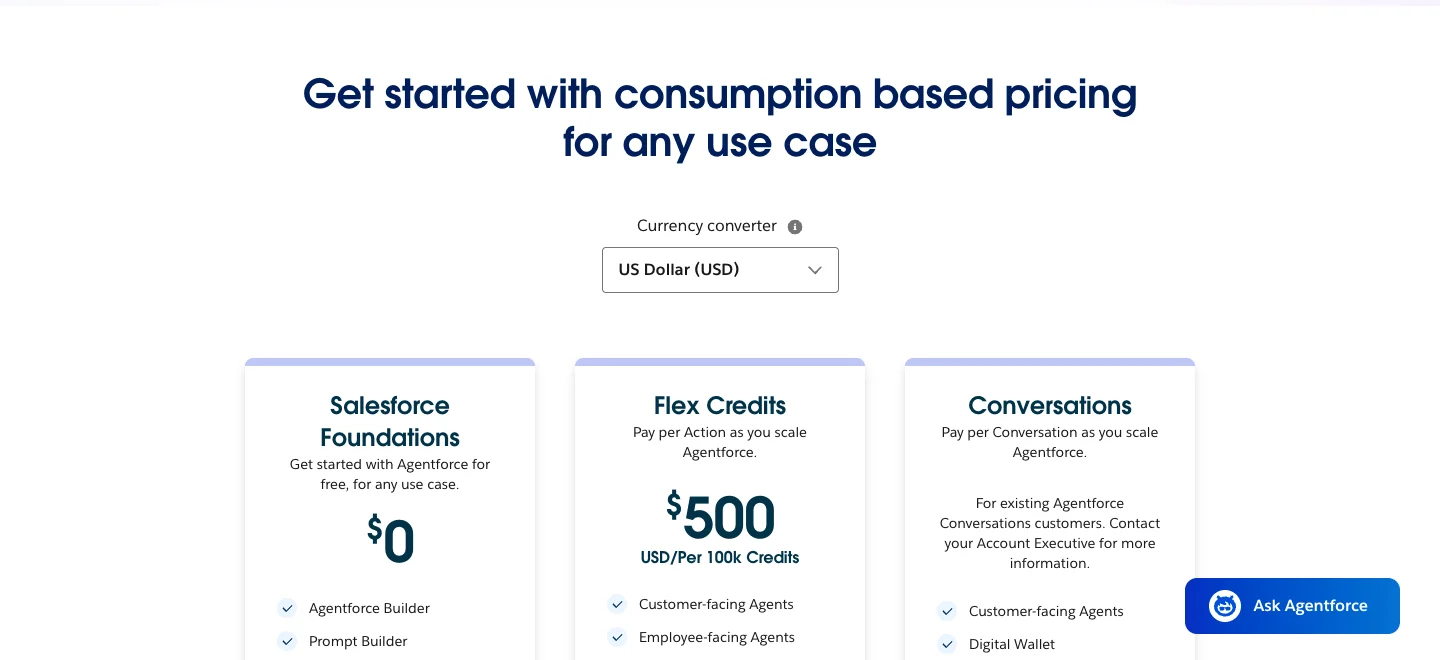
On our queue: $600 plus your Salesforce plan, or $0.40 per resolution
Agentforce charges by the action. Every step the agent takes, like looking up an order or updating a record, uses Flex Credits, and $500 buys 100,000 of them. A standard action is 20 credits, so 10 cents. A voice action is 30.
Salesforce’s own pricing page walks through a “Where is My Order?” request: two actions, 40 credits, 20 cents. Run our 3,000 conversations at that rate and you get $600 a month, or $7,200 a year. That’s $0.20 per conversation and $0.40 per resolution, the lowest published figure in this comparison after YourGPT.
Actions are metered on every conversation, resolved or not, and the two-action example is a simple one. A request that authenticates the customer, looks up the order, updates it, and confirms the change takes four actions, and the bill doubles. Count the actions in your five most common request types before you budget.
Salesforce also sells per-conversation pricing, but its pricing page now sends that to existing Conversations customers through an account executive. Agentforce add-ons for Sales, Service, and Field Service users cost $125 per user per month, and the agent runs on a Salesforce org, so your Salesforce plan sits underneath. If you already live in Salesforce, this is a strong price. If you don’t, the platform is the real cost.
Further reading: 8 Salesforce Alternatives in 2026
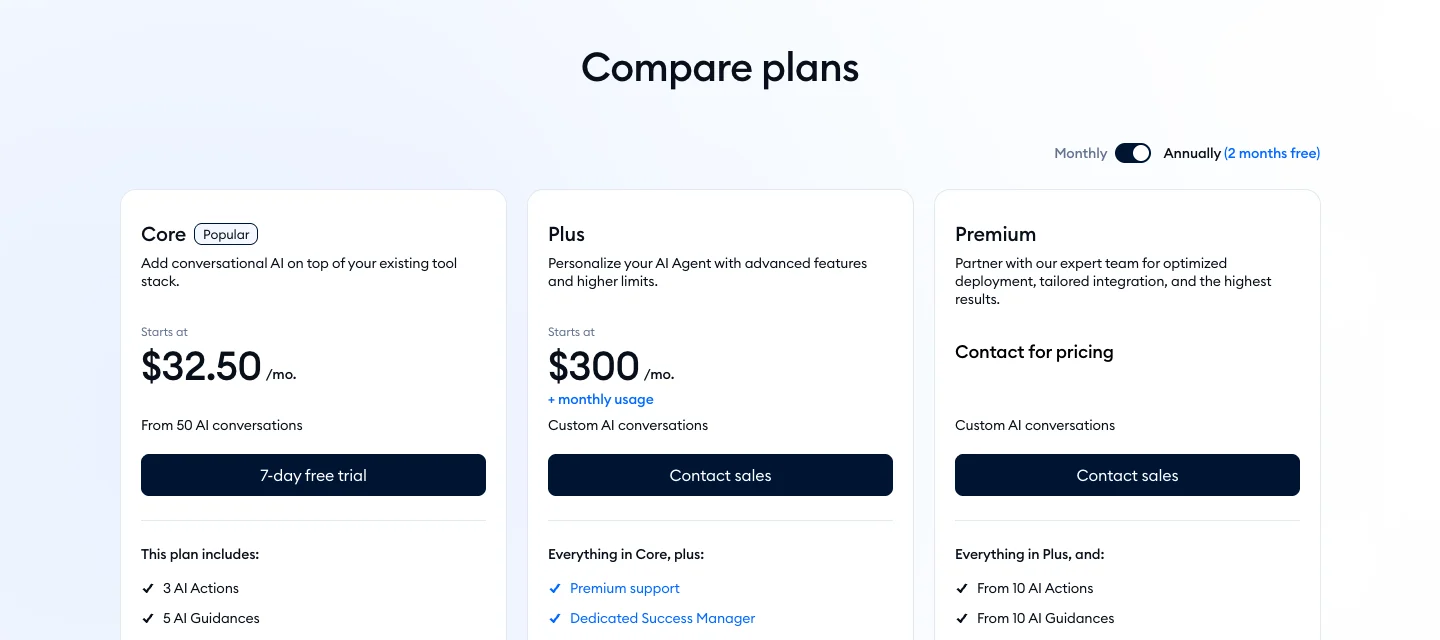
On our queue: on request at this volume (Core starts at $32.50 for 50 conversations)
Tidio sells Lyro by the conversation, and a chat counts once as soon as Lyro sends a reply, however many replies follow. Core, the entry plan, starts at $32.50 a month for 50 AI conversations on annual billing, so 65 cents each, and every account gets 50 conversations free for life.
For a queue our size, Tidio’s custom-volume plans are Plus and Premium. Plus starts at $300 a month plus usage. Premium is priced on request, and it’s the only Tidio plan that lists pay-per-resolution billing and a “Guaranteed 50% Lyro AI resolution rate.”
That guarantee is worth a call. If Tidio contracts to a resolution rate and bills per resolution, a weak month doesn’t raise your unit cost. Get the resolution definition and the rate in writing. Our Tidio cost calculator shows the Core math for your volume.
Further reading: Tidio Review 2026: Pricing, Lyro Limits & Who It’s Actually For
YourGPT charges a monthly subscription that includes a pool of AI credits. Each conversation uses credits whether the agent resolves the issue or hands it off. As long as usage stays within the pool, the monthly fee stays the same and the cost per resolution falls as the agent solves more issues.
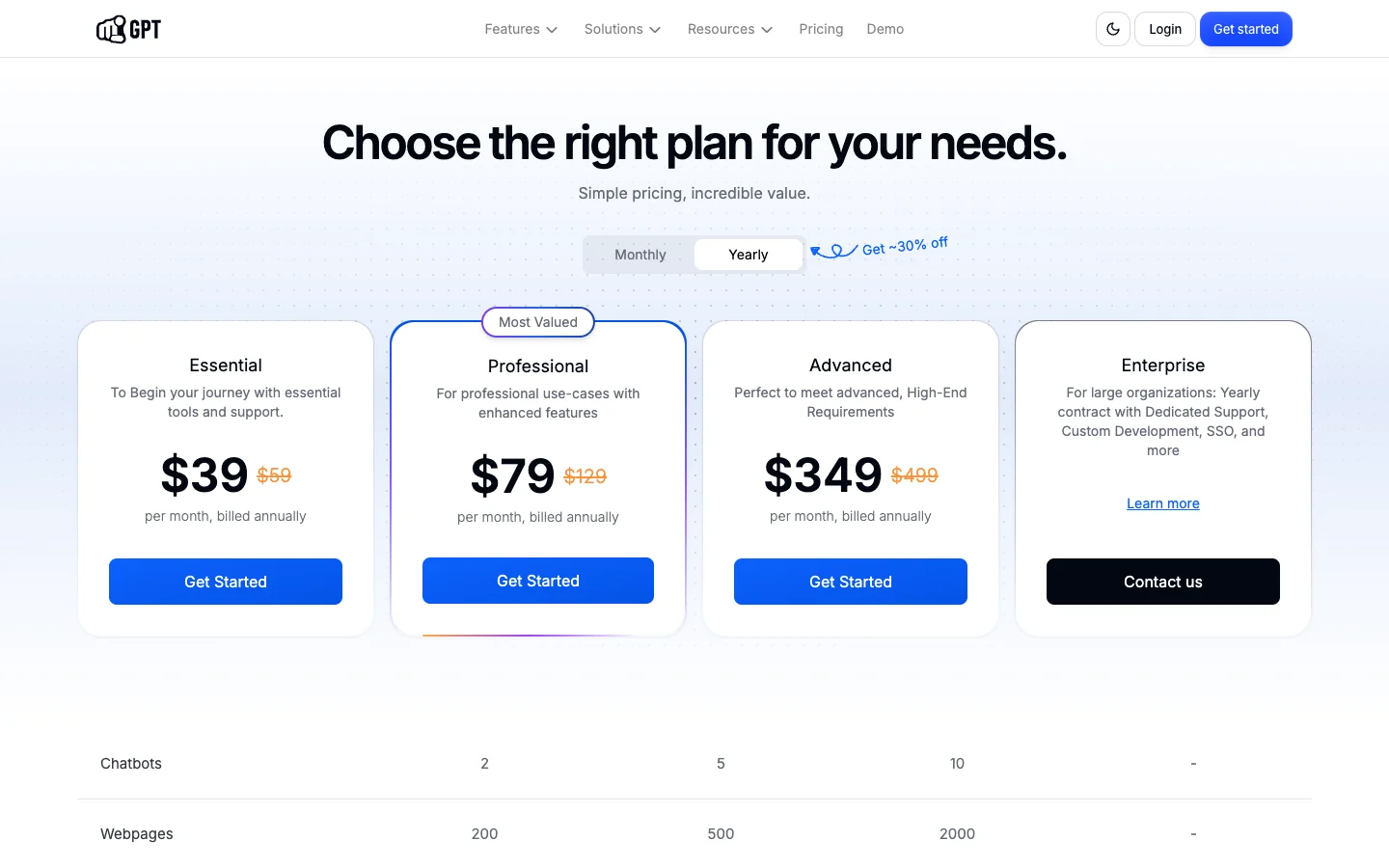
On our queue: $79, or about $0.05 per resolution
YourGPT is our product, and it bills differently from everything above: a flat monthly plan with a shared pool of AI Credits. There are no per-resolution fees, no per-session charges, no per-message fees, and no message caps.
On YourGPT’s annual plans, Essential costs $39/month with 10 million AI credits and 3 team members. Professional costs $79/month with 30 million credits, 5 team members, and human handoff. Advanced costs $349/month with 100 million credits and 20 team members. On monthly billing, the plans cost $59, $129, and $499, respectively.
AI credit usage varies by model. At an estimated 5,000 credits per conversation on a 1× model, Professional covers about 6,000 conversations. In our example, 3,000 conversations and 1,500 resolutions work out to about $0.05 per resolution on annual billing or $0.09 on monthly billing, before help desk costs. A 2× model would use roughly the full 30 million credits for the same queue.
With six support agents, you can route conversations from Professional to your existing help desk and include that subscription in the comparison. If all six need access to YourGPT, Advanced works out to about $0.23 per resolution on the same queue. APIs, webhooks, and AI Studio can connect your systems, though advanced workflows may require setup.
Use the AI credits calculator to estimate usage by model. During your trial, check actual credit usage under Settings → Billing & Usage → Credits and measure how many issues the agent resolves on its own.
Ada, Decagon, and Sierra don’t publish prices. To put them on the same page, we price them at a $50,000 to $100,000 annual contract, the range we use to budget a mid-size deal. Replace it with your quote the moment you have one. The formula stays the same.
| Vendor | Billing unit | Per month | Per conversation | Per resolution |
|---|---|---|---|---|
| Ada | Per conversation by default, per resolution for some enterprises | $4,167 to $8,333 | $1.39 to $2.78 | $2.78 to $5.56 |
| Decagon | Per conversation or per resolution, your choice | $4,167 to $8,333 | $1.39 to $2.78 | $2.78 to $5.56 |
| Sierra | Per outcome, as your contract defines it | $4,167 to $8,333 | $1.39 to $2.78 | $2.78 to $5.56 |
Ada prices through sales. Its default meter is the conversation, so you pay for every conversation the AI agent has. A resolution-based model exists for some enterprises, and Ada’s service terms define an automated resolution as a conversation that isn’t escalated.
That difference matters more than the contract size. On a conversation meter, dropping from 50% to 25% resolution doubles what each solved issue costs you. Our Ada cost calculator runs the comparison with your own volume.
Further reading: Ada CX Review 2026: Pricing, Pros & Cons
Decagon also sells through sales, and it lets you pick the meter: per conversation or per resolution. Pick per resolution if you can. A conversation contract bills you for every chat that ends in a human transfer, while a resolution contract ties the spend to work the agent finished.
Sierra prices on outcomes. You pay when the agent achieves the outcomes your contract defines, which makes the definition of an outcome the most important line in the deal. Read it before you read the rate.
Before you sign with any quote-only vendor, get these seven answers in writing:
Our queue resolves 50%. Now say gaps in your help content push it down to 25%, so the agent resolves only 750 of the same 3,000 conversations.
| Billing model | Cost at 50% resolution (1,500 resolved) | Cost at 25% resolution (750 resolved) | Budget impact |
|---|---|---|---|
| Per outcome (Intercom Fin) | $0.99 per resolution ($1,485 usage) | $0.99 per resolution ($742.50 usage) | Monthly bill drops by half; unit cost stays capped |
| Per session (Freshdesk Freddy) | $0.98 per resolution ($1,470 usage) | $1.96 per resolution ($1,470 usage) | Unit cost doubles; you pay for all 3,000 attempts |
| Per action (Agentforce) | $0.40 per resolution ($600 usage) | $0.80 per resolution ($600 usage) | Unit cost doubles; actions run on every conversation |
| Flat credit pool (YourGPT) | About $0.05 per resolution ($79 plan) | About $0.11 per resolution ($79 plan) | Fixed fee; unit cost doubles if the workload still fits the credits |
| Quote-only contract ($50k to $100k) | $2.78 to $5.56 per resolution ($4,167 to $8,333) | $5.56 to $11.11 per resolution ($4,167 to $8,333) | Fixed contract fee; unit cost doubles as solved volume drops |
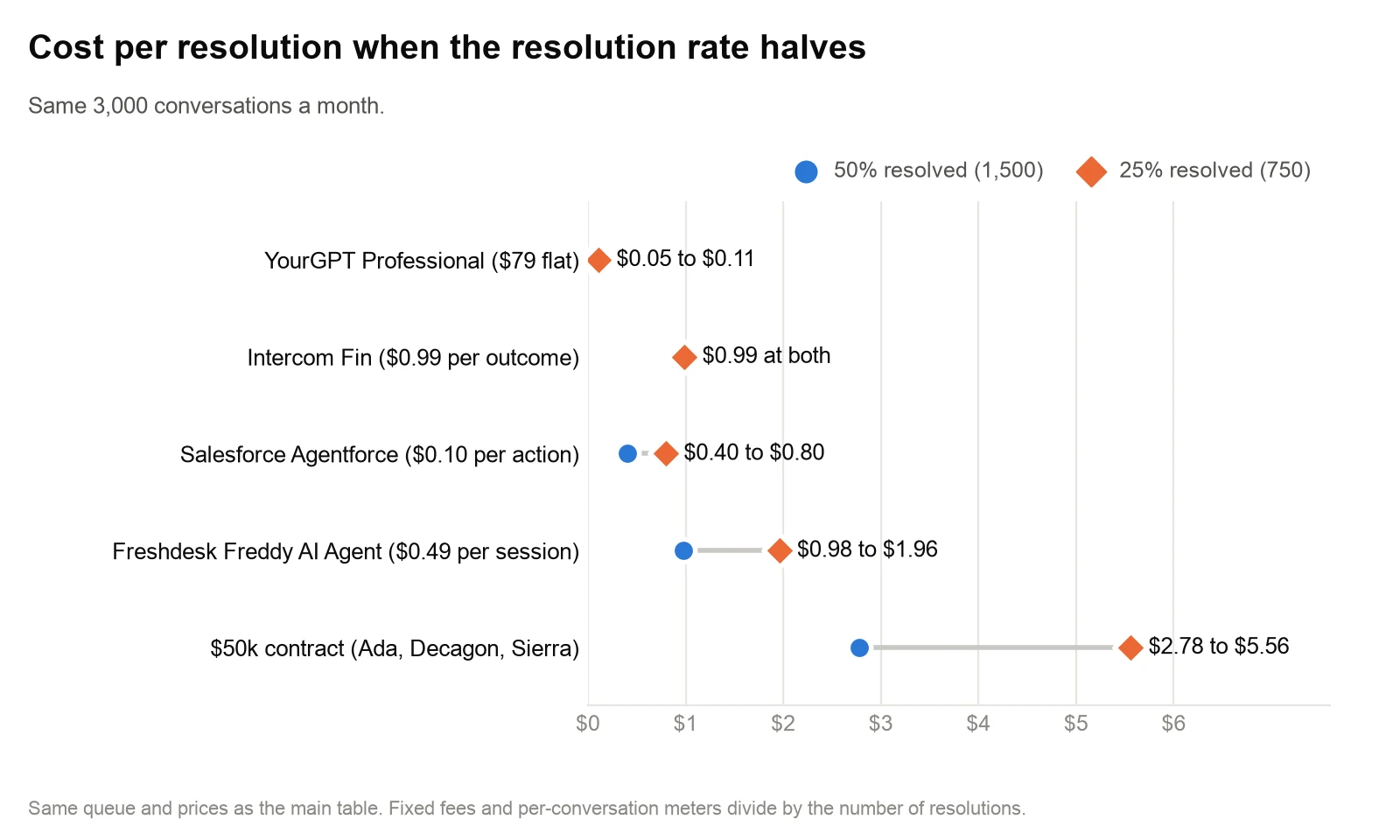
At a 25% resolution rate, Freshdesk and Agentforce usage charges stay at $1,470 and $600 under the same usage assumptions. Their costs per resolution double to $1.96 and $0.80, respectively. Intercom Fin stays at $0.99 per resolution, with resolution charges falling to $742.50.
YourGPT Professional’s $79 fee stays fixed within its credit allowance, bringing the cost to about $0.11 per resolution. An illustrative $50,000–$100,000 annual contract works out to $5.56–$11.11 per resolution at the same volume. Use our AI customer support benchmark to measure your own resolution rate.
Every rate above depends on one definition. Here’s what each published-price vendor counts:
Goodhart’s law states that when a measure becomes a target, it ceases to be a good measure. In customer support, a vendor-defined resolution confirms that a chat met contract billing rules, not that the customer got what they needed.
So audit it. Pull 50 conversations billed as resolved last month and read them. Count how many of those customers came back within seven days, on any channel, about the same issue.
Every returning customer represents an issue you paid for as resolved that still required human attention. Subtract those repeat contacts from your total resolved count before calculating your true unit cost. The transcripts also show you what to fix. That’s the idea behind self-learning AI agents: a person reviews the questions the agent missed before anything trains.
The rate on the pricing page isn’t the only number you control. Six levers move cost per resolution:
Start with the help desk and seats you already pay for. Then use your monthly ticket volume and measured AI resolution rate to compare what each option would add to your bill.
Add AI to your existing Zendesk plan : Check your included resolution allowance, then compare committed and pay-as-you-go pricing at your expected usage. A commitment makes more sense if your team consistently uses the volume it buys. If the combined cost of seats and AI is too high, compare Zendesk alternatives using the same ticket volume.
Use Fin with Intercom or your current help desk : If you want to keep your current help desk, price Fin as an add-on and keep your existing subscription in the total. Check the minimum commitment and include any configured Procedure handoffs that count as billable outcomes.
Budget for ticket and AI charges in Gorgias : For a Shopify or ecommerce team already using Gorgias, model both the ticket volume and the automated interactions. An AI-resolved ticket can count toward both. If overages drive up the total, compare Gorgias alternatives using a typical month and a peak month.
Compare flat-rate plans with per-agent pricing : If seats account for most of your bill, compare the full cost of a flat-rate plan, including team access, extra credits, and any help desk you keep for human support. If you’re considering a move from Zendesk to an AI agent, test where escalated tickets will go before switching.
Estimate credit usage for high-volume repeat questions : If most tickets cover repeat issues, start with the requests you can automate. Measure credits per conversation on a sample of those tickets, then check whether normal and peak volumes fit the plan’s allowance.
Count Agentforce actions per Salesforce request : If your support workflows already run in Salesforce, count the billable actions in your most common requests. A simple order lookup and a request that also updates a record can carry different usage costs. Include your Salesforce subscription in the total.
Compare written quotes for enterprise contracts : Ask Ada, Decagon, or Sierra to price the same queue. Request the billing unit, minimum commitment, overage rate, and conditions that make an interaction billable. Divide each modeled monthly cost by the same number of confirmed AI resolutions to compare the quotes.
No, Intercom doesn’t bill for Fin if a customer explicitly asks for a human agent or if default workspace rules escalate the conversation. Intercom does bill an outcome if Fin completes a configured Procedure handoff before transferring the customer, or if it qualifies or disqualifies a lead. Failed Procedures and conversations where a customer stops replying after a clarifying question don’t trigger an outcome charge.
Not by default, because it depends on your monthly resolution volume. At 1,500 resolutions a month, Zendesk’s $1.50 overage adds $2,205 on top of $330 in seats, while a flat plan holds steady if your volume fits the credit pool. At low volume, an outcome meter with no seat costs keeps your bill small. Run your queue through our cost formula to compare both options directly before upgrading seats.
Yes, several AI platforms plug directly into third-party helpdesks without forcing you to migrate your team. Intercom Fin connects to outside helpdesks without buying Intercom seats, subject to a monthly commitment. YourGPT connects to systems such as Zendesk, Salesforce, and HubSpot through integrations, APIs, and webhooks, and hands conversations to people through its handoff options.
You receive email alerts first, when your account hits 50%, 70%, and 100% of its credit allowance. When your pool runs low, you can purchase add-on credit plans or switch the agent to a model that consumes fewer credits. Treat the 70% notification as your planning signal so you can adjust settings before credits run out.
Use the rate you measure on your own support tickets rather than an industry average. Run a sample of 100 recent customer tickets against your help articles and Default Questions. Count how many inquiries the agent answers completely without passing the customer to a person. That percentage gives you an accurate denominator to plug into your budget formula.
An AI agent can resolve hundreds of tickets and still leave your team with most of the work. If it handles quick questions about shipping or business hours while staff spend their day on returns and billing disputes, a high resolution rate may save only a few staff hours.
Use a support automation rollout plan to track staff time saved by request type alongside cost per resolution. Subtract time spent reviewing replies, correcting mistakes, and handling repeat contacts. Expand the workflow that consistently saves staff time at a cost you can sustain through a peak month.
Train an agent on your help content, run real tickets, and check the credits each conversation used.
A comparison of 10 AI customer support tools for electronics retailers, with findings from live store chats and a 10-ticket trial plan.

Model the cost of Zendesk AI agents with your ticket volume, then test order lookups, handoffs, and billing against your own support queue.
TL;DR Agentforce is Salesforce’s AI agent platform, built into its Sales, Service, and Field Service clouds, letting agents read and write live CRM records and execute multi-step tasks instead of only replying with text. Pricing splits into three parallel models built for different use cases, and picking the wrong one for a given deployment can […]
TL;DR The best business productivity tools help teams reduce repetitive work, improve collaboration, and save time. This guide compares 10 tools for 2026, including YourGPT, Proton Pass, Notion, Semrush, CoAnimator, Loom, Canva, Cal.com, Jira, and Airtable. Each tool serves a different purpose, from AI automation and project management to content creation and scheduling. Rather than […]
TL;DR Salesforce offers powerful CRM capabilities, but implementation and ongoing management can increase costs for smaller teams. Pipedrive and Nutshell simplify pipeline management, while HubSpot and Zoho CRM offer broader automation. Freshsales, monday CRM and Copper suit specific workflows. For customer support and lead qualification, YourGPT Chatbot works alongside your CRM, starting at $39/month billed […]
TL;DR Yellow.ai has spent a decade building an enterprise conversational AI platform out of Bangalore, and in 2026 it is asking Wall Street to value it at half a billion dollars while cutting a third of its staff and rebuilding its core product around a new “agentic interface” called Nexus. Both moves showed up in […]