Retrieval vs. Generative Chatbots: Best Choice for Your Business in 2026

Neha
Last updated on August 24, 2026

TL;DR
Retrieval-based chatbots answer from a fixed script library. They are fast, predictable, and cost-effective, but struggle with questions outside their database.
Generative chatbots use large language models to create original responses and handle open-ended conversations, but they can produce convincing yet inaccurate information.
RAG chatbots combine retrieval and generation. They first pull relevant information from a live knowledge base, then use an AI model to generate a grounded response. This approach powers many production AI agents today.
If accuracy matters more than improvisation, especially for customer support, compliance, or internal tools, RAG is usually the better starting point. Pure generative chatbots are better suited to genuinely open-ended use cases.
Chatbots are becoming increasingly useful in our daily lives, from virtual voice assistants like Siri, Google Assistant, and Alexa to customer support chatbots on websites.
Chatbots are designed to provide human-like responses to user queries. They can be broadly categorised into two types: retrieval-based chatbots and generative chatbots. This article aims to examine the differences between these two types of chatbots, their advantages, disadvantages, and their practical applications. Let’s start with understanding the basics of retrieval-based chatbots.
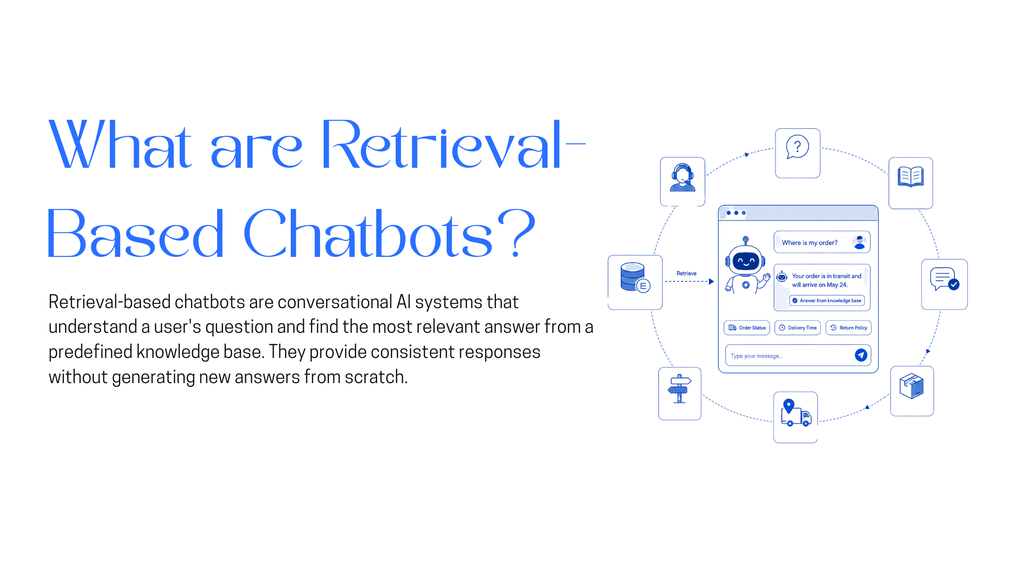
Retrieval-based chatbots are a type of conversational AI system that operate by matching user inputs to a predefined set of responses stored in a knowledge base. They use natural language processing techniques to understand user intents and queries, and then retrieve the most appropriate pre-written response from their database to provide back to the user.
Retrieval-based chatbots rely on a curated knowledge base containing conversational scripts, information, and responses customised to specific use cases and domains. When a user sends a message, the chatbot analyses the input using techniques like pattern matching, keyword identification, and intent recognition to map the user’s query to the most relevant response in its database. The chatbot then returns this pre-written response to the user.
Now, let’s understand Generative Chatbots
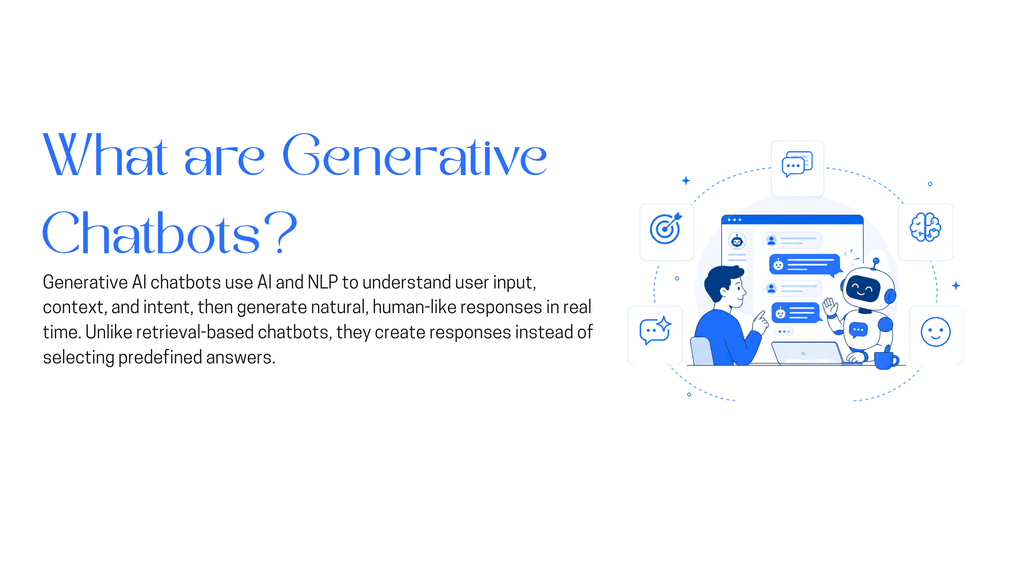
Generative AI chatbots are artificial intelligence-powered and use deep learning and natural language processing (NLP) to generate human-like text responses in natural language during conversations with users. They are designed to understand user input, context, and intent and then generate contextually relevant textual responses.
Generative AI chatbots are trained on vast datasets of text from the internet, books, articles, and other sources. They use natural language processing and deep learning models to process and generate text. When a user sends a message, the chatbot preprocesses and tokenizes the input, breaking it down into smaller units called Tokens. It then uses these tokens to create an initial representation of the user’s message and generates a response by predicting the next words or tokens based on its training data and learned language patterns.
Every limitation on both sides comes down to the same trade-off: control versus range. Retrieval-based systems have complete control over what they say. Generative systems have complete range in how they say it. Neither on its own does both well.
| Factor | Retrieval-Based | Generative | RAG (Hybrid) |
|---|---|---|---|
| Accuracy | High, but only for known questions | Variable, with risk of hallucination | High, grounded in live data |
| Flexibility | Low, breaks on unscripted queries | High, handles open-ended conversation | High |
| Setup Effort | Lower, mostly scripting and mapping | Higher, needs model training and tuning | Higher, needs both a knowledge base and a model |
| Ongoing Cost | Fixed, no per-token fees | Variable, scales with usage | Variable, scales with usage |
| Best Fit | Closed-domain FAQs and high query volume | Open-ended assistance and content generation | Customer support, internal tools, and use cases needing both accuracy and range |
| Main Risk | Sounds robotic on anything off-script | Confidently wrong answers | Still depends on retrieval quality |
Retrieval-based chatbots and generative chatbots are two distinct approaches to building conversational AI systems. While both aim to engage in meaningful interactions with users, they differ in how they generate responses
Retrieval-based chatbots rely on a pre-defined set of responses. They use techniques like keyword matching, machine learning, or deep learning to select the most appropriate response from their database. They are often used in closed-domain scenarios and are good at handling a large volume of requests. However, they may appear less flexible and may struggle with generating dynamic responses.
when dealing with complex or ambiguous queries. They may struggle to understand the user’s intent and provide generic or irrelevant responses. Additionally, they are limited by their pre-defined responses, making them less adaptable to changing needs.
Generative chatbots, on the other hand, create original responses by generating new combinations of language. They are trained on vast datasets and use advanced deep learning and natural language processing techniques. These chatbots can engage in more human-like conversations, handle context, and provide contextually relevant responses. However, they require extensive training data and are more complex to develop and optimise.
Generative chatbots, despite their impressive capabilities, have their own set of issues. They may generate inaccurate or misleading responses, known as “hallucinations or confabulations” They can also exhibit biases and perpetuate harmful stereotypes if not carefully trained and monitored, very resource intensive to train on custom data. Furthermore, generative chatbots require significant computational resources and extensive training data, making them more costly to develop and maintain.
How can businesses address the limitations of retrieval-based chatbots‘ inflexibility and generative chatbots’ potential for inaccuracies and biases, ensuring accurate and most importantly training on your own data?
To address the limitations of both retrieval-based and generative chatbots, businesses can use a hybrid approach called Retrieval-Augmented Generation (RAG). RAG combines the strengths of both retrieval-based and generative chatbots. It enhances the capabilities of generative chatbots by allowing them to access external knowledge bases or databases. By retrieving relevant information from these sources, generative chatbots can provide more accurate, up-to-date, and contextually appropriate responses. RAG improves the quality and relevance of the generated text, making chatbots more reliable and trustworthy. To learn more about RAG Chatbots, you can read (Here)
Retrieval-based chatbots select a response from a fixed set of pre-written answers. Generative chatbots use a language model to create a new response for each query.
Retrieval-based systems are consistent but limited to what has already been written. Generative systems are more flexible, but they can sometimes produce answers that sound correct without being accurate.
Not necessarily. A rule-based chatbot follows fixed if-then logic and generally falls under retrieval-based systems.
The term “AI chatbot” can refer to a retrieval-based system using NLP matching or a generative chatbot powered by a language model, so the label alone does not tell you how the chatbot works.
RAG adds a retrieval step before the generation step. Instead of answering only from the model’s training data, the chatbot first retrieves relevant information from a connected knowledge base and then generates a response using that information.
This helps keep production chatbots grounded in documentation, policies, product information, and other trusted sources instead of relying on the language model alone.
No, but hallucination is a risk with generative models. A language model predicts likely responses rather than automatically checking every answer against a source of truth.
RAG reduces this risk by retrieving relevant information first and giving the model concrete source material to use when generating its response.
For most customer support use cases, a RAG-based chatbot is the better fit. It can understand different ways customers phrase a question while grounding answers in your documentation, policies, and knowledge base.
Retrieval-based chatbots work well when the question set is small and predictable, such as store hours. Pure generative chatbots without retrieval are usually less suitable when factual accuracy matters.
Platforms like YourGPT use this RAG-based approach to build support agents that retrieve information from your help center and knowledge base before generating a response.
When choosing between two types of chatbots retrieval-based and generative it’s important to consider their strengths and weaknesses. Retrieval-based chatbots provide consistent answers and can connect with different systems, but they might struggle with flexibility. Generative chatbots can interact more naturally but may sometimes give incorrect information and require lots of data.
To solve these issues, a hybrid approach called Retrieval-Augmented Generation (RAG) combines the best of both approaches, giving better, more accurate responses. While both approaches have their advantages and disadvantages, when combined, they will be far more effective and solve some of the issues of both approaches, ultimately helping businesses improve customer service and efficiency.
Use the RAG Chatbot for improved customer engagement, accuracy, and efficiency!
Use YourGPT to help Black Friday shoppers choose products, check orders and understand returns. Prepare your answers and team before the sale.

Add in-app chat support to your SaaS or mobile app. Place it on the screens where users stall, pass who they are, and hand hard cases to your team.

Group new-account tickets by onboarding stage, train an AI agent on your docs, and place it in the product where new users get stuck.
AI agents can now find and buy products for shoppers. See what agentic commerce changes for a Shopify store and which support jobs stay yours.
Build a Halloween shopping assistant for Shopify with YourGPT. Set up product recommendations, stock checks, cart actions and human support before launch.

See what a good customer effort score looks like, how to word and calculate CES on each scale, and which support habits raise customer effort.