Top AI Voice Agent Trends in 2026: What’s Shaping the Future of Voice Technology

Rajni
June 29, 2026
AI voice agents have moved past answering questions to resolving real issues and completing tasks across business systems, working from a caller’s intent instead of a fixed script.
Five trends define where the technology stands in 2026: real-time adaptive conversations, emotion-aware responses, full-duplex interaction, multilingual and accent handling, and brand-level voice personalization.
The payoff shows up in operations through higher first-call resolution, lower cost per contact, and global always-on support without scaling headcount.
Success depends less on surface features and more on system design, clear escalation boundaries, and reliable data.
Voice technology is going through its biggest shift since businesses first introduced automated phone systems.
For years, phone automation meant IVR menus, scripted conversations, and bots that could answer only a limited set of questions. They helped reduce call volume, but they struggled when customers interrupted, explained a problem differently, switched languages, or needed the system to perform an actual task instead of reading a predefined response.
Recent advances in large language models, speech recognition, speech synthesis, and business system integrations have changed what voice AI can do. Modern AI voice agents can understand intent, maintain context throughout a conversation, retrieve information from connected systems, and complete actions such as booking appointments, updating account details, checking order status, or creating support tickets while the conversation is still happening.
This changes how businesses evaluate voice technology. The goal is not just to automate calls, but to resolve more customer problems. Metrics such as first-call resolution, handle time, escalation rate, and customer satisfaction now matter more than call containment alone.
The technology is improving fast. Lower latency, stronger language models, multilingual speech processing, emotion detection, and full-duplex interaction are making voice agents better at handling real customer conversations. At the same time, security, compliance, transparency, and clear escalation paths are becoming essential for production use.
This blog covers the top AI voice agent trends shaping 2026 and what they mean for businesses planning to deploy voice AI at scale.
The defining change in this generation is comprehension. Older voice tools recognized words and matched them to a script. The current ones work out what a caller means, read how they say it, and hold the thread across several turns.
Three capabilities have to work together for that to hold up.
Take any one away and the experience slides back toward the old phone-menu feel.
Each of these becomes a working capability further down, so the next section gets into the mechanics. The point to hold onto here is the simple one. A caller no longer has to phrase a request the way the system expects, and that single change is what turns a voice bot from a way to deflect calls into something that resolves them.
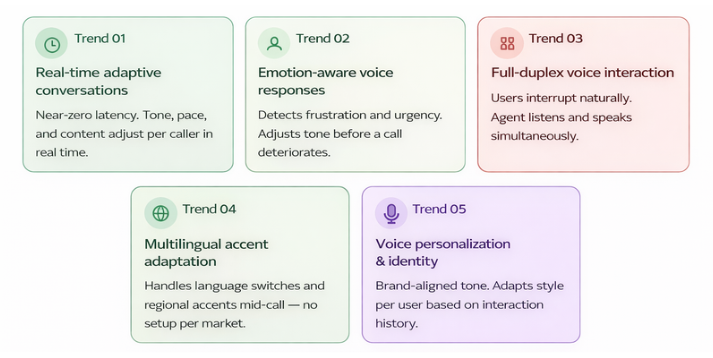
The broad shift toward conversational intelligence is being driven by specific technical and strategic developments. These five trends are the ones that will define how voice AI is built, deployed, and evaluated over the next two to three years.
Conversations break the moment they feel delayed. Even a one- to two-second pause signals to the caller that they are speaking to a system rather than a responsive agent.
Modern voice agents eliminate this gap with near-zero latency, allowing conversations to flow without interruption. The interaction feels continuous instead of segmented into steps.
The deeper shift is adaptability. These systems adjust both delivery and content based on context. Tone, pacing, and phrasing change depending on urgency, prior interactions, and user behavior. A repeat caller continues from where they left off. A confused user receives a clearer explanation. A time-sensitive request gets a direct response.
This reduces effort for the user. Fewer repetitions, fewer corrections, and faster outcomes. For businesses, it leads to shorter handle times, higher completion rates, and more efficient support operations.
A correct answer delivered in the wrong tone still leads to a poor outcome. In voice interactions, emotional context often determines whether the interaction succeeds or fails.
Modern voice agents detect emotional signals through tone, pacing, pauses, and speech patterns. These signals indicate frustration, urgency, or confusion before the issue is fully explained.
The system uses this input to adjust its response strategy. It can acknowledge frustration, slow down explanations, or escalate when emotional intensity increases.
This directly improves outcomes. Many failed interactions are not caused by the problem itself, but by how it is handled. Emotion-aware systems reduce avoidable escalations and improve customer retention, especially in high-value interactions.
Real conversations do not follow rigid turn-taking, but traditional voice systems did. Users had to wait for the system to finish speaking before responding, and interruptions often caused errors or forced restarts.
Full-duplex interaction removes this limitation. Users can interrupt, clarify mid-response, or change direction naturally. The system processes input continuously while generating responses.
This shortens interaction cycles and removes friction. Conversations feel like dialogue instead of a sequence of prompts, which improves both speed and user satisfaction.
Voice systems have historically struggled with language diversity. Performance dropped when users spoke with strong accents, used regional expressions, or switched languages mid-conversation.
Modern voice agents address this with unified multilingual models and real-time adaptation. They handle multiple languages within the same interaction and adjust to regional pronunciation patterns without requiring separate configurations.
Users can switch languages mid-call or speak naturally without modifying how they talk. The system adapts to the speaker rather than enforcing standardization.
For global businesses, this ensures consistent service quality across regions and reduces performance gaps across different user groups.
Voice interactions represent the brand more directly than any other channel. A generic tone weakens that connection, especially when interactions are frequent.
Modern voice agents allow businesses to define tone, style, and delivery to match their brand identity. This creates a consistent experience across all interactions.
Personalization extends to the individual level. Some users prefer concise responses, while others need more detail. The system adjusts based on past interactions and behavior patterns.
This creates continuity across conversations. Users recognize the experience, interactions feel familiar, and trust builds over time. The voice agent becomes a consistent extension of the brand rather than a neutral interface.
The trends shaping voice AI are not incremental improvements. They change how support functions are structured, how teams are staffed, and how customer experience is delivered at scale. The impact shows up across four areas.
Traditional support is built around information gathering. A large share of every call goes to identifying the customer, understanding the issue, and pulling up context before anyone can start solving the actual problem.
Voice AI removes that layer. The agent opens the call already holding prior interactions, account history, and the caller’s intent, so the conversation starts at resolution instead of working its way toward it.
That collapses a multi-step process into a direct one. Issues that used to mean a transfer, an escalation, or a callback get handled in the same interaction.
The gain compounds. Every issue closed on the first call is one that doesn’t come back as a second contact, which pulls down total volume over time. And first-call resolution is one of the tightest predictors of satisfaction and retention there is, so the effect shows up in loyalty, not just in handle time, especially in high-frequency service like banking or telecom.
Cost savings in voice AI usually get framed as machines replacing people. The bigger lever is how the work gets divided.
Instead of treating every interaction the same, operations tier by complexity. AI takes the predictable, high-volume requests at consistent accuracy. Human agents take the edge cases, the exceptions, and anything that needs judgment.
Both sides get sharper. The AI runs without fatigue or drift across thousands of identical calls. Agents stop burning hours on password resets and spend that time on the problems that actually need a person.
The savings are real and measurable. Deloitte’s 2026 service research found that 39 percent of leaders report lower cost per contact after adopting AI, and 43 percent expect AI to cut contact center costs by 30 percent or more within three years. But the quieter win is stability. Staffing gets easier to plan, performance gets more predictable, and complex cases improve because human attention is no longer spread thin across work a machine could have handled.
Customer support has always scaled with headcount. New regions meant new local teams, new time zones to cover, and the standing problem of keeping training consistent across all of them.
Voice AI breaks that link. One system covers interactions across time zones, languages, and regions without a matching jump in staff. Coverage becomes continuous instead of shift-based, and a caller gets the same standard of service at 3 a.m. as at 3 p.m.
That rewrites the economics of expansion. A business can enter a new market without standing up a full support operation on day one, and quality holds because every caller is served by the same underlying system rather than a patchwork of distributed teams at different maturity levels.
In a traditional support setup, feedback is thin and slow. It arrives through sampled call reviews, surveys, and periodic reports, and most of what happens at scale never gets looked at.
Voice AI captures everything. Every call produces structured data on intent, sentiment, response behavior, and outcome, with no sampling and no lag.
That turns reporting into a live feedback loop. Recurring issues surface on their own, friction points show up while they’re still happening, and the effect of a change is visible almost immediately instead of a quarter later.
Over time this moves support from a reactive function to one that adapts. Processes improve against real caller behavior rather than assumptions, and because product, support, and operations are all reading the same data, decisions get made on evidence instead of guesswork.
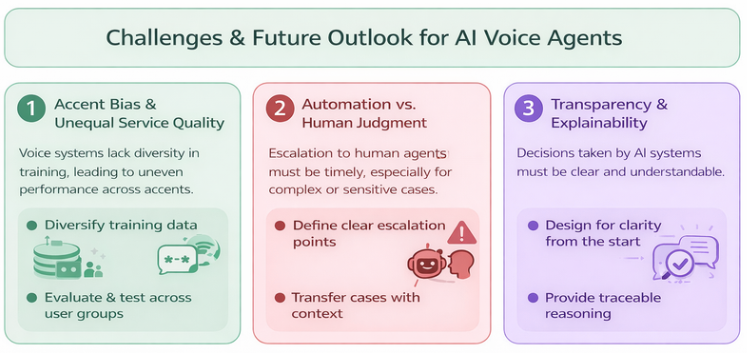
Progress in voice AI has been significant, but the technology is not complete. As adoption scales, limitations become more visible in real-world usage. The challenge is no longer just building capable systems, but ensuring they behave reliably across diverse users and scenarios.
Three areas require focused attention.
Voice systems reflect the data they are trained on. When that data lacks diversity, performance becomes inconsistent across accents, dialects, and speech patterns.
In practice, this leads to uneven experiences. Some users move through interactions smoothly, while others face repeated misunderstandings, longer calls, or unresolved issues.
This is more than an accuracy problem. It directly affects service quality and user trust. Customers who are consistently misunderstood disengage quickly, escalate more often, or avoid the channel altogether.
Addressing this requires continuous effort. Diverse training data, ongoing evaluation across user groups, and real-world testing are necessary to maintain consistent performance. Without this, gaps in experience widen over time.
Automation improves efficiency, but not every interaction should be handled by AI.
The risk is not failure on complex cases. The risk is failing to recognize those cases early. Situations involving financial stress, medical issues, disputes, or emotional sensitivity require human judgment and flexibility.
When escalation thresholds are poorly defined, the system handles these interactions longer than it should, increasing frustration and reducing trust.
Effective systems treat escalation as part of the core design. They define clear thresholds based on intent, sentiment, and risk. When those thresholds are met, the system transfers the interaction with full context, preserving continuity.
The quality of this routing layer often determines whether the overall experience improves or degrades.
As voice agents take on more responsibility, their decisions carry greater impact.
Customers want to understand outcomes. When a request is denied, a call is routed, or an action is taken, the reasoning must be clear.
Opaque systems create friction. Lack of clarity leads to repeated contacts, disputes, and reduced trust, even when decisions are correct.
At the same time, expectations around explainability are increasing, especially in regulated industries. Systems must provide clear, traceable reasoning for decisions that affect users.
In practice, this means designing for clarity from the start. Responses should reference relevant context or policy in simple terms, and decision paths should remain auditable internally. Transparency improves acceptance of outcomes and strengthens long-term trust.
Voice AI is moving from interaction to execution.
The next phase focuses on completing tasks across systems with clear boundaries and accountability.
This introduces new requirements.
Systems must operate within defined guardrails, align with business rules, and remain observable in real time.
An IVR menu makes the caller press numbers to move through a fixed tree, and it breaks the moment their issue does not fit a branch. A voice AI agent works from what the caller says, follows the intent across a full conversation, pulls up their account, and completes the task. The caller can interrupt, change direction, or explain a messy problem without starting over.
Most voice AI is priced per minute of conversation or per resolved interaction rather than per agent seat, so cost scales with usage instead of headcount. The number that matters is cost per contact. Deloitte’s 2026 research found that 39 percent of service leaders report a lower cost per contact after adopting AI, with the actual savings depending on your call volume and how much you automate.
It depends on how deep the integration goes. An agent that only answers common questions can be live in days. One that reads account data and takes actions in your CRM, billing, or order systems takes longer, because the integration and testing are the real work, not the voice model itself.
Modern agents handle several languages in one call and adapt to regional accents, and consumer comfort is rising fast, with PwC reporting that 62 percent of people are now at ease using AI voice agents for routine tasks. Performance still varies by language and accent, so test the system against recordings of your actual callers before launch rather than trusting a generic demo.
A well-built agent hands the call to a human the moment it hits its limit, and passes the full context across so the caller never has to repeat themselves. Set those handoff rules around intent, sentiment, and risk, and route anything involving billing disputes, medical issues, or financial stress to a person early. The quality of that handoff shapes the experience more than the agent’s solo resolution rate.
Voice agents touch account, billing, and personal data, so check the vendor’s encryption, data retention, and where call recordings are stored before you commit. On disclosure, the EU AI Act’s Article 50 takes effect on 2 August 2026 and requires any AI system that talks to people to make clear they are speaking with AI, with audible disclosure for voice. It applies to businesses serving EU customers even from outside the EU, and fines reach €15 million or 3 percent of global turnover, so confirm your setup discloses at the start of the call and check the details with your legal team.
No. Voice AI takes the repetitive, high-volume calls, which frees your team for the complex, sensitive, and high-value work where judgment matters. In practice it changes what your agents spend their day on rather than how many you need, and it tends to cut the burnout that comes from repetitive queries.
Track first-call resolution, average handle time, cost per contact, escalation rate, and customer satisfaction, then compare them against your pre-deployment baseline. The clearest early signal is how many issues the agent closes without a human and without a repeat call. Watch the escalation and repeat-contact numbers in the first weeks, since they expose gaps faster than satisfaction scores do.
Voice AI is becoming useful because it can finally handle the messy parts of real support conversations.
Customers do not call with perfect keywords. They interrupt, explain problems out of order, sound frustrated, switch languages, and expect the business to already know their context. A good voice agent has to manage that and still move the issue forward.
That is why the real test is not whether the agent sounds natural in a demo. The test is whether it can resolve repetitive calls, know when to hand off, and pass the full context to a human when judgment is needed.
Start with call types that have clear outcomes. Connect the right systems, define escalation rules, and measure what changes: first-call resolution, repeat contacts, handle time, and customer satisfaction.
For teams using platforms like YourGPT, this is where voice AI becomes more than a response layer. It becomes part of the support operation, helping resolve more issues without making customers work harder.
YourGPT turns voice interactions into real outcomes, combining conversational intelligence, system integrations, and workflow automation in one platform.
Full access for 7 days · No credit card required
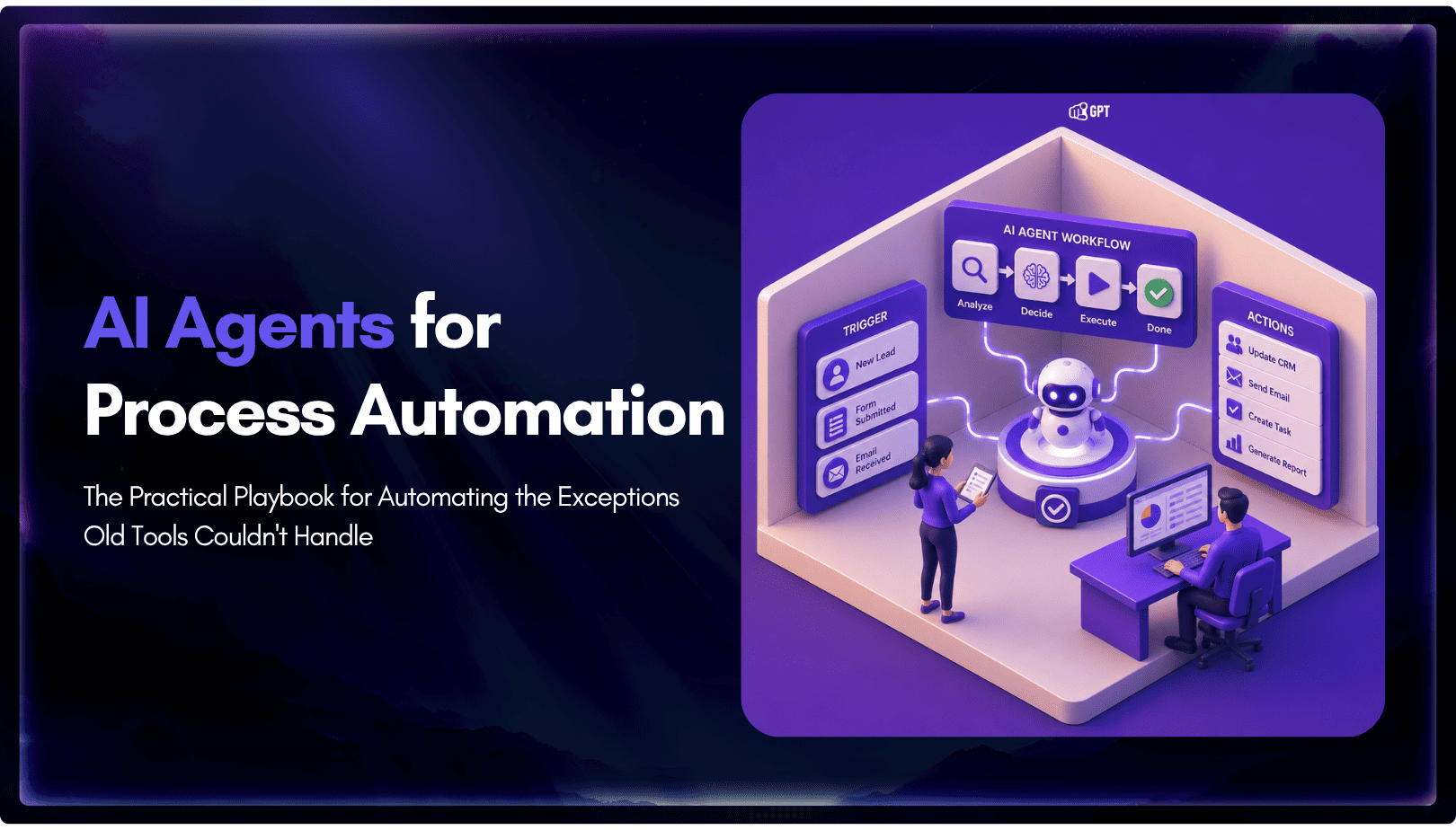
TL;DR Business process automation with AI agents lets software plan multi-step work, call tools, and handle exceptions instead of following fixed scripts like traditional RPA. AI agents can adapt when a process changes, but that flexibility also requires clear permission boundaries, reliable data, and human oversight for consequential actions. Start with one repetitive process, document […]

TL;DR AI web scraping replaces hardcoded selectors with an agent that reads a page, decides what matters, and returns structured output, even after the layout changes. Script-based scraping is being layered with agent-based extraction. Scripts still fetch the page. The model decides what to keep. A fetch layer renders the page, a conversion step strips […]
TL;DR The Shift: Support bots used to answer questions. In 2026, AI agents resolve them by reading live order and carrier data, then taking direct action. They can issue refunds, update addresses, and close WISMO tickets without human involvement. The Stakes: WISMO and refund requests already account for a large share of a typical support […]
TL;DR A customer experience strategy is a documented plan for how people, process, and technology work together across every customer touchpoint, not just a support-team initiative. Strong CX optimization can drive 5 to 10 percent revenue growth and reduce costs by 15 to 25 percent within two to three years, making it an executive-level priority. […]
SaaS companies usually do not hit support overload because the product is failing. They hit it because the product is working. More users mean more onboarding questions, more billing confusion, more integration issues, more feature requests, more account-access problems, and more tickets arriving outside business hours. A small support team that could manage 500 customers […]
TL;DR OpenAI shipped workspace agents inside ChatGPT Business and Enterprise in April 2026, giving the product the ability to plan multi-step work and act inside connected tools. The update narrows the gap between ChatGPT and dedicated AI agents for internal work, but it does not replace customer-facing support platforms. Workspace agents live in the ChatGPT […]