5 Best Certainly.io Alternatives and Competitors in 2026

Rajni
Last updated on September 7, 2026

Certainly.io’s customization, scalability, and integration limits can push growing teams toward alternatives built for deeper automation and more flexible support workflows.
YourGPT leads with action-oriented AI agents that can handle real backend tasks while supporting omnichannel deployment across customer-facing channels.
Landbot and TARS suit teams that prefer structured, rule-based conversation flows for lead generation, while Verloop.io and Haptik fit larger enterprises that need governed, intent-based automation at scale.
Certainly.io is a conversational AI platform that helps businesses automate customer interactions.
However, as businesses grow, some find Certainly.io limited in customization, scalability, and integrations. These challenges lead organizations to explore alternatives that better meet their needs.
This article covers five alternatives to Certainly.io, each with features to address its limitations. These platforms are suitable for startups and enterprises looking to improve efficiency and customer engagement.
Certainly.io works well for e-commerce teams, but several documented limitations lead growing businesses to look elsewhere.
Evaluating alternatives helps businesses find platforms with clearer pricing, broader use-case fit, and less dependency on manual flow maintenance or developer support as needs grow.
| Platform | Best For | Pricing | Main Limitation |
|---|---|---|---|
| 1. YourGPT AI | No-code AI agents, customer support automation, backend actions, and omnichannel deployment | Essential $39/month. Professional $79. Advanced $349 when billed annually. Enterprise custom. | Advanced workflows, API support, and higher usage limits require paid tiers |
| 2. Landbot | Visual no-code conversation flows, lead generation, and structured customer journeys | Free plan available. Starter €32/month and Professional €80/month when billed annually. Business custom. | WhatsApp and more advanced integrations require higher plans or additional fees |
| 3. TARS | Lead generation, structured conversational experiences, and customer-service automation | Freemium $0 for 50 conversations/month. Premium starts at $499/month. Enterprise custom. | Premium pricing is relatively high for smaller teams, with some capabilities sold as add-ons |
| 4. Verloop.io | Large support teams needing omnichannel AI, multilingual automation, chat, and voice | Enterprise-focused pricing based on requirements and usage; contact sales for a quote. | Enterprise orientation and custom pricing make it less straightforward for smaller teams |
| 5. Haptik | Large enterprises needing governed conversational AI across customer service and operations | Custom enterprise pricing based on deployment requirements; contact sales. | Enterprise-focused implementation can be heavier than simpler no-code chatbot platforms |
Explore these alternatives based on features, pricing, user interface, customer support, integrations, and unique advantages to find the best fit for your business needs.

YourGPT is an AI-first platform designed to build and run autonomous AI agents across customer support, sales, and internal operations. Instead of relying on tickets or agent-led workflows, it enables AI to handle conversations end to end, answering questions, taking actions, and triggering workflows within a single interaction.
The platform is built to reduce manual effort and scale support without increasing headcount, making it suitable for teams moving beyond basic chatbot or assistive AI use cases.
Frequent product updates mean features and interfaces may evolve quickly over time.
YourGPT AI Chatbot offers a comprehensive AI-driven solution for customer support. Its no-code approach, multilingual capabilities, and extensive integration options make it a versatile choice for businesses of all sizes.
Discover how YourGPT AI chatbot can streamline your customer service

Landbot is a no-code chatbot platform focused on building conversational experiences using visual flow builders. It is commonly used for lead generation, surveys, onboarding, and simple customer interactions where structured conversations are required.
The platform emphasizes design control and conversational UI, making it popular with marketing and growth teams rather than support teams looking for deep automation or backend execution.
Landbot is ideal for businesses looking for a simple yet effective chatbot solution. Its intuitive design and multi-channel capabilities make it an accessible choice for small to mid-sized companies.

TARS is a conversational chatbot platform built around guided, decision-tree–based conversations. It is commonly used for lead qualification, customer routing, and basic support automation where conversations follow a predefined path.
The platform focuses on replacing static landing pages and forms with interactive chat experiences. It works best for use cases where flows are predictable and outcomes are clearly defined.
TARS is a versatile chatbot platform suitable for businesses focusing on lead generation and improving customer experiences. Its industry-specific templates and ease of use make it a practical choice for various sectors.

Verloop is an enterprise-focused conversational AI platform designed to automate customer support and internal service workflows at scale. It is commonly used by large organizations to handle high conversation volumes across messaging channels with a strong emphasis on process consistency and operational control.
The platform is built around structured automation, intent handling, and agent handoff, making it suitable for enterprises that need AI-driven support while maintaining governance and standardized workflows.
Verloop.io is well-suited for businesses looking to automate customer support and streamline operations. Its omnichannel capabilities and AI-driven features cater to companies of all sizes.

Haptik is an enterprise conversational AI platform focused on automating customer support, commerce, and service workflows at scale. It is widely used by large consumer-facing businesses, especially in high-volume environments such as telecom, banking, eCommerce, and on-demand services.
The platform is built to handle structured automation across messaging channels, with a strong emphasis on intent management, process-driven flows, and human handoff for complex cases.
Haptik stands out as a robust conversational AI platform, especially for businesses in need of scalable, industry-specific solutions. Its advanced AI capabilities and omnichannel support make it a powerful tool for enhancing customer engagement.
Here’s a quick comparison of all 5 Certainly alternatives:
| Platform | Best For | Main Strength | AI & Automation | Omnichannel Fit | Main Limitation |
|---|---|---|---|---|---|
| 1. YourGPT AI | Teams needing AI-first support, sales automation, and action-oriented agents | No-code AI agents that can answer questions and execute backend business actions | Multi-step workflows, API calls, code execution, knowledge grounding, and automated handoff | Strong across web chat, WhatsApp, Messenger, Instagram, voice, and other messaging channels | Advanced workflows and higher automation capacity require paid plans |
| 2. Landbot | Marketing, lead generation, and structured conversational experiences | Visual no-code builder for creating rule-based chatbot flows quickly | Conditional logic, lead capture flows, integrations, and conversational automation | Good for web and WhatsApp-based conversational journeys | Better suited to structured flows than complex autonomous AI workflows |
| 3. TARS | Lead generation, customer acquisition, and guided support conversations | Easy-to-build conversational funnels designed around conversion-focused journeys | Rule-based conversational flows, lead qualification, routing, and form-style automation | Primarily suited to web-based conversational experiences and campaign workflows | Less suitable for teams needing deep AI reasoning or complex backend automation |
| 4. Verloop.io | Large support teams needing governed AI automation across multiple channels | Enterprise-oriented conversational AI with strong support automation and routing | Intent-based automation, multilingual support, routing, AI agents, and human escalation | Strong across web chat, WhatsApp, messaging channels, and voice-oriented deployments | Enterprise focus and custom implementation may be excessive for smaller support teams |
| 5. Haptik | Large enterprises needing conversational AI for support, marketing, and operations | Enterprise-grade conversational automation with governance and large-scale deployment support | Generative AI, intent-based automation, workflow orchestration, and enterprise integrations | Strong across messaging, web, mobile, and large customer-service deployments | Heavier implementation and enterprise orientation make it less practical for smaller teams |
Assessing alternatives to Certainly.io comes down to a few concrete factors, not a generic feature checklist.
Focusing on these factors helps businesses identify alternatives that fit their actual use case, technical capacity, and budget, rather than the platform with the longest feature list.
Certainly.io’s visual flow builder requires real manual effort to maintain as conversation paths grow, and independent reviews note some functionality feels more like a workaround than a polished feature. The platform is also built specifically for e-commerce, so businesses running general support outside a storefront context tend to outgrow its structure, and pricing isn’t published upfront.
YourGPT trains directly on a business’s own website, documents, and help center content, and its AI Studio lets agents take real backend actions, such as fetching account details or triggering a workflow, instead of following a fixed conversation path. It also covers support, sales, and operations from one platform, extending beyond e-commerce-specific conversations.
Certainly.io’s templates are tuned for order tracking, sizing, and returns. Teams running B2B or general support looking for a platform built around a broader use case, such as YourGPT, tend to find a better fit than a commerce-specific tool.
Landbot and TARS both use visual, decision-tree flow builders designed for lead qualification, forms, and guided conversations, which suits marketing and growth teams more than teams needing AI-led issue resolution.
Verloop.io and Haptik are both built around structured, intent-based automation with strong human handoff, making them a fit for large organizations that need standardized workflows and process consistency across high conversation volumes.
Landbot, TARS, Verloop.io, and Haptik rely mainly on predefined intents and decision-tree flows, so new conversation paths generally need manual setup. AI agent platforms reason through the conversation directly and can take backend action without every scenario being pre-built into a flow.
Pricing transparency varies across this list. YourGPT and TARS both publish plan pricing directly on their sites, while Certainly.io, Verloop.io, and Haptik require a sales conversation to get an exact quote.
Certainly.io handles e-commerce conversations well, but growing support and sales operations often need more than a flow builder tuned for order tracking and returns. Landbot and TARS fit teams that want guided, rule-based conversations for lead generation and forms. Verloop.io and Haptik suit large enterprises that need governed, intent-based automation at scale.
YourGPT fits teams ready to move past scripted flows, with AI agents that reason through a conversation and take real backend action across support, sales, and operations from one platform. Matching the choice to actual conversation volume and use case matters more than picking the platform with the longest feature list.
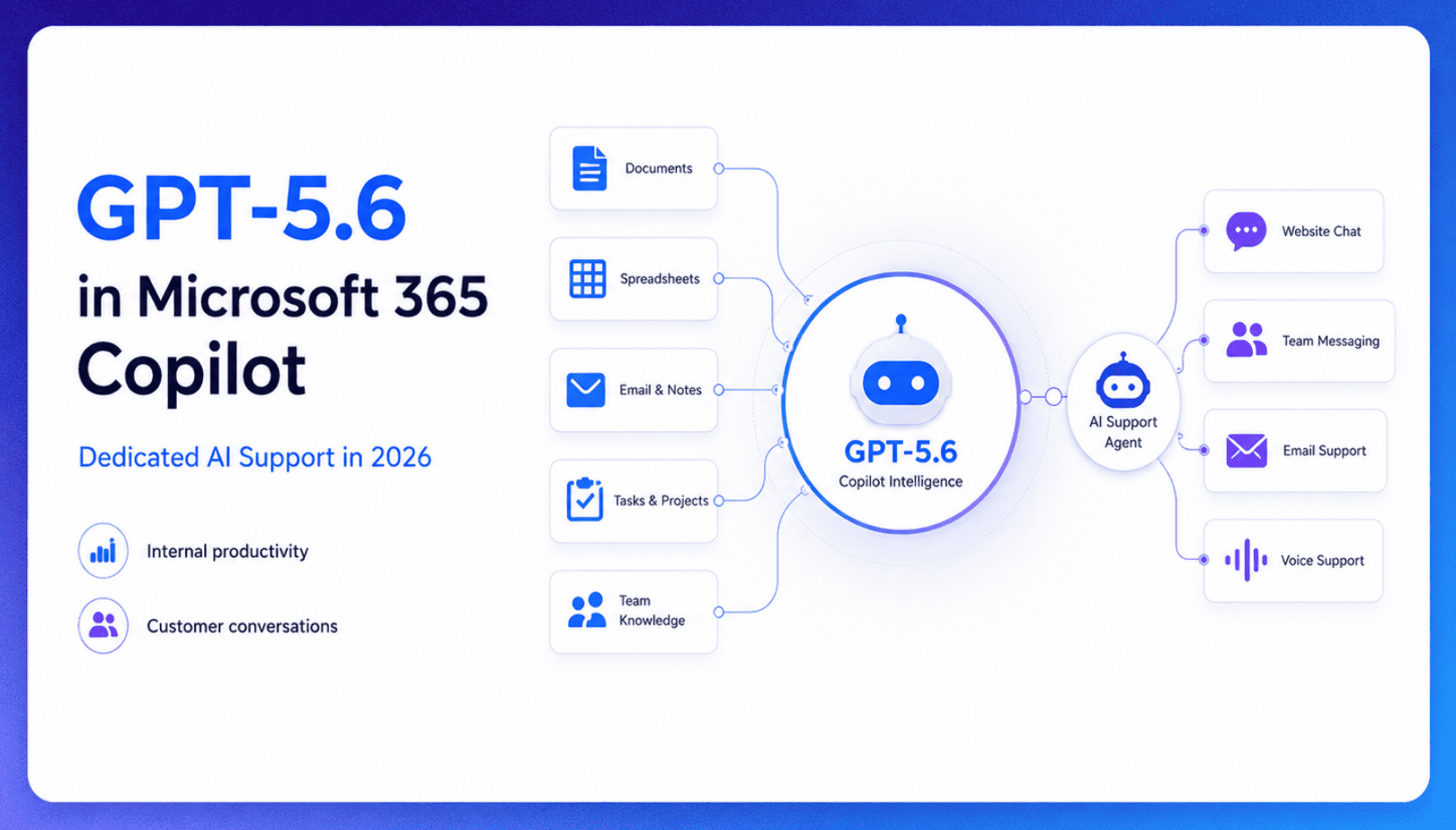
TL;DR Microsoft made GPT-5.6 the preferred model across Word, Excel, PowerPoint, Copilot Chat, and Cowork on July 9, 2026, focusing on internal workplace productivity rather than customer-facing support. Dynamics 365 Service Agent also reached general availability, but it mainly helps human support representatives manage cases within Microsoft’s existing permission structure and requires separate licensing. A […]

TL;DR Cheap frontier models now compete for the same high-volume support workloads, with DeepSeek V4 remaining the lowest-cost option in this comparison. Kimi K2.6 and GLM-5.2 are open-weight and self-hostable, while Qwen 3.7 Plus is proprietary and available only through an API. Claude Haiku 4.5 is the only model here that its developer explicitly recommends […]
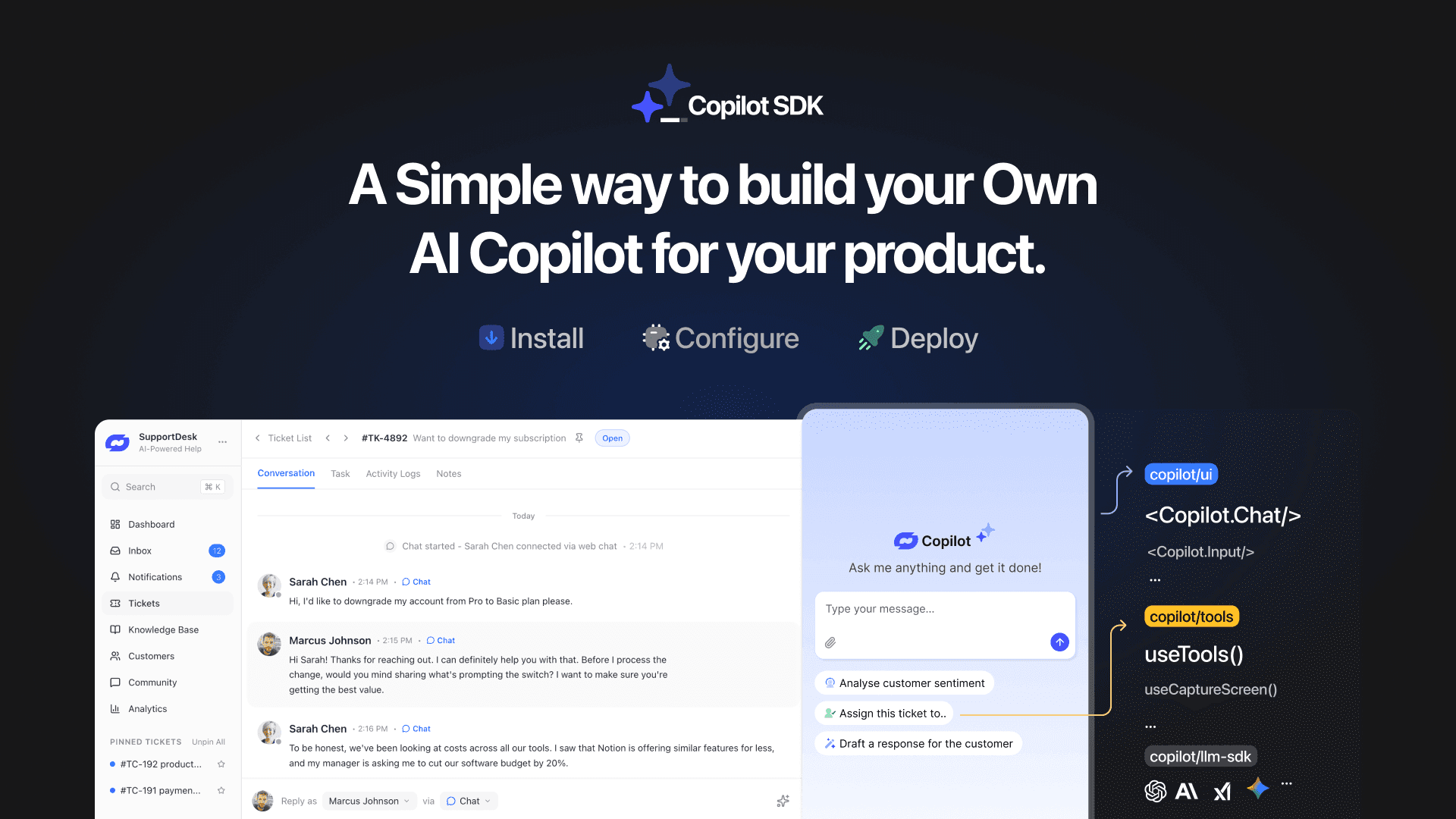
TL;DR YourGPT Copilot SDK is an open-source SDK for building AI agents that understand your application state, user context, and what is happening inside your product. Instead of working like isolated chat widgets, these agents connect directly with your product and can take real actions within existing workflows. This helps teams build contextual AI experiences […]
TL;DR YourGPT 2.0 adds AI Studio for building, testing, and debugging automated workflows. It includes native MCP integration for more than 100 tools, upgraded voice agents, and native SDKs for iOS and Android applications. With shared context across web, WhatsApp, Instagram, Telegram, and mobile, YourGPT turns conversations into real actions across support, sales, and operations. […]

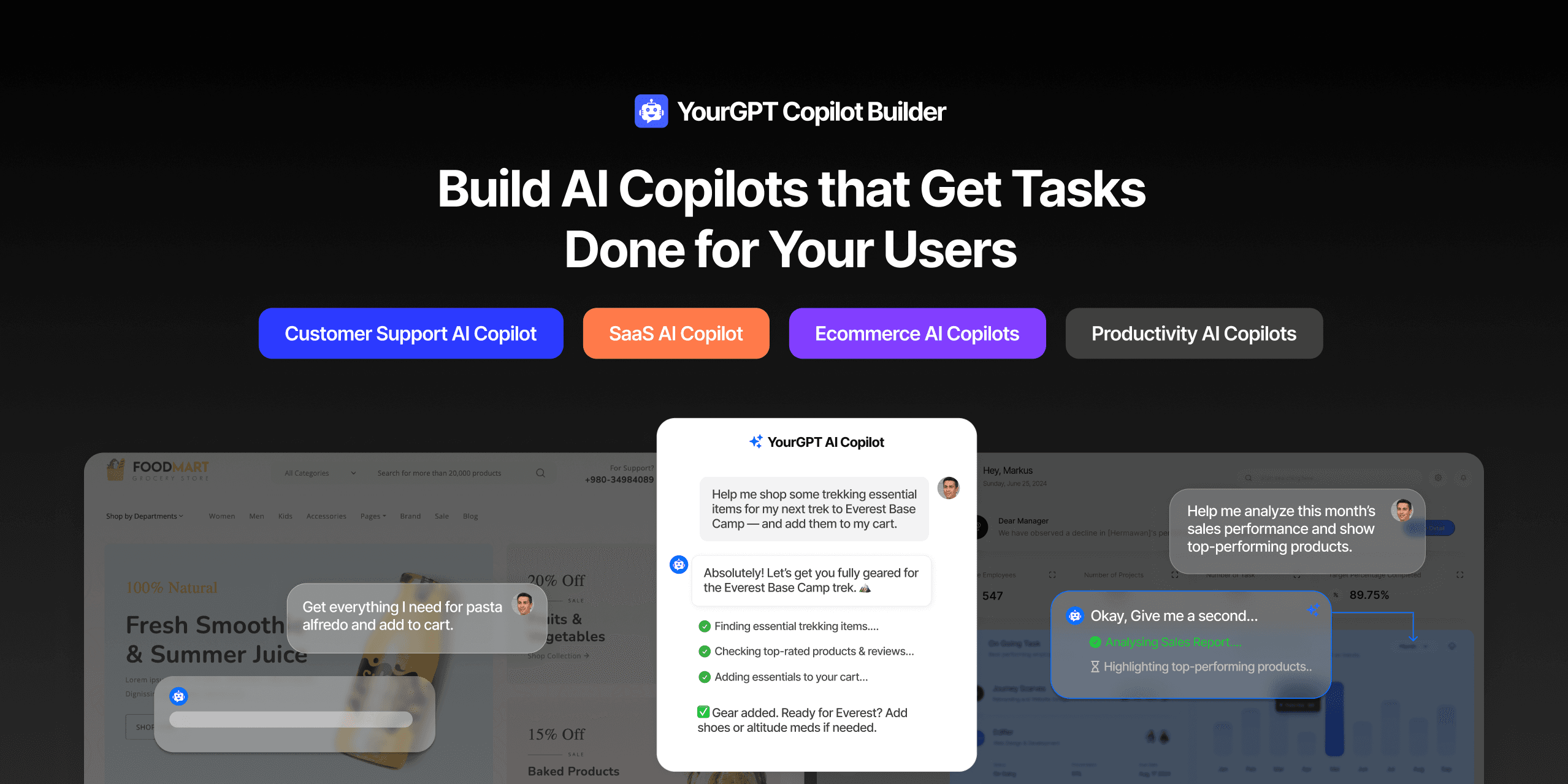
TL;DR Most AI tools provide answers but still leave users to complete the task through search results, settings pages, or checkout flows. AI Copilot Builder closes that gap by executing registered actions directly inside the product instead of only explaining what to do. Search, cart updates, account changes, and multi-step bookings can all happen within […]
TL;DR Building an AI-powered Telegram bot does not require custom development. BotFather provides the Telegram bot token, while a no-code platform like YourGPT handles AI training, free-form conversations, and the Telegram connection. This guide covers the full setup, from creating the bot in BotFather to connecting it with YourGPT and taking it live. Most Telegram […]
