Agentic AI in Customer Support: What It Means for Businesses

Rajni
Last updated on May 6, 2026
Agentic AI in customer support refers to autonomous AI systems that understands a customer’s intent, build the required service workflow, and execute actions across connected enterprise systems to deliver a completed resolution within a single interaction. Unlike chatbots that generate answers and route tickets, agentic AI acts: the refund is issued, the subscription is changed, the appointment is rescheduled, without human handoff.
Customer support leaders are dealing with a difficult mix of constraints.
Support volume keeps rising across chat, email, social messaging, and in-product experiences. The work itself has become more complex because products are connected to billing systems, subscription platforms, shipping partners, identity providers, and third-party integrations. Customers also expect faster resolution with less effort. They want the issue fixed during the interaction, not explained and handed back to them.
Most teams already tried automation. They built chatbots, published knowledge bases, and added generative AI features to help agents answer faster. These changes help, but they often leave the hardest part untouched.
The customer still needs the action to happen.
A customer asking for a refund does not want a policy summary. A subscriber asking to change plans does not want a list of steps. A user rescheduling an appointment does not want a phone transfer. In all these cases, response-based AI can be helpful, but it still ends by sending the customer to a form, a queue, or a human.
Agentic AI is designed to close this gap. It turns customer support from “answer and route” into “understand and complete.”
This blog explains what agentic AI is in customer support, how it operates inside a real service stack, what technical foundations make it reliable, where it creates the most value, and what risks teams must address to run it safely in production.
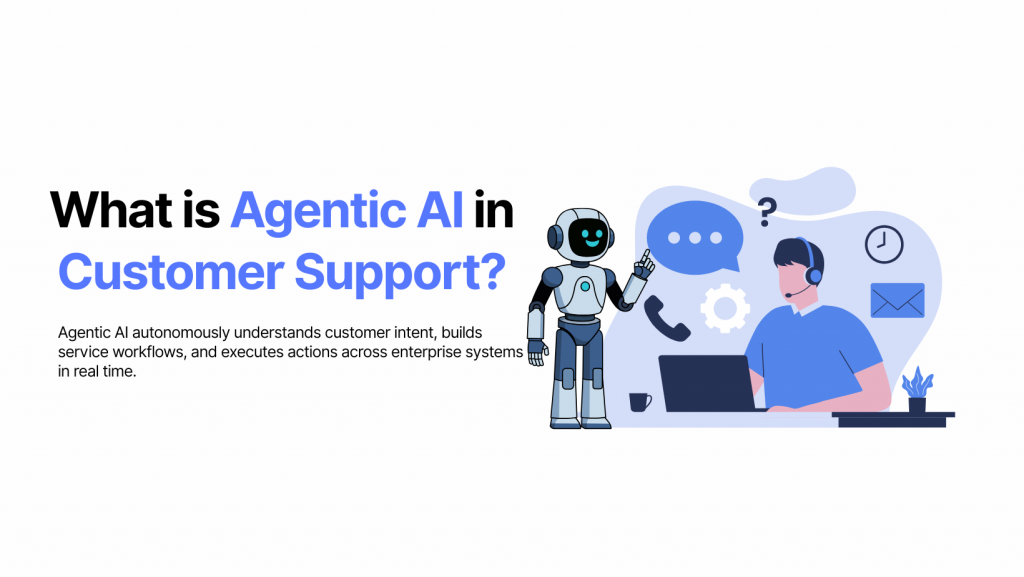
Agentic AI in customer support refers to autonomous AI systems that interpret a customer’s objective, plan the required service workflow, and execute actions across enterprise systems to deliver a completed resolution within the same interaction.
Traditional chatbots and generative AI tools focus on answers. They retrieve information, explain policy, and guide the next step. The work itself still lands in a queue, a form, or an agent’s hands.
Agentic AI orchestrates the underlying service operations required to complete the request.
When a customer asks for a refund, subscription change, address update, or appointment reschedule, the system can check the relevant conditions, follow the service rules, make the update in the connected system, and confirm the outcome in the same interaction.
Support teams deal with more than answering questions. Most of the operational load comes after the conversation: checking eligibility, applying policy, updating records, and completing the request correctly across multiple systems.
This is what gives agentic AI value in customer support. It connects the conversation to the operational steps behind it and carries structured requests through to completion within defined limits.
Agentic AI in customer support only works when the system can identify the request, check the relevant business context, carry out the allowed action, and record what it did. Without that foundation, automation breaks down quickly. A model may produce a confident answer, but confidence does not verify refund eligibility, protect account access, or apply policy consistently.
That is why agentic support systems depend on a few core layers. Each one supports a different part of the workflow.
Large language models are not trained on your company’s return policies, pricing structures, escalation logic, or service procedures. To operate reliably in customer support, they need controlled access to verified business knowledge.
This is where Retrieval-Augmented Generation (RAG) comes in. It gives the system access to approved business knowledge at the moment the request is being handled, so the model can pull the relevant policy, procedure, or service rule before it replies or takes action.
This layer has to do more than fetch documents. It has to surface the right source for the case in front of it.
That may depend on the customer’s plan, product, region, contract status, issue type, or service history.
Once the AI begins taking action, traceability also becomes important. If a refund, entitlement update, or account change depends on a specific rule, the system should be able to show which source guided that action.
Support requests depend on more than policy. The outcome changes based on the customer, their account history, their entitlements, and the conditions tied to that case.
Agentic AI needs access to that context before it can make decisions or complete actions. The system has to evaluate account status, transaction history, contract terms, verification state, geography, service history, and other workflow-specific inputs. Two customers can submit the same request and still require different outcomes because the surrounding context is different.
This layer also carries security and access controls. The system should retrieve and act only on data that the user, agent, or workflow is permitted to access. That includes role-based permissions, account restrictions, and compliance requirements tied to region or industry. Without those controls, the AI can surface the wrong information or trigger actions it should never have access to.
Autonomy without structured logic creates liability.
Production-ready agentic AI operates within defined business rules. These include:
If certainty falls below a defined level, the system escalates the case.
The AI executes within policy. It does not redefine policy.
Clear boundaries preserve operational control while increasing efficiency.
Agentic AI only becomes operational when it can work across the systems where support tasks actually happen. That usually includes the CRM, billing platform, order system, subscription stack, scheduling tool, identity layer, and internal knowledge base.
The system needs reliable ways to read data, make updates, trigger actions, record outcomes, and pass the case forward when required. That is why integrations matter. They let the AI move beyond answering and into execution.
This layer also determines how well the system improves over time. Teams need to see where workflows fail, where escalations increase, which actions require reversal, and which requests still need manual handling. Those signals help refine the logic, tighten the controls, and expand automation carefully instead of rebuilding the whole stack every time a process changes.
Customer support used to be measured by how fast someone replied. It is now measured by how fast the issue is resolved.
Most organizations still separate conversation from execution. A customer explains a problem, receives guidance, and then waits while someone processes the actual change. That gap increases effort, delays resolution, and raises operating cost.
Agentic AI closes that gap. In 2026, several structural pressures make this capability essential.
Digital business models generate recurring service activity. Subscription billing cycles, usage adjustments, feature releases, integrations, and compliance requirements all increase support touchpoints. Each product change creates new workflow scenarios that require validation and system updates.
Expanding headcount to absorb this growth introduces higher payroll cost, longer onboarding cycles, and operational complexity. Margins compress as interaction volume rises.
Agentic AI absorbs structured, repeatable workflows without increasing staffing proportionally. This shifts support from a linear cost model to a more controlled operating structure.
Customers measure support quality by how much effort they expend to solve a problem. Repeating information, switching channels, waiting for approvals, or filling additional forms increases friction.
In subscription businesses, friction affects renewal decisions. When resolution requires multiple steps, customers perceive the brand as difficult to work with.
Agentic AI reduces effort by executing the transaction within the conversation. Fewer steps and faster completion directly influence retention and lifetime value.
Knowledge bases and conversational assistants improve information access. They explain policies and provide instructions. They do not execute billing adjustments, entitlement changes, or shipment replacements.
The moment a workflow touches a core operational system, manual intervention typically begins. This creates delay and increases the likelihood of repeat contacts.
Agentic AI connects conversational intent to system-level execution under defined governance rules. It removes the separation between explanation and operation.
Each additional interaction adds cost. Repeat contacts increase average handling time and escalate queue pressure. Small inefficiencies multiply across thousands of cases.
First-contact resolution stabilizes support economics. When high-volume workflows such as refunds, plan modifications, address updates, and appointment changes are resolved in one interaction, downstream workload decreases.
Agentic AI improves resolution efficiency by completing structured workflows immediately, reducing escalation and backlog growth.
Support agents often spend a significant portion of their day performing structured system updates. These tasks require accuracy but limited strategic judgment.
When experienced agents focus on transactional updates, their availability for escalations and complex cases decreases. This slows resolution in situations that require nuance.
Agentic AI reallocates repetitive execution to automation while preserving human oversight for ambiguity and sensitive decisions. Workforce capacity is used more effectively without compromising control.
Customers compare service experiences across industries. When one organization resolves issues immediately and another requires multiple handoffs, the difference is noticeable.
Execution speed influences perception of reliability. Faster completion reduces uncertainty and builds trust.
Agentic AI enables consistent, outcome-based resolution across structured service categories. This consistency supports retention and brand positioning.
Human processing introduces variability. Two agents may interpret refund eligibility or subscription rules differently. Inconsistent outcomes create audit exposure and customer dissatisfaction.
Agentic systems apply policy logic uniformly. Validation checks, decision paths, and system updates are logged automatically.
This improves governance discipline while maintaining operational efficiency.n and improved lifetime value.
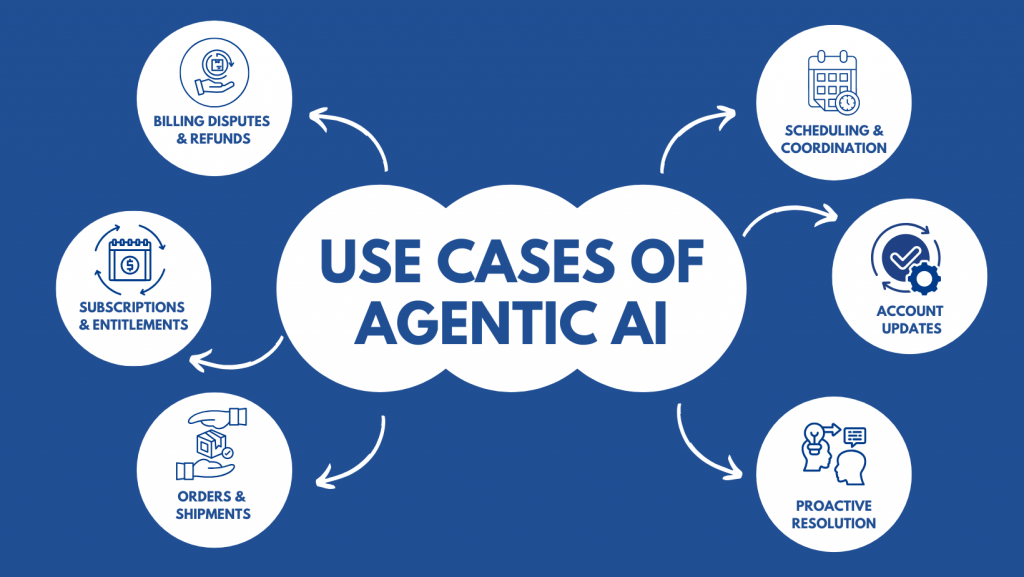
Agentic AI delivers the most value in service scenarios that combine three characteristics: high volume, structured rules, and system-level execution. These workflows consume a large share of support capacity while requiring consistent policy enforcement.
In these environments, AI agents can execute predefined actions directly within business systems rather than stopping at response generation. This makes them particularly effective for transactional support cases where consistency and accuracy matter.
Billing-related issues are among the most frequent drivers of support tickets. Disputed charges, duplicate payments, proration questions, and refund eligibility reviews require agents to cross-check invoices, payment history, contract terms, and internal policies.
Agentic AI automates this validation sequence. It retrieves transaction records, evaluates eligibility under refund rules, applies credits when permitted, logs the adjustment, and confirms the outcome.
This reduces resolution time and eliminates repeat contacts caused by delayed manual processing.
Subscription businesses face constant requests for upgrades, downgrades, renewals, and cancellations. These changes often require billing recalculations, feature entitlement updates, and contract validation.
An agentic system sequences these actions in one interaction. It calculates proration, applies changes to the subscription system, updates CRM records, adjusts feature access, and issues confirmation.
This prevents mismatched entitlements and reduces escalation risk.
Ecommerce and logistics-heavy businesses experience high volumes of “Where is my order?” inquiries, address updates, delivery exceptions, and lost shipment claims.
Agentic AI integrates with order systems and carrier data to:
The interaction concludes when the replacement or correction is confirmed, not when instructions are provided.
Healthcare, field services, and consultation-based businesses rely on scheduling accuracy. Rescheduling, cancellations, and availability checks require coordination across calendars and authorization systems.
Agentic AI validates eligibility, checks real-time availability, updates scheduling infrastructure, and sends updated instructions in a single workflow.
This reduces administrative overhead and missed appointments.
Routine account modifications such as address updates, payment method changes, profile corrections, and credential resets generate recurring demand.
Agentic AI performs identity validation, applies the requested changes inside account systems, confirms the update, and records the action for audit.
These high-volume requests no longer require human processing unless anomalies are detected.
The highest leverage use cases occur before a customer initiates contact. This is the foundation of proactive customer service solving problems before they become tickets.
Agentic AI monitors operational signals such as failed payment attempts, shipment delays, subscription renewal conflicts, or service outages. These signals act as triggers tied to predefined workflows.
When conditions are met, the system automatically initiates corrective actions and notifies the customer with relevant updates.
This shifts support from reactive responses to preventative operations, reducing inbound volume while increasing customer trust.
Agentic AI changes support economics at the workflow level. Its impact shows up in measurable operational metrics rather than abstract experience improvements.
Structured workflows such as refunds, subscription adjustments, shipment replacements, and account updates often require agents to move across multiple systems.
Each system interaction increases handling time and creates delays.
When these workflows are executed autonomously, system navigation is removed from human workload. Resolution occurs immediately within policy boundaries, reducing average handling time across high-volume categories.
Repeat interactions inflate cost and increase queue pressure. Many cases require follow-up because execution is separated from the initial conversation. This separation directly reduces First-Contact Resolution (FCR) rates.
Agentic AI closes that gap by completing transactional workflows within the same interaction. Instead of escalating or creating additional tickets, the system executes actions immediately.
When outcomes are finalized during the initial exchange, first-contact resolution improves, repeat contacts decline, and backlog growth stabilizes.
Support cost scales with labor intensity. As interaction volume grows, operating expenses rise proportionally when execution remains manual.
By automating structured, high-volume workflows, organizations reduce the marginal cost of each additional interaction. Cost growth becomes more controlled even as demand increases.
Highly trained agents often spend substantial time performing repetitive updates inside internal tools.
Agentic AI absorbs rule-based execution, allowing human agents to focus on escalations, edge cases, exception handling, and sensitive situations.
This improves capacity allocation without reducing service coverage.
Manual processing introduces variability and delay. Cases escalate due to incomplete updates, inconsistent policy interpretation, or slow execution.
Autonomous workflows apply policy logic consistently and complete structured actions immediately. Escalations that do occur include documented reasoning and system history, reducing rework.
When high-volume workflows are automated under defined rules, case resolution becomes more predictable.
Queue fluctuations stabilize, handling time variance decreases, and staffing forecasts become more accurate. Predictability improves planning discipline and financial visibility.
Manual workflows rely on individual interpretation of policy. This creates variability and audit exposure.
Agentic systems log validation checks, rule application, system updates, and timestamps automatically. This strengthens governance while reducing the operational burden of compliance reporting.
Agentic AI can improve support efficiency because it does more than answer questions. It can take action across billing systems, CRMs, subscription platforms, and operational tools. That is exactly why governance matters.
The moment an AI system can issue a refund, update an account, change a subscription, or trigger a replacement, the real question is no longer whether it sounds helpful. The real question is whether it can act within clear business boundaries, with reliable data, and with full accountability.
Not every support interaction should be automated.
Agentic AI performs best in workflows that are structured, repeatable, and policy-bound. Refunds under a fixed threshold, address updates with identity checks, appointment rescheduling, and plan changes are strong candidates. Cases involving negotiation, unclear intent, legal risk, or emotional sensitivity are not.
The goal is not to automate everything. The goal is to automate the kinds of work where consistency, speed, and policy execution matter most. Clear scope prevents teams from giving autonomous systems authority in situations that still require human judgment.
Autonomous systems are only as reliable as the systems they depend on.
If customer records are outdated, entitlements are misaligned, shipment data is incomplete, or billing history is inconsistent, the AI will not solve the workflow correctly. It will scale the underlying operational problem. In practice, that means poor data can turn automation from an efficiency layer into a source of repeated errors.
Before expanding execution authority, businesses need confidence in the quality of the data flowing across CRM, billing, subscription, identity, and order systems. Reliable automation starts with reliable operational infrastructure.
Support decisions often look simple on the surface but rely on layered business rules underneath.
Refund eligibility may vary by geography, contract type, payment method, customer tier, product category, promotional terms, or timing. The same applies to credits, cancellations, renewals, replacements, and account changes. If those conditions are not clearly modeled, the system will behave inconsistently across similar cases.
Agentic AI works well when policy is converted into explicit operational logic. That means the system knows what is allowed, when exceptions apply, and when it must stop and escalate. Strong policy modeling is what turns automation into something predictable instead of something risky.
The moment AI can affect revenue, credits, refunds, or billing adjustments, financial controls become non-negotiable.
Routine cases can often be resolved autonomously, but only within predefined authority levels. Refund caps, approval thresholds, exception triggers, and fraud checks should all be built into the workflow. When those boundaries are crossed, the case should move to a human with the relevant context already attached.
This preserves efficiency where the decision is straightforward while protecting the business in cases where exposure is higher.
Good escalation does not restart the case. It continues it.
When agentic AI reaches a limit, whether because confidence is low, policy is unclear, or the case falls outside scope, the next human should not have to reconstruct the interaction from scratch. They should see what the customer asked for, what the system checked, what actions were attempted, what rules were applied, and why escalation happened.
This continuity matters operationally. It reduces rework, shortens handling time, and creates a smoother customer experience at the exact point where frustration usually increases.
Once AI begins executing transactional workflows, traceability becomes essential.
Teams need a reliable record of what the system validated, what decision path it followed, what action it took, what systems were updated, and when those changes occurred. Without that visibility, governance weakens quickly, especially in regulated or high-volume environments.
Detailed logging supports compliance, simplifies internal review, and makes it easier to identify failure patterns before they spread. In agentic support systems, auditability is not a reporting feature added later. It is part of the operating model.
Agentic AI does not just change tooling. It changes the shape of support work.
As repetitive execution moves to automation, support teams spend more time on exceptions, escalations, edge cases, and customer situations that require judgment. That shift can improve team leverage significantly, but only if people understand how the system works, where its boundaries are, and when they are expected to intervene.
Organizations that roll out agentic AI successfully treat this as a workflow transition, not just a technology deployment. Clear training, role clarity, and strong internal trust are what turn automation into operational progress.
The value of agentic AI does not come from how much authority it has. It comes from how well that authority is designed.
When scope is clear, data is reliable, policy logic is explicit, financial controls are enforced, escalations are structured, and every action is traceable, autonomous support becomes far more than a productivity feature. It becomes a dependable execution layer inside customer operations.
That is the difference between an AI system that creates risk and one that creates real operational advantage.
Agentic AI closes the gap between conversation and completion. Instead of only explaining policies or steps, it plans workflows and executes actions across connected systems so the customer request ends with a completed outcome.
Start with high-volume, repeatable, policy-bound workflows such as subscription changes, address updates with identity checks, refunds under a defined limit, and shipment replacements triggered by carrier status.
Escalation should occur when policy thresholds are exceeded or system confidence is low. Examples include high-value refunds, fraud signals, contract exceptions, unclear identity, or missing system data.
Workflow chatbots follow predefined scripts. Agentic AI interprets intent against system state, selects appropriate steps dynamically, and executes across enterprise systems like a digital service operator.
Reliable automation requires accurate access to customer profiles, entitlements, subscription status, billing history, order records, shipment data, and policy logic. Poor data quality can scale inconsistencies.
Control autonomy through refund caps, policy rule checks, identity validation, fraud detection, mandatory escalation thresholds, and detailed logging for audits and reviews.
Track outcome-based metrics such as first-contact resolution, average handling time, escalation rates, repeat contact rate, and automated action error or rollback rates.
In most operations, agentic AI shifts routine execution to automation while human agents focus on exceptions, complex decisions, and sensitive cases.
Look for secure system integrations, governance controls such as thresholds and audit logs, and strong retrieval and grounding to ensure decisions follow approved policies and context.
YourGPT enables outcome-driven support automation by combining approved knowledge responses with workflow execution through integrations, including built-in controls for escalation and human handoff.
Customer support currently demands execution over explanation. As software environments grow complex, the gap between a user asking for help and the system completing the task creates heavy operational drag. Agentic AI attacks this inefficiency directly by tying customer intent to system-level commands. It moves beyond conversational sympathy to execute tasks within defined rules.
YourGPT structures this process. The platform connects autonomous agents with core business software (while keeping strict governance) to carry out the required work.
Leaders evaluating these systems must prioritize practical steps. Target high-volume workflows, define clear authority limits, and maintain absolute data reliability. A lasting service advantage comes from the consistent ability to finish the job.
Automate refunds, subscription updates, account changes, and support actions across your business systems with governed AI agents.
No credit card required • 7-day trial • Setup in minutes
Use YourGPT to help Black Friday shoppers choose products, check orders and understand returns. Prepare your answers and team before the sale.

Add in-app chat support to your SaaS or mobile app. Place it on the screens where users stall, pass who they are, and hand hard cases to your team.
Group new-account tickets by onboarding stage, train an AI agent on your docs, and place it in the product where new users get stuck.
AI agents can now find and buy products for shoppers. See what agentic commerce changes for a Shopify store and which support jobs stay yours.
Build a Halloween shopping assistant for Shopify with YourGPT. Set up product recommendations, stock checks, cart actions and human support before launch.

See what a good customer effort score looks like, how to word and calculate CES on each scale, and which support habits raise customer effort.