AI Chatbots for Travel Booking, Trip Planning and Customer Support

Rajni
Last updated on June 5, 2026
Travel booking and support often involve several separate steps: searching for options, checking policies, comparing prices, confirming availability, managing documents, and contacting support when something changes.
AI travel agents bring those steps into one conversational interface, where travelers can ask questions, compare options, get relevant information, and complete booking-related tasks without moving through multiple forms, pages, or support channels.
For travel businesses, this shift creates both an opportunity and a challenge. Customers want 24/7 assistance, multilingual support, real-time updates, and personalized guidance across websites, WhatsApp, email, social media, and voice. AI chatbots help meet these expectations by automating repetitive queries, supporting booking workflows, assisting with itinerary planning, and escalating complex issues to human agents when needed.
This guide compares five AI chatbots for travel booking, itinerary planning, guest support, and travel automation. It explains where AI travel chatbots fit across hotels, agencies, airlines, and tour operators, then compares the features that matter most: booking support, live updates, multilingual conversations, handoff, integrations, and automation depth.
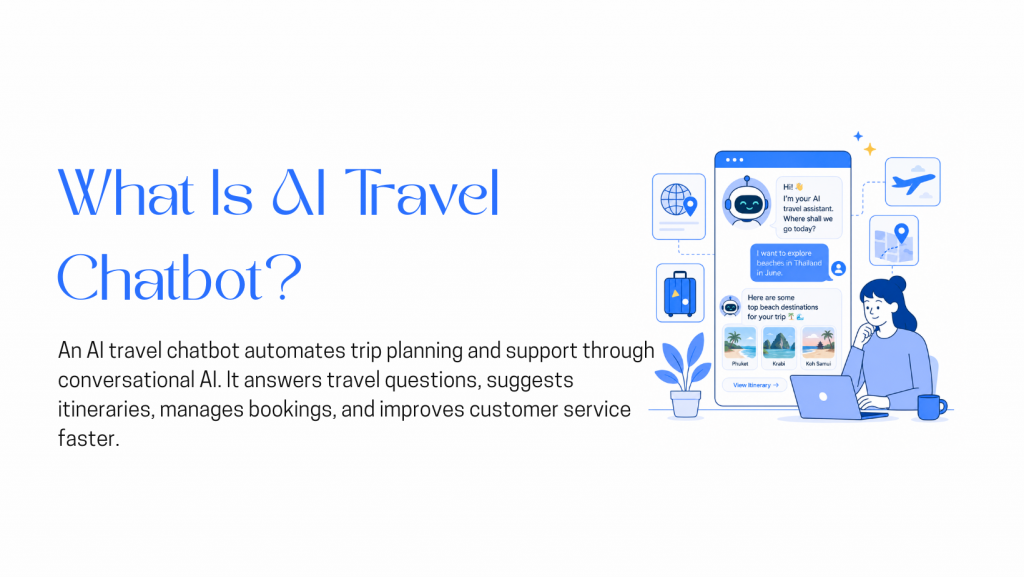
An AI travel chatbot is a conversational assistant that helps travelers ask questions, compare options, manage bookings, and get support through natural language. Travel businesses use these chatbots across websites, mobile apps, email, voice, WhatsApp, and other messaging channels.
In simple deployments, an AI travel chatbot answers common questions about check-in times, baggage rules, cancellation policies, visa requirements, room details, loyalty points, and trip documents. Modern AI travel chatbots differ significantly from older rule-based systems. Traditional bots rely on fixed menus, keywords, and predefined paths, which work well only when a traveler asks a predictable question in a specific format. They struggle with more complex or nuanced requests, such as “I need a beachfront hotel for a family of four, under budget, with breakfast included.”
In contrast, today’s AI travel chatbots are far more context-aware and flexible. If a user enters a query like “rent a flat in Lisbon,” the chatbot can understand that the request goes beyond a simple property search. It can identify the destination, accommodation type, likely intent, budget sensitivity, length of stay, and even booking preferences. A connected system can then search available apartments and filter them by dates, price, neighborhood, amenities, cancellation policies, guest reviews, and lease conditions, presenting options that better match the user’s actual needs.
In stronger deployments, it connects with booking engines, payment systems, CRMs, property management systems, and operational databases so the traveler can complete an action instead of only receiving instructions.
That difference matters for hotels, airlines, agencies, airports, and tour operators. A chatbot that only explains a cancellation policy still leaves the customer to do the work. A connected AI travel chatbot can check the booking, confirm eligibility, collect the required details, start the change or refund process, and escalate the case with context when human review is needed.
Modern AI travel chatbots are different from older rule-based bots. Rule-based bots usually depend on fixed menus, keywords, and predefined paths. They work when the traveler asks a predictable question in the expected format. They fail when the request is more specific, such as “I need a beachfront hotel for a family of four, under budget, with breakfast included.”
AI travel chatbots use the large language models to understand intent, context, constraints, follow-up questions and agentic ai to perform multistep actions. This makes them more useful for travel because travel requests often include multiple variables at once: destination, dates, budget, traveler type, room needs, flight timing, documents, cancellation terms, and personal preferences.
The market data also points to broader investment. Grand View Research estimated the global AI in tourism market at USD 3.37 billion in 2024 and projected it to reach USD 13.87 billion by 2030, with a compound annual growth rate of 26.7% from 2025 to 2030. Grand View Research
AI travel tools fall into two different categories. Mixing them together creates poor comparisons and weak buying decisions.
A hotel comparing chatbot platforms should evaluate tools that can support bookings, guest questions, escalation, CRM updates, and operational workflows. A solo traveler planning a holiday needs itinerary discovery, destination ideas, and trip organization. Those are not the same buying criteria.
The reviews below separate these categories clearly so travel businesses can evaluate platforms based on how they will actually be used.
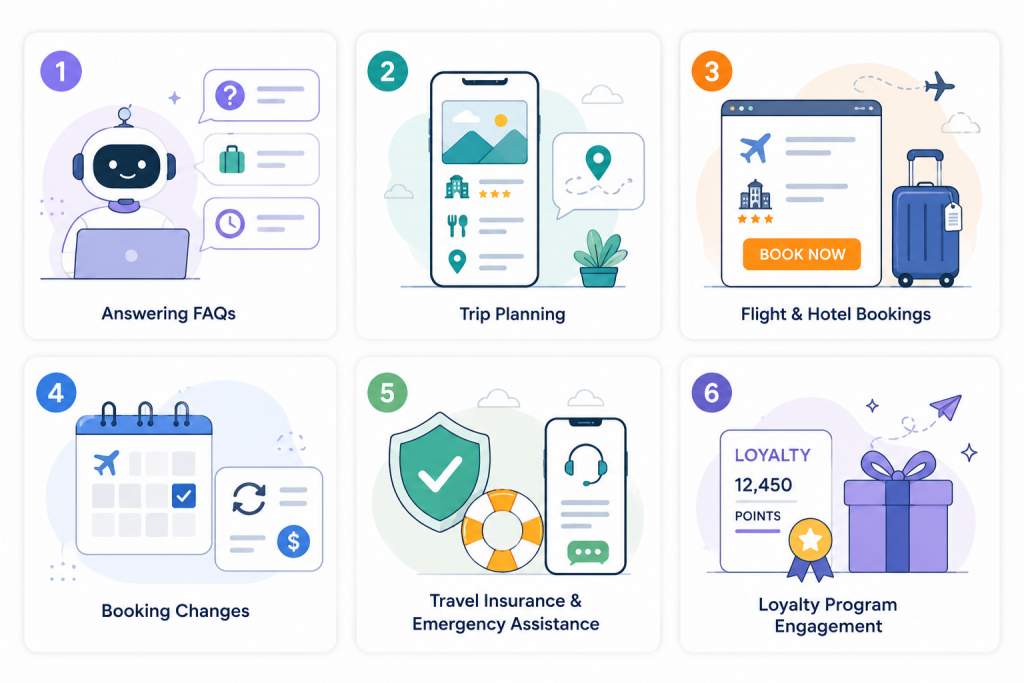
AI in travel is not limited to answering FAQs. It now sits inside booking, service, sales, operations, and post-trip communication. The strongest use cases reduce support load, improve conversion, protect revenue during booking changes, and keep travelers informed across web, mobile, email, voice, WhatsApp, and other messaging channels.
The difference between a basic travel chatbot and a useful AI agent is execution. A basic bot answers policy questions. A stronger system connects with booking engines, payment systems, CRMs, loyalty platforms, inventory tools, and operational databases so travelers can complete actions without being pushed into a queue for every request.
The pattern is consistent across the travel industry. AI creates the most value when it is connected to the systems that already run bookings, payments, inventory, guest records, loyalty data, and support operations. That is when it can resolve traveler requests instead of only explaining what a traveler should do next.
We included both travel-focused platforms and general AI tools for transparency. General tools like Gemini can help with trip research and itinerary ideas, but they are not built to run booking workflows, connect with travel systems, or manage guest support at an operational level.
Each platform was assessed on seven criteria, weighted by importance:
| Criterion | Weight | What We Checked |
|---|---|---|
| Booking execution | 25% | Whether the chatbot can move beyond recommendations and help with availability checks, booking steps, itinerary changes, cancellations, and confirmations. |
| Travel context handling | 20% | How well it understands dates, destinations, budget, traveler type, policies, local constraints, multi-city trips, and incomplete user requests. |
| Real-time system connectivity | 20% | Support for booking engines, CRMs, helpdesks, payment tools, inventory systems, airline or hotel data, and API-based workflow actions. |
| Guest support reliability | 15% | Ability to answer policy questions accurately, handle disruptions, escalate with context, and avoid risky answers around refunds, visas, delays, or payments. |
| Channel fit | 10% | Whether it works where travel conversations happen: website chat, WhatsApp, email, voice, mobile, and social messaging. |
| Control and deployment | 10% | How easily teams can train the assistant, define guardrails, review conversations, update knowledge, and measure booking or support outcomes. |
Each platform was assessed against the criteria above, with more weight given to booking execution, travel context, and real-time system connectivity.
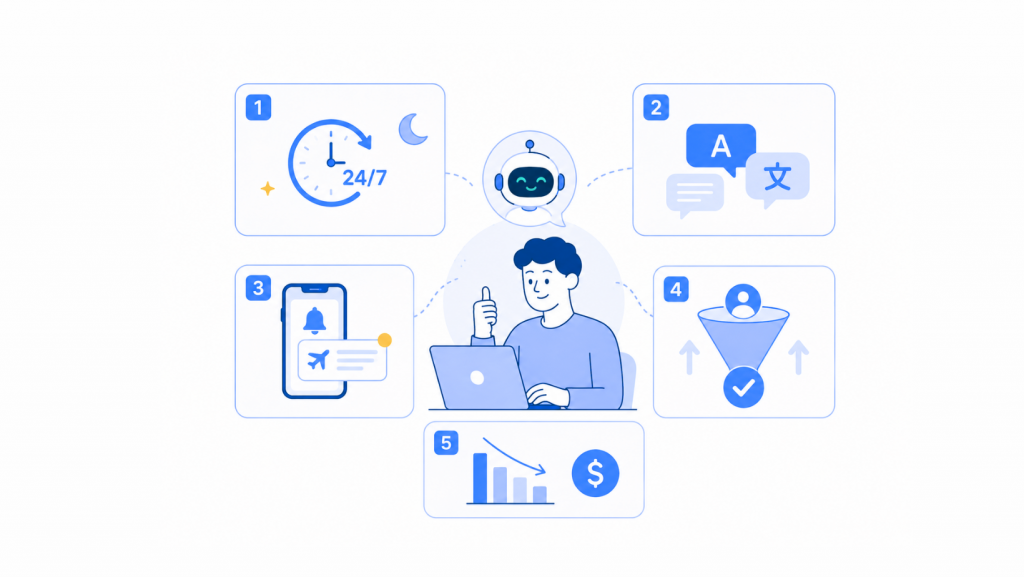
The case for deploying an AI chatbot in a travel business comes down to five core benefits that show up across verticals and business sizes.
With that full picture in mind, here is the ranked list of the top platforms for travel businesses in 2026. These have been evaluated on travel-specific functionality, integration breadth, ease of deployment, user reviews, pricing, and overall performance.
Best for: no-code AI agents for customer support, sales, and automation across chat, email, messaging apps, and voice.
YourGPT is a no-code AI agent platform for travel businesses that need to automate customer support, booking assistance, lead capture, and operational workflows. Hotels, travel agencies, tour operators, and hospitality brands can use it to answer guest inquiries, handle reservation questions, collect traveler details, qualify booking requests, create support tickets, and escalate complex cases to human agents when needed.
The platform can be deployed across websites, mobile apps, WhatsApp, Telegram, Messenger, Instagram, LINE, email, and other customer communication channels. This is useful for travel teams that receive questions about room availability, cancellation policies, check-in times, refunds, itinerary changes, package details, destination information, and post-booking support from multiple places. By centralizing these conversations, YourGPT helps teams manage customer context, automate repetitive queries, and reduce manual handoffs between inboxes, helpdesks, and booking-related systems.
YourGPT is useful for travel teams because it is easy to set up, can be trained on business-specific information and systems. Teams can use their FAQs, website content, hotel policies, booking rules, and destination guides to make the chatbot answer based on how their business actually works. It also supports 100+ languages and human handoff, making it practical for travel companies that handle a high volume of guest or customer queries.

Best for: AI-powered trip planning, itinerary generation, and personalized travel recommendations for individual travelers.
Mindtrip is a travel-focused AI platform designed for travelers who want help planning trips, building itineraries, discovering destinations, and organizing travel ideas. It is not a business support chatbot. It acts as a personal AI travel planner.
What genuinely differentiates Mindtrip from a general-purpose AI assistant is its visual-first planning experience. Recommendations are not just text responses. They become editable itineraries with maps, timelines, saved locations, and shareable travel plans. A traveler asking for a five-day trip to Bali gets a navigable, organized itinerary they can modify, share with companions, and build on.
The collaborative planning tools are a second genuine strength. Group travel coordination (agreeing on activities, managing shared itineraries, keeping everyone informed) is one of the most friction-heavy parts of planning, and Mindtrip addresses it directly.
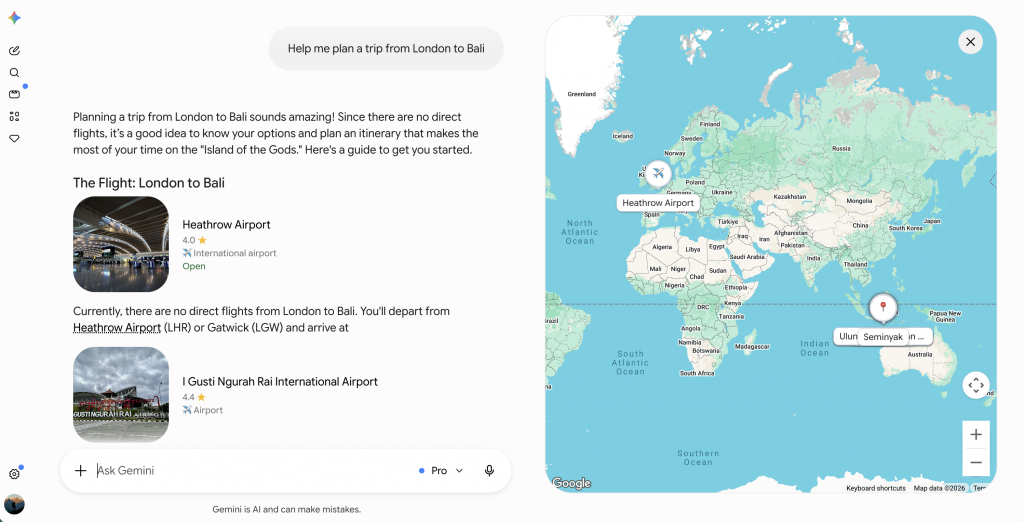
Best for: travel research, destination comparisons, itinerary brainstorming, and general AI planning assistance.
Google Gemini is an AI assistant that helps users research, write, summarize, brainstorm, code, and plan tasks through conversational prompts.
Google Gemini can also support travel planning with AI-generated suggestions, maps-style exploration, and destination research. Users can ask prompts like “help me plan a trip from London to Bali,” and Gemini can provide flight guidance, airport details, itinerary ideas, attractions, restaurants, and travel tips in a structured format.
What makes Google Gemini different is its connection to Google’s ecosystem. It can help users explore information visually, connect ideas quickly, and generate useful responses across many personal productivity tasks, not just travel planning.
Another major advantage is ease of use. Gemini works well for quick questions, idea generation, writing help, and general planning. However, it is better suited for individual productivity and research than for full business workflows or enterprise travel management.
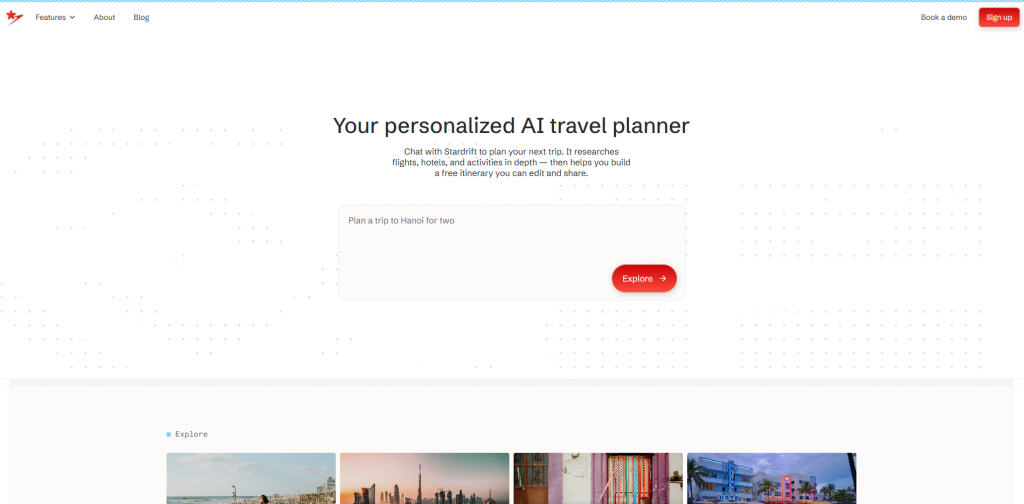
Best for: lightweight travel inspiration, destination discovery, and simple AI-generated itinerary suggestions for travelers.
Stardrift AI is an AI-first travel planning tool focused on destination discovery, trip ideation, and itinerary generation through conversational prompts. Its primary value is reducing the cold-start problem of trip planning: the blank-page moment where travelers know they want to go somewhere but are unsure where to begin.
The honest assessment is that Stardrift AI occupies similar territory to both Mindtrip and Google Gemini, and in the areas where they overlap, it currently trails both. Its itinerary outputs are less visually organized than Mindtrip’s, and its general knowledge breadth is narrower than Gemini’s. It earns its place on this list for its travel-focused positioning and usefulness as a quick inspiration tool, but travelers with access to Mindtrip or Gemini should evaluate whether Stardrift adds meaningfully to their planning toolkit.
Published reviews are limited, and the platform’s roadmap is not fully transparent, which adds uncertainty to forward-looking assessments.
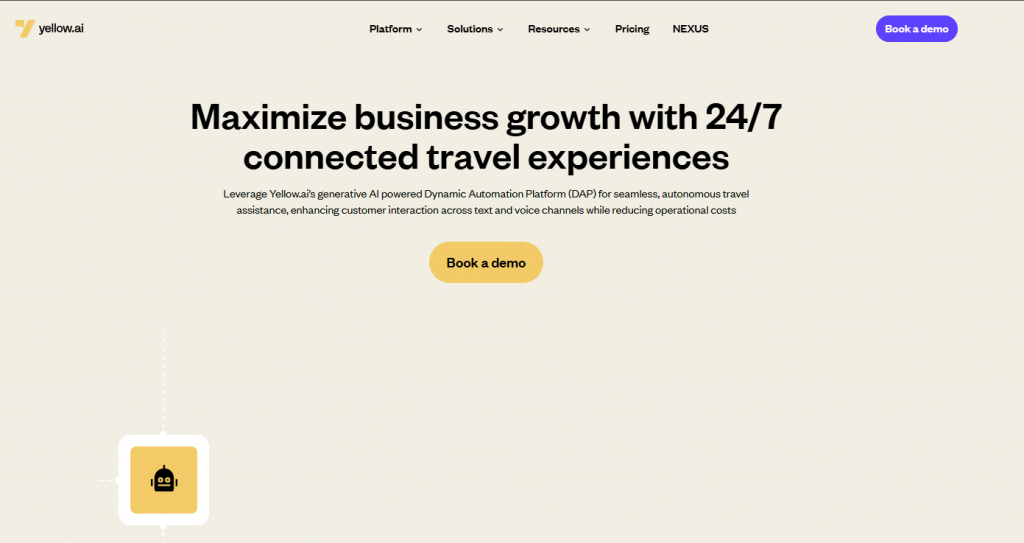
Best for: enterprise travel automation, customer support workflows, multilingual chat, and voice AI for large travel brands.
Yellow.ai is an enterprise conversational AI platform built for travel companies that need to deploy AI agents at scale. For travel businesses, it covers the full support spectrum: booking queries, flight and hotel FAQs, cancellations, refunds, loyalty inquiries, multilingual support, and voice, all from a single deployment.
What genuinely differentiates Yellow.ai is the combination of breadth and depth. It supports over 135 languages including code-mixed dialects, which is critical for markets across India, Southeast Asia, and the Middle East. It operates across web, app, WhatsApp, and voice simultaneously, and integrates with CRMs, booking engines, and helpdesk platforms through a mature integration library. Its Dynamic Automation Platform allows non-technical teams to build and modify conversation flows without developer dependency, though complex workflows benefit from professional implementation support.
For large travel operations handling tens of thousands of conversations across international markets, Yellow.ai has the infrastructure and track record to deliver. For smaller businesses, it is likely more than is needed.
Choosing the right AI Agent platform requires evaluating scalability, integration capabilities, customization, and ease of use. The best platforms align with business goals while delivering reliable performance and measurable value.
An AI travel chatbot is a software tool that uses artificial intelligence to communicate with travelers or customers in natural language, 24/7, across channels such as website chat, WhatsApp, and email. Capable platforms can answer policy questions, process bookings, manage cancellations, and support both business-deployed customer service and consumer-facing trip planning.
AI chatbots simplify travel booking by answering questions, guiding travelers through reservations, handling support requests, sending confirmations, and reducing friction during the customer journey. Whether they can complete bookings automatically depends on integrations with booking engines, CRMs, and payment systems.
The best AI travel chatbot depends on the use case. For travel businesses, Yellow.ai is strong for enterprise depth, while YourGPT is strong for accessibility. For individual travelers, Mindtrip offers an organized planning experience, Gemini provides strong research capability, and Stardrift AI is useful for destination discovery.
Yes, better enterprise AI travel chatbot platforms can handle cancellations and refunds by connecting directly to booking engines and payment processors. This requires proper backend integration, which makes integration depth an important factor when choosing a platform.
Most modern AI travel chatbot platforms support multiple languages. Yellow.ai supports 135+ languages, including code-mixed dialects. YourGPT supports 100+ languages across chat and voice, while Google Gemini handles major global languages effectively.
Setup time depends on the platform and integration needs. No-code platforms like YourGPT can often go live within days, while enterprise platforms like Yellow.ai typically require 6 to 12 weeks for full integration, configuration, and testing.
AI travel chatbot pricing varies by use case. Consumer tools like Mindtrip and Google Gemini are free at the core level. Business platforms can start at $39 per month for YourGPT’s entry tier, while enterprise platforms like Yellow.ai use custom pricing based on volume and deployment complexity.
No, AI chatbots do not replace human travel agents. They handle high-volume, repeatable queries automatically so human agents can focus on complex interactions that require expertise, empathy, creativity, and judgment. The best travel support systems use AI and human agents as complementary layers.
The right platform depends on who is using it and what problem they are trying to solve.
Travel businesses deploying customer-facing support should look at Yellow.ai for enterprise scale and YourGPT for mid-market accessibility. Both handle real workflows including bookings, cancellations, and multilingual support across the channels customers actually use.
Individual travelers planning trips will find Mindtrip the most organized and visual planning experience, Google Gemini the most information-rich research assistant, and Stardrift AI a useful starting point for destination discovery, though it currently trails the other two in depth and polish.
What the data consistently shows is that the gap between capable AI customer support and the absence of it is widening across conversion rates, cost per resolution, and traveler satisfaction. The businesses and travelers that engage with these tools thoughtfully now are better positioned than those treating it as something to figure out in the next planning cycle.
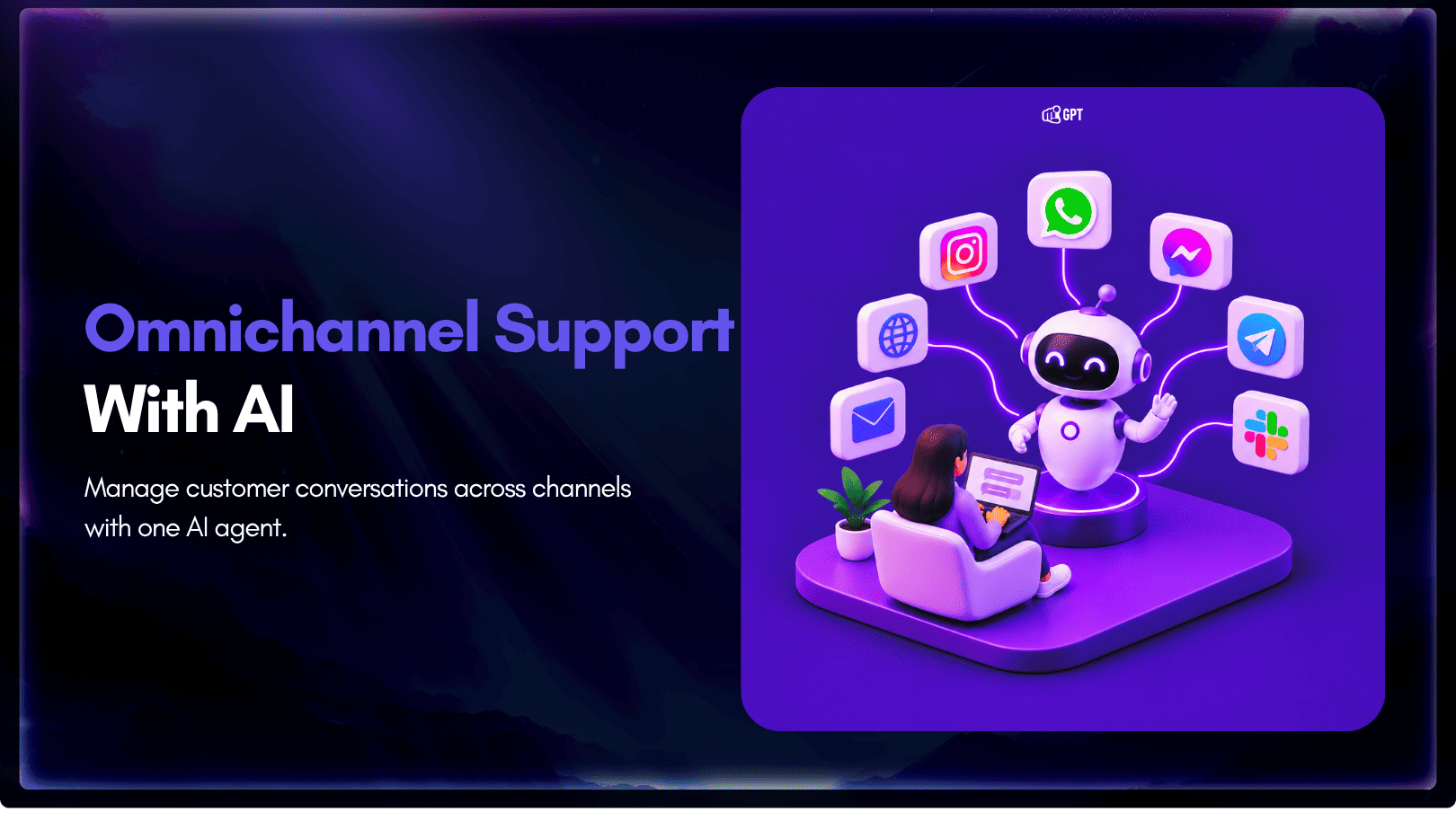
Omnichannel support means every channel answers from the same knowledge. Train one AI agent, pick your first channel, and test that answers match.

Self-learning AI agents log the questions they miss. Learn how human review turns those gaps into trained answers and how to run the weekly loop.
Train an AI agent on your return policy, connect the Shopify template in AI Studio to check real orders, and route exceptions to your team.
WISMO means Where Is My Order. Measure your WISMO share from last month’s tickets, fix the tracking gaps, and let an agent answer order status.
Run WordPress customer service alone. Train a YourGPT agent on your help pages, test it on real tickets, install the plugin, and get only the exceptions.
Learn how to judge Shopify AI resolution rates with clear formulas, a worked example, ticket-level checks and practical ways to improve support quality.