Top 9 Yellow AI Alternatives & Competitors in 2026
Rajni
Last updated on October 14, 2026
Summarize this post with AI
TL;DR
Yellow AI can feel complex and rigid for many teams, especially as support scales across channels.
YourGPT and Intercom stand out YourGPT for AI-first automation and Intercom for structured, agent-driven support.
Choose based on whether you want automation-led workflows or human-led support with AI assistance.
Yellow AI is widely used by enterprises for chatbots and voice-based customer engagement. However, many teams, especially small and mid-sized businesses, run into limitations when it comes to setup complexity, pricing flexibility, and day-to-day control over automation. As customer support expectations continue to rise in 2026, these gaps become harder to ignore.
Today’s businesses need more than scripted conversations. They need platforms that are easier to customize, integrate cleanly with existing tools, and provide clear insight into performance across channels. This has led many teams to evaluate alternatives that offer stronger flexibility, better analytics, and more predictable costs without sacrificing reliability.
In this blog, we break down the top 9 Yellow AI competitors and alternatives for 2026. Each platform is reviewed based on real-world use cases, customization options, integration depth, and pricing approach, helping you choose a solution that fits your customer engagement goals, not just your budget.
Reasons to Consider Other Yellow AI Alternatives
While Yellow AI is used by many businesses, there are several reasons why businesses may want to consider alternative options:
Pricing: Yellow AI’s pricing may not be suitable for businesses, particularly small and medium-sized enterprises.
Responses: Some users have highlighted that sometimes the response quality is not good.
Limited customisation: Some users have reported difficulty in customising Yellow AI’s chatbots to meet their specific needs. This can impact the effectiveness of the chatbots in addressing customer enquiries and providing personalised support. For a detailed comparison of other chatbot alternatives, check out our Chatbot Alternatives.
Outages and stability issues: Some users have reported outages and stability issues with Yellow AI, which can impact customer support and engagement. This can lead to missed communications, delayed responses, and a negative customer experience.
Difficulty Bot Building: Some users have reported difficulty in creating and editing chatbots with Yellow AI, which can impact the customer experience. Journeys may not be tailored to meet the specific needs of customers, leading to a lack of personalisation and effectiveness.
These limitations highlight the importance of considering alternative AI tools that can better meet the specific needs of a business.
Quick Glance
Based on user feedback, community suggestions, and in-depth analysis, we have selected these chatbot platforms. Here is a list of the top 8 alternatives to Yellow AI for 2026:
Platform name
Best for
YourGPT AI
Teams looking for a no-code, AI-first platform to automate support, sales, and operational workflows using their own data
Intercom
Businesses that want live chat, AI assistance, and customer engagement tools in a single communication platform
Zendesk
Growing support teams that rely on structured ticketing, reporting, and SLA-driven workflows
Fini
Teams seeking AI-powered support automation with managed setup, autonomous resolution, and human handoff
Haptik
Enterprises seeking conversational AI for customer support, marketing automation, and business operations
Kore AI
Large organizations needing advanced NLP, complex dialog management, and deep enterprise integrations
Verloop.io
Support teams focused on omnichannel automation with strong intent handling and human handoff
Ada CX
Companies aiming to automate FAQs and high-volume customer queries using intent-based AI
Certainly
Businesses that need guided customer journeys and personalized engagement on web channels
Best Yellow AI Alternatives & Competitors
Let us explore these alternatives based on key criteria such as features, user interface, customer support, integration options, and unique selling points.
1. YourGPT
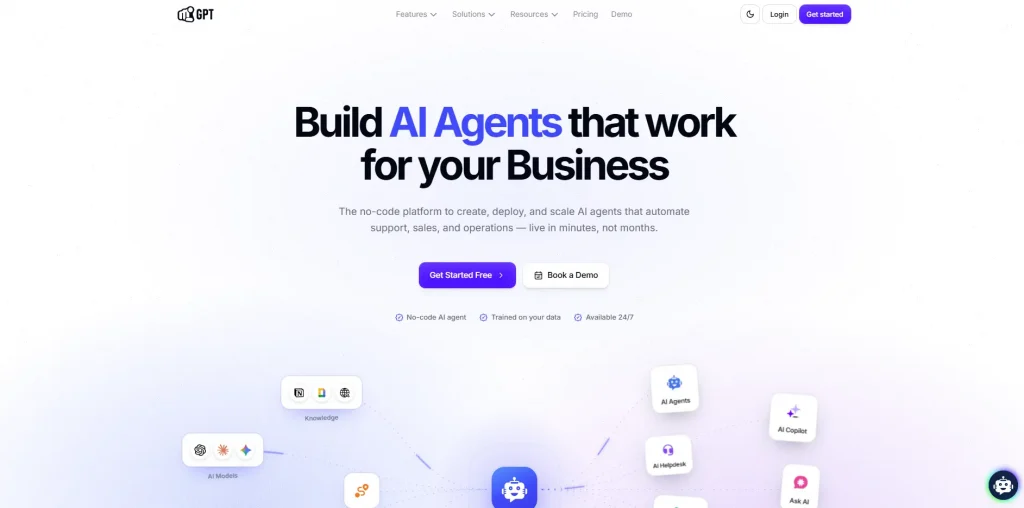
YourGPT is an AI-first no code platform that helps businesses automate customer support, sales, and internal workflows using intelligent AI agents. Teams can build and train agents with a no-code interface using their own data, deploy them across multiple channels, and hand off complex conversations to human agents with full context when needed. Achieved over 90% resolution in production deployments.
Features
No-Code AI Builder: Create AI agents visually without technical setup.
Multi-Source Training: Train agents using websites, PDFs, FAQs, Notion pages, and Google Sheets.
Omnichannel Messaging: Manage conversations across Web, WhatsApp, Messenger, Telegram, and LINE from a unified inbox.
AI Studio Workflows: Build logic-based, multi-step conversations with intent detection and memory.
AI + Human Handoff: Route conversations to human agents via internal dashboard, Slack, or email with full chat history.
Voice AI Agent: Handle real-time inbound and outbound calls using AI-powered voice interactions.
Integrations and APIs: Connect with CRMs, helpdesks, and internal tools to automate actions beyond chat.
Pros
Suitable for real customer support workflows, not just FAQs
No-code setup works well for non-technical teams
Strong balance between automation and human control
Supports both chat and voice in one platform
Scales across multiple channels as support volume grows
Cons
Reporting depth depends on setup and selected plan
Advanced workflows may need initial configuration
Full value is clearer when used across multiple channels
Pricing
Essential – $39/month (billed annually) for core chatbot features and basic support.
Professional – $79/month (billed annually) with advanced automation and higher limits.
Advanced – $349/month (billed annually) for scaling teams with high performance needs.
Enterprise – Custom pricing with dedicated support, custom builds, and enterprise features.
Enhance Your Customer Interactions with AI
Discover how YourGPT AI chatbot can streamline your customer service
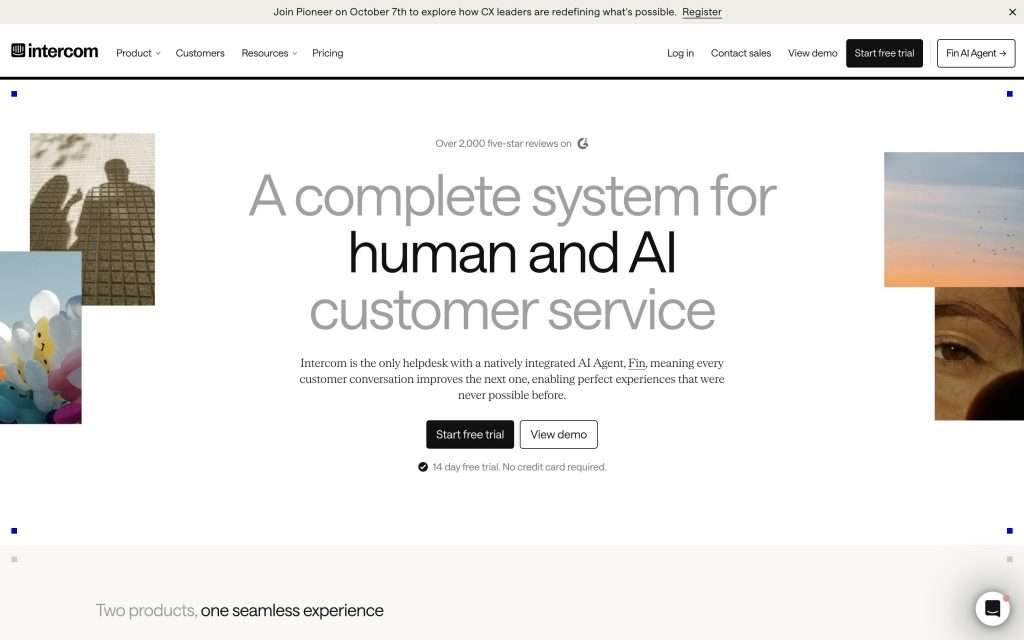
Intercom is a customer communication platform designed to help businesses manage customer conversations across support, sales, and onboarding. It combines live chat, AI assistance, and proactive messaging to improve response times and customer engagement, especially for SaaS and product-led teams.
Features
Live chat and shared inbox for real-time customer conversations
AI assistance for answering common questions and routing chats
Proactive in-app messaging for onboarding and product updates
Help center and ticketing for structured support workflows
Customer context visibility including user activity and conversation history
Wide integration support through APIs, webhooks, and native connectors
Pros
Clean, modern interface designed for fast agent response
Strong in-app and product messaging capabilities
Rich customer context available during conversations
Large ecosystem of integrations for SaaS tools
Well suited for onboarding and product support use cases
Cons
Setup and configuration can feel complex for smaller teams
Pricing increases quickly as teams and usage scale
Heavily agent-driven for complex or high-volume support
AI automation is limited compared to AI-first platforms
Pricing
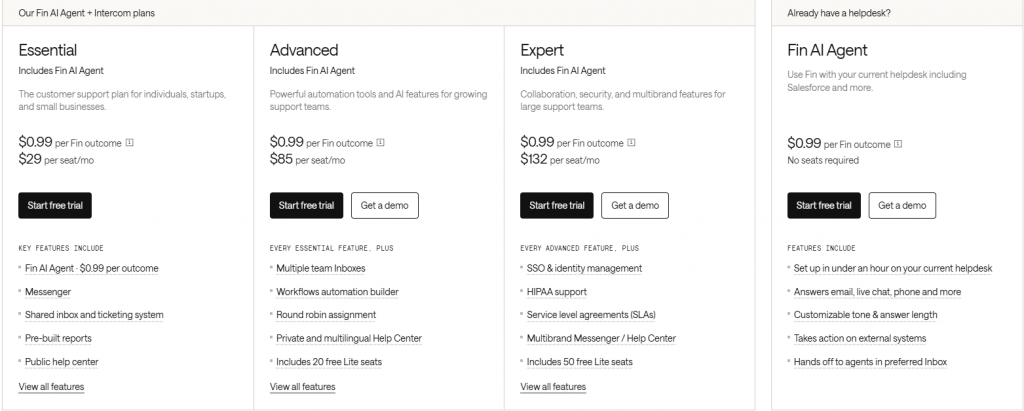
Essential – $29/seat/month + $0.99 per Fin outcome for core support features and basic automation.
Advanced – $85/seat/month + $0.99 per Fin outcome with workflows, automation, and team collaboration tools.
Expert – $132/seat/month + $0.99 per Fin outcome for large teams with security, SLAs, and multibrand support.
Fin AI Agent – $0.99 per outcome with no seat cost, works across support channels with automation and handoff.
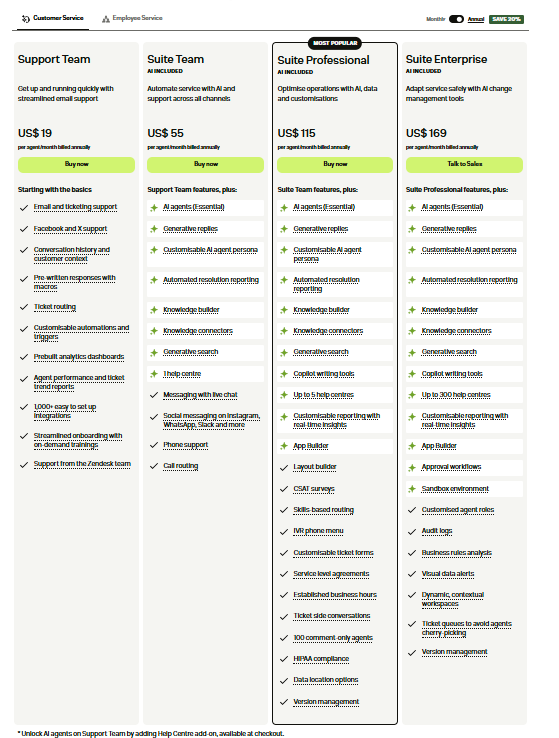
3. Zendesk
Zendesk is a customer service platform built around ticketing, designed to help businesses manage, track, and resolve customer support enquiries across multiple channels. It provides tools for email, chat, voice, and self-service support, along with reporting and SLA management. Zendesk is commonly used by growing and enterprise teams that need structured workflows and detailed support analytics.
Features
Omnichannel ticketing across email, chat, social media, and web forms
Centralised support inbox with SLA and workflow automation
Help center and knowledge base for self-service support
AI-powered tools for ticket routing, suggested replies, and prioritisation
Advanced reporting and analytics for support performance tracking
Integrations with CRMs, eCommerce platforms, and internal tools
Pros
Strong ticketing and workflow management for complex support operations
Scales well for teams handling large support volumes
Mature reporting and analytics capabilities
Large integration ecosystem and marketplace
Reliable for structured, process-driven support environments
Cons
Can feel complex and heavy for small teams
Pricing increases as features, agents, and channels are added
AI automation is more assistive than fully autonomous
Setup and configuration may require time and training
Pricing
Support Team – $19/agent/month (billed annually) for basic email support and ticketing.
Suite Team – $55/agent/month (billed annually) with AI agents, live chat, and knowledge base tools.
Suite Professional – $115/agent/month (billed annually) for automation, analytics, and advanced customization.
Suite Enterprise – $169/agent/month (billed annually) with enterprise controls, security, and advanced workflows.
4. Fini
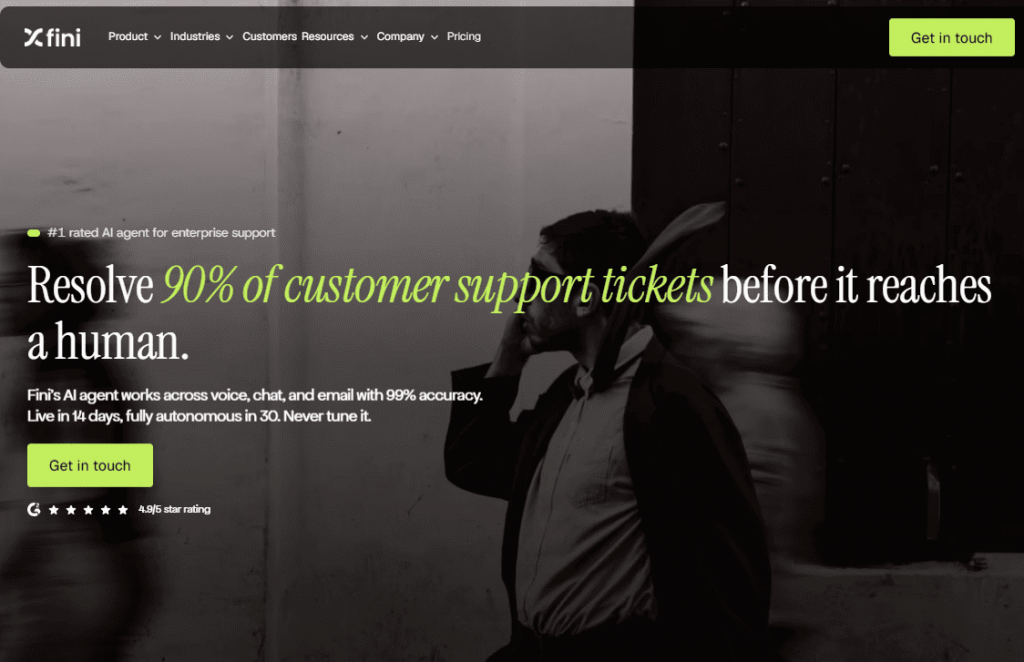
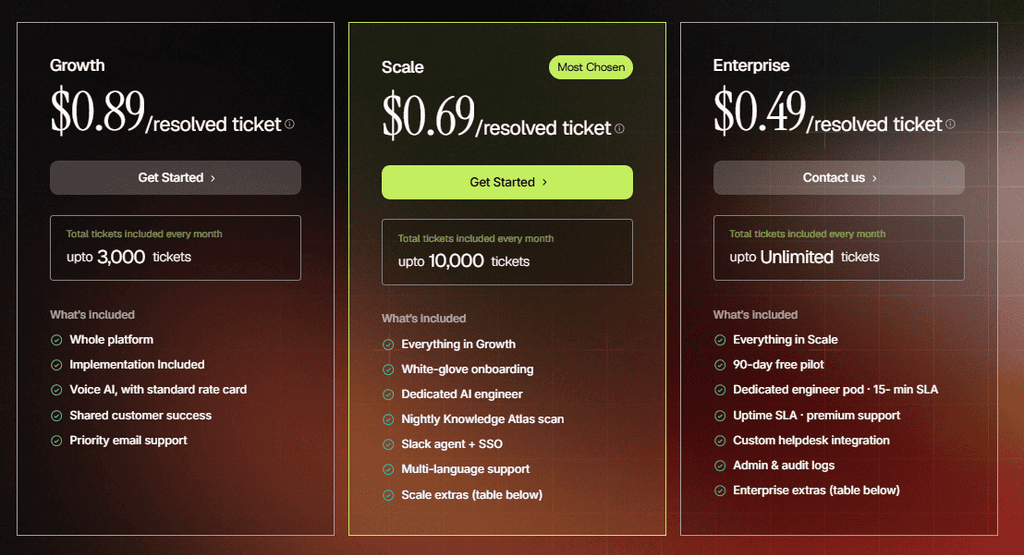
Fini is an enterprise AI customer support platform built for regulated, high-volume industries such as fintech, banking, insurance, and healthcare. It automates customer queries across voice, chat, and email in 130+ languages, handling tasks such as refunds and account updates. Fini integrates with existing helpdesks, including Zendesk, Intercom, and Salesforce. The company reports 90% resolution at 99% accuracy, with guided implementation designed to get teams live in 14 days and fully autonomous in 30.
Features
AI-powered customer support across voice, chat, and email in 130+ languages
Automated actions such as refunds, account updates, and order changes
Knowledge Atlas for identifying knowledge gaps and generating missing articles
Confidence scoring, policy checks, and human handoff when needed
Integrations with Zendesk, Intercom, Salesforce, HubSpot, Freshdesk, Front, and Gorgias
Enterprise security and compliance support, including SOC 2 Type II, ISO 27001, PCI DSS Level 1, HIPAA, and GDPR
Pros
Automates complex support requests beyond basic FAQs
Designed for regulated industries with strict security requirements
Resolution-based pricing without charges for escalated tickets
Guided rollout with deployment in 14 days and full autonomy targeted within 30
Conditional 90-day money-back guarantee tied to resolution performance
Cons
Built for high-volume teams; a small team with a few hundred tickets a month isn’t the core fit
Guided implementation with Fini’s team rather than instant self-serve setup
Pricing
Starts at $0.49 per resolution, with no per-seat fees. Details on Fini’s pricing page.
5. Haptic
Haptik is a conversational AI platform focused on automating customer interactions across support, marketing, and operational use cases. It enables businesses to deploy AI-powered chatbots and virtual assistants across multiple channels, with an emphasis on large-scale automation and integration into existing enterprise systems. Haptik is commonly used by enterprises handling high volumes of customer conversations.
Features
AI-powered chatbots for customer support, sales, and marketing use cases
Strong WhatsApp Business API integration for automated conversations
NLP-driven intent detection and conversation flows
Prebuilt industry templates for faster deployment
Live agent handoff for complex or sensitive queries
Analytics and dashboards to track conversation performance
Pros
Well suited for WhatsApp-first customer engagement
Designed to handle high conversation volumes
Offers industry-specific use cases and templates
Supports automation combined with human escalation
Common choice for large consumer-facing brands
Cons
Limited flexibility compared to no-code, AI-first platforms
Customisation and changes may require platform support
Less suited for multi-channel workflows outside messaging apps
Pricing and setup may be heavy for small or mid-sized teams
6. Kore AI
Kore AI is an enterprise-grade conversational AI platform used to build virtual assistants for both customer-facing and internal employee use cases. It offers advanced natural language processing, dialog management, and orchestration tools to support complex, multi-turn conversations. Kore AI is typically adopted by large organizations that require deep integrations, security controls, and scalable AI deployments.
Features
Advanced conversational AI with strong NLU and intent recognition
Support for chat and voice bots across web, messaging, and contact center channels
Visual dialog builder for designing complex, multi-turn conversations
Prebuilt industry use cases and conversational templates
Enterprise integrations with CRMs, ERPs, and backend systems
Analytics and monitoring tools for bot performance and conversation outcomes
Pros
Powerful AI capabilities for complex enterprise use cases
Suitable for large-scale deployments and high conversation volumes
Strong support for voice and contact center automation
Flexible integration options for enterprise systems
Designed for regulated and security-conscious environments
Cons
Steep learning curve for setup and ongoing management
Requires technical expertise or partner support to customise effectively
Higher cost compared to SMB-focused chatbot platforms
Less suitable for teams looking for quick, no-code deployment
7. Verloop
Verloop.io is a conversational AI platform focused on automating customer support conversations across web and messaging channels. It enables businesses to handle common support queries through AI-driven chat while providing smooth handoff to human agents when needed. Verloop.io is commonly used by teams looking to scale support operations without increasing agent workload.
Features
AI-powered chatbots for customer support and FAQs
Strong WhatsApp and web chat support
Live agent handoff with shared inbox and conversation routing
Prebuilt conversation flows and industry templates
Knowledge base–driven bot training for faster setup
Analytics to track bot performance and resolution rates
Pros
Easy to get started compared to heavier enterprise platforms
Good balance between AI automation and human support
Works well for WhatsApp-first and chat-based support teams
Prebuilt flows help reduce initial setup time
Suitable for handling repetitive customer queries at scale
Cons
Limited flexibility for advanced, custom workflows
AI capabilities are less advanced than enterprise-grade platforms
Reporting and analytics are basic for large support operations
Less suited for voice-based or multi-channel automation beyond chat
8. Ada CX
Ada CX is an AI-powered customer support platform focused on automating high-volume customer enquiries using intent-based conversational AI. It helps businesses resolve common questions through chatbots while ensuring seamless escalation to human agents for complex issues. Ada CX is commonly used by mid-sized and enterprise teams aiming to reduce ticket volume and improve response consistency.
Features
AI-driven chatbot for handling common customer support queries
Intent-based conversation automation using natural language understanding
Omnichannel support across web, mobile, and messaging channels
Knowledge base integration for automated responses
Analytics and reporting on automation and deflection rates
Live agent escalation for complex or unresolved issues
Pros
Strong focus on customer support automation and deflection
Reduces incoming ticket volume for support teams
Suitable for high-volume support environments
Clean interface for managing automated responses
Designed for enterprise-scale deployments
Cons
Limited flexibility for custom workflows and advanced logic
Setup and optimisation can take time
Pricing is high compared to many alternatives
Less control over AI behaviour compared to no-code platforms
Better suited for support deflection than full customer journey automation
9. Certainly
Certainly is a conversational AI platform focused on guiding customers through structured, goal-oriented journeys across web and digital channels. It helps businesses automate customer interactions using decision-based conversations while maintaining a clear path to human support when required. Certainly is commonly used by teams that prioritize guided experiences over open-ended chat.
Features
AI-powered chatbots for customer support and sales automation
Personalised conversations using customer data and behaviour
Omnichannel deployment across web chat and messaging platforms
Visual conversation builder for designing chatbot flows
Built-in analytics to measure engagement, conversions, and performance
Live agent handoff for complex or high-value conversations
Pros
Strong focus on personalised customer interactions
Useful for both support and conversion-oriented use cases
Setup and optimisation can require time and planning
Less flexible for highly custom or complex workflows
AI control is more constrained than no-code platforms
Pricing and feature depth may be better suited to larger teams
Pricing
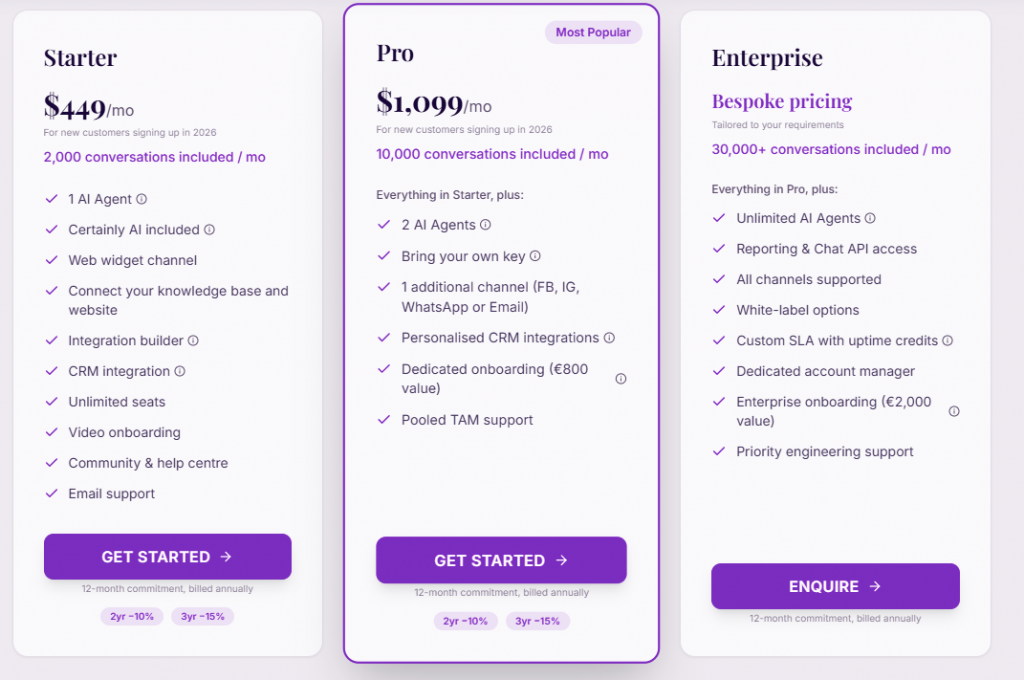
Starter – $449/month (billed annually) with 2,000 conversations, 1 AI agent, and core chatbot + integrations.
Pro – $1,099/month (billed annually) with 10,000 conversations, multiple agents, extra channels, and CRM integrations.
Enterprise – Custom pricing with 30,000+ conversations, unlimited agents, full channel support, and enterprise features.
Yellow AI vs Alternatives: Quick Comparison Table
Here’s a quick comparison of all 8 Yellow AI alternatives:
Feature
YourGPT AI
Intercom
Zendesk
Fini
Haptik
Kore AI
Verloop.io
Ada CX
Certainly
Setup experience
No-code, fast setup
Moderate
Moderate
Guided rollout, live in 14 days
Enterprise onboarding
Complex enterprise setup
Moderate
Structured setup
Flow-based setup
AI approach
AI-first agents & workflows
Assistive AI
AI-assisted ticketing
Autonomous AI resolution
Enterprise conversational AI
Advanced NLP & orchestration
Support-focused AI
Intent-based AI
Decision-driven AI
Customization
Advanced workflows & APIs
Apps & webhooks
Rules & macros
System actions & policy controls
Enterprise-level
Full platform control
Conversation tuning
Predefined flows
Guided flows
Omnichannel support
Web, WhatsApp, IG, Slack, voice
Chat, email
Email, chat, voice
Voice, chat, email (130+ languages)
Messaging & voice
Web & enterprise channels
Web & messaging
Chat-focused
Web channels
Human handoff
Built-in with context
Yes
Primary workflow
Yes, with full context
Yes
Yes
Yes
Yes
Escalation supported
Best fit
AI-first support & ops teams
SaaS & product teams
Structured support orgs
Regulated, high-volume support teams
Large enterprises
Complex enterprise use cases
Scaling support teams
FAQ-heavy automation
Guided journeys
How to Choose the Right Yellow AI Competitors and Alternatives?
When evaluating competitors and alternatives to Yellow AI, consider the following criteria:
Performance & Features: Focus on how the AI performs in real conversations, not polished demos. The platform should understand everyday language, keep context across messages, handle follow-up questions naturally, and hand off to a human when needed. If the AI creates extra exceptions for your team, it’s not helping. A strong alternative reduces manual effort while keeping conversations smooth and consistent.
Ease of Use: The platform should be simple enough for non-technical teams to manage day-to-day work. Look for clear dashboards, visual builders, and settings that don’t require constant developer involvement. If basic changes take too long, adoption will suffer.
Customisation & Integration: Every business has different workflows. Choose a solution that lets you adjust conversation flows, data sources, and automation logic without rigid limits. Strong integrations with CRM, helpdesk, messaging channels, and internal tools matter more than long feature lists.
Pricing & Scalability: Pricing should grow with your usage, not jump sharply as soon as volume increases. Pay attention to limits on conversations, agents, or AI usage, and check whether the platform supports scaling from a small team to larger operations without rework.
Customer Support & Community: Reliable support becomes critical once the bot is live. Look for responsive support teams, clear documentation, and an active user base. A healthy ecosystem often signals long-term product stability and faster problem resolution.
Frequently asked questions
Which Yellow AI alternative works best if my support team is small?
For small support teams, YourGPT AI is worth considering because it offers a no-code chatbot builder, AI-powered automation, and human handoff without requiring extensive technical expertise. Prioritize platforms with simple setup, flexible workflows, and low-maintenance operations.
Can I switch from Yellow AI without rebuilding all my support flows?
Yes, some alternatives let you import existing FAQs, knowledge bases, or conversation logic. Look for platforms that support data import from documents, websites, or chat history to avoid rebuilding from scratch.
Which alternatives handle real customer language better than intent-only bots?
Choose platforms that support natural language understanding and context retention. These systems adapt better to different phrasings and follow-up questions, unlike intent-only bots that often fail with dynamic conversations.
Are there alternatives that work well without long onboarding cycles?
Yes, some chatbot platforms can be deployed in just a few hours. These tools are ideal for teams that want quick results and don’t want to rely on long onboarding or consultants.
Which Yellow AI competitors are easier to customise without developers?
Look for tools with visual builders, rule-based flows, and editable responses. These features let non-technical teams manage and update bots without needing developer help.
How important is omnichannel support when choosing an alternative?
Omnichannel support is crucial if your users contact you via WhatsApp, web chat, email, or social platforms. Limiting your channels can fragment communication and slow down response times.
Which alternatives scale better as conversation volume grows?
Scalable platforms go beyond handling high volume—they offer advanced analytics, routing, and consistent performance. Avoid systems that require constant manual tuning to keep up with demand.
Are there platforms that offer better pricing transparency than Yellow AI?
Yes, many alternatives offer simple, predictable pricing with clear monthly plans. Avoid platforms with hidden fees or pricing that changes based on chat complexity if budget stability is important.
What should I check before moving customer data to a new platform?
Check for security standards, compliance (like GDPR), and whether you can export your data later. Understand how past chat history will be stored and migrated before switching platforms.
Which alternative is better if I want AI plus human collaboration?
Choose a platform with built-in AI-human collaboration features like unified inboxes, internal notes, and seamless handoffs. This ensures your AI supports agents rather than working in silos.
Conclusion
Yellow AI works well for large enterprises, but it may not suit every business. Pricing complexity, setup effort, and limited flexibility often push teams to look for alternatives that are easier to operate and adapt as needs change.
The platforms covered in this list take different approaches. Some prioritise structured ticketing, others focus on enterprise AI depth, while a few emphasise guided conversations and ai automation. The right choice depends on how naturally the AI handles real conversations, how easily it fits into your existing tools, and how much ongoing effort your team needs to maintain it.
For teams looking for an AI first platform that balances automation, control, and ease of use, YourGPT AI Chatbot stands out as a practical option. Its no code workflows, strong integration support, and focus on real business use cases make it a solid choice for scaling customer engagement without added complexity.
Looking for a Yellow AI Alternative?
Build an AI agent trained on your own data. Automate customer support across channels and hand off complex queries to your team.
A practical breakdown of Gorgias Helpdesk and AI Agent pricing, including what counts toward each allowance, how to compare plans and how to budget with your own volumes.
Compare six Yuma alternatives by ecommerce capabilities, helpdesk compatibility, pricing and human handoffs to choose a replacement for your support team.