How AI Chatbots Are Changing Ecommerce (And What Brands Get Wrong)

Rajni
June 28, 2026
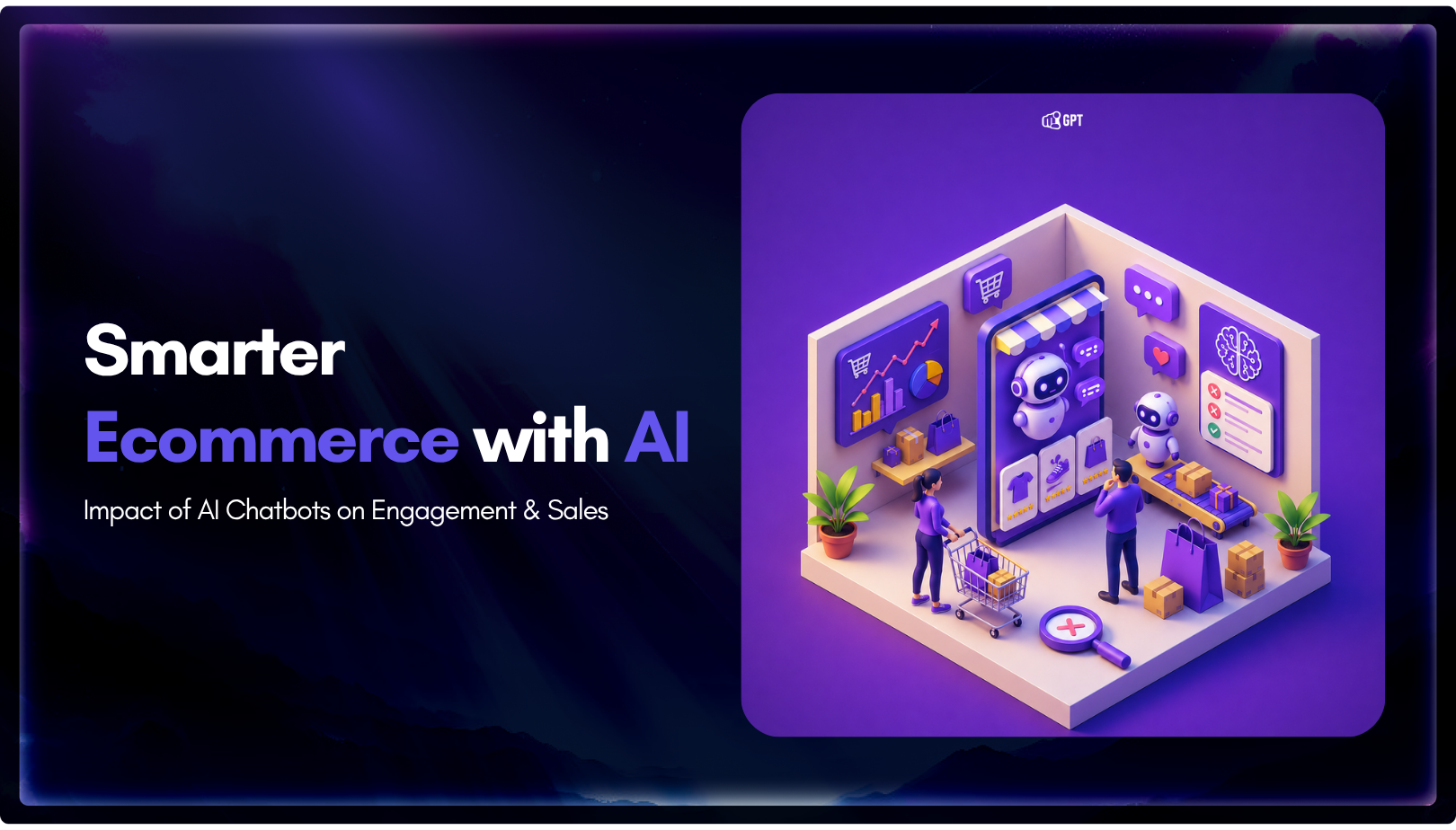
AI chatbots are transforming ecommerce by handling order tracking, returns, customer support, and sales conversations in real time.
However, many brands fail because their chatbots rely on static FAQs instead of live store data, leading to poor customer experiences.
This blog explains how successful brands use AI chatbots to improve support, recover revenue, and scale ecommerce operations effectively.
AI chatbots are now part of everyday ecommerce operations. They answer order questions, process returns, manage subscription changes, and step into checkout flows where customers hesitate. For some brands, this has changed how support teams work. For others, it has created more handoffs, more confusion, and more cleanup work for agents.
The difference is not which tool was selected. It comes down to how the system was designed. When AI is connected directly to order data, inventory, subscriptions, and internal policies, it can resolve real issues. When it is limited to scripted replies or disconnected knowledge, it adds another layer customers have to work through before reaching a solution.
Adoption is no longer the challenge. Execution is. Some teams treat AI as part of their operational workflow. Others treat it as a chat interface placed on top of existing systems.
This blog looks at what AI is actually changing inside ecommerce customer operations and where most deployments fall short.
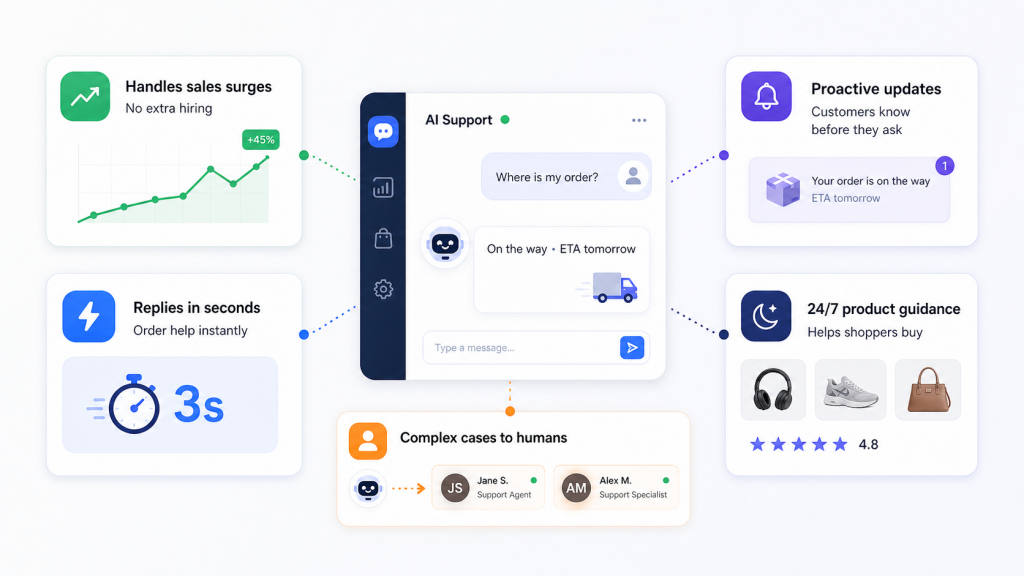
E-commerce growth traditionally required scaling support staff directly alongside order volume. A sudden spike in sales from a product launch or holiday campaign inherently created a staffing bottleneck. Today, complete AI suites like YourGPT, which help businesses in customer support, sales, and business operations, have severed this linear dependency.
High-volume, predictable inquiries, such as order status, return eligibility, shipping timelines, and discount codes, are no longer just deflected to static FAQ pages. They are entirely resolved in seconds, tailored to the specific customer and their exact situation, without human intervention.
Here is how successful brands are experiencing this operational shift:
The most frequent mistake in deploying customer service AI is training the system on static PDFs and FAQ pages rather than connecting it to live operational data.
For example, a bot trained only on a shipping policy document might confidently tell a customer that orders ship within two to three business days. If that customer’s package has been stuck at a carrier facility for four days, the bot is technically stating the correct policy, but it is providing a completely useless answer. Confident but unhelpful answers destroy customer trust much faster than providing no answer at all.
To achieve real operational value, a complete AI suite like YourGPT, which helps businesses in customer support, sales, and business operations, must be integrated with three crucial live data streams before anything else is built:
Without these live data connections, an AI chatbot is simply a static FAQ page with a conversational interface. It might be mildly convenient, but it will not transform your customer operations.
There is a massive difference between an AI that simply recites information and one that actively executes tasks for the customer.
An informational bot might tell a shopper their return window is still open. A truly action-oriented solution, such as YourGPT, goes much further. It initiates the return, updates the order management system, and sends the confirmation. This entire process happens within a single conversation without any human agent involvement.
Failing to provide this level of action creates unnecessary friction. If a customer confirms their return eligibility with a bot only to be told to contact support to finish the process, the system has failed them.
Here is what a fully automated, AI-driven return flow should look like:
This workflow handles standard cases instantly. Exceptions like damaged goods or high-value items requiring manual review are seamlessly escalated to human agents who can apply critical judgment.
Most discussions about the return on investment for chatbots focus strictly on cost reduction. While lowering support overhead is valuable, this mindset completely undervalues how the best customer service AI tools drive direct revenue.
Cart abandonment rates hover above 70 percent across most e-commerce sectors. Traditional email recovery sequences work, but they only trigger after the customer has already left the website. An intelligent bot operating directly on the checkout screen addresses hesitation before the abandonment happens.
Shoppers often abandon carts over minor, unanswered questions. They might wonder about delivery dates, discount code applicability, or sizing issues. When these simple questions go unanswered, the transaction ends.
The key to recovering these sales is proactive and highly specific intervention. A generic greeting is ineffective. However, if a customer has been lingering on the checkout page for 90 seconds, a targeted prompt works wonders. Stating that orders to their specific city are currently shipping within two days answers their exact unspoken question.
Discount code failures are another hidden revenue leak. Codes fail for various reasons, from unmet minimum cart values to excluded product categories. Instead of letting the customer abandon the cart in frustration, a smart AI diagnoses the specific error and offers a solution. Telling a customer they need to add a specific item to qualify for a discount keeps the transaction alive and recovers real revenue.
Many platforms highlight deflection rate as their primary success metric. This number simply measures how often a human agent was avoided. It reveals absolutely nothing about whether the customer actually received help. A bot that replies to every query with a promise that the team will follow up later has a perfect deflection rate but a zero percent resolution rate.
To understand how AI is genuinely improving your business operations, you must track metrics that reflect actual customer success:
The marketing language across AI chatbot vendors has become nearly identical. Every platform claims to be AI-powered, omnichannel, and deeply integrated with your store. The actual value lies in the technical implementation details that marketing pages often omit.
Here is what separates platforms that actually perform from those that only look good on paper:
YourGPT is an AI-native customer service platform designed with automation embedded at the architectural level. The system combines customer support, sales enablement, and operational workflows within a single AI framework.
The platform is built to handle multi-step and novel customer requests by interacting directly with business systems such as product catalogs, order management systems, subscription records, and internal knowledge bases. It processes structured and unstructured data to generate context-aware responses tied to real customer and product information.
YourGPT gives non-technical teams control over conversational logic, escalation paths, workflow triggers, and automation rules without requiring code. Teams can design, adjust, and monitor AI-driven flows as part of daily operations.
At the infrastructure level, the platform provides complete orchestration and operates on an omnichannel architecture that maintains a persistent customer identity across website chat, WhatsApp, Instagram direct messages, and SMS. Conversations are not stored as isolated channel threads. Instead, the system preserves shared context and a unified customer profile across touchpoints.
Organizations use YourGPT to automate high-volume service requests, manage subscription updates, recover abandoned carts, and streamline support operations while maintaining system-level integration and data consistency.
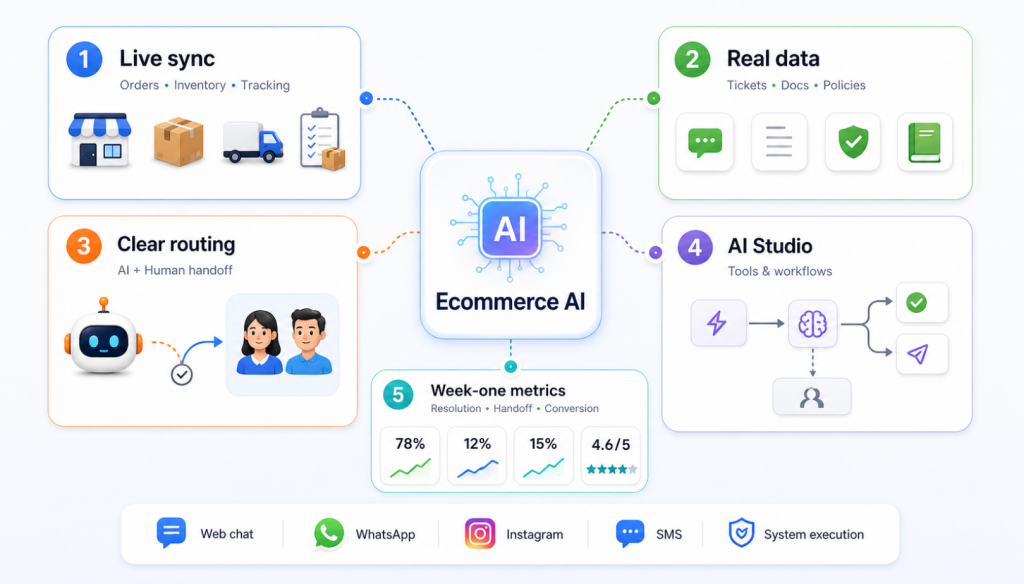
The most effective ecommerce AI deployments are built on a strong operational foundation.
YourGPT is an AI-native suite that supports customer service, sales workflows, and operational automation. Its performance comes from real-time integrations and structured training rather than static scripted flows.
Below is a practical launch sequence used in high-performing deployments.
Immediate value comes from connecting the AI directly to ecommerce platforms such as Shopify or WooCommerce. This enables:
When the AI operates on live data instead of cached or manually updated information, response accuracy improves dramatically and customer trust increases.
Strong performance requires training on real support ticket history, internal documentation, brand policies, and operational edge cases. Historical data exposes the AI to real customer phrasing, refund exceptions, subscription changes, and product-specific nuances.
This grounding reduces hallucination risk and increases first-contact resolution.
Effective deployments clarify ownership from the start. The AI takes responsibility for repetitive, rules-based, and data-driven workflows, resolving them without human involvement. Human agents step in for ambiguous situations, sensitive cases, or high-value edge scenarios that require judgment.
When routing is defined properly, transitions feel natural. Customers do not have to repeat themselves, and conversations move smoothly between automation and human support when needed.
For advanced use cases, AI Studio enables the creation of custom tools and workflow logic aligned with specific operational requirements. This moves beyond rigid decision trees and allows direct execution within order management, returns, and subscription systems.
Measurement starts in the first week. The focus is on how many conversations the AI resolves end to end, how often customers are routed to a human agent, and whether AI-assisted sessions contribute to completed purchases, recovered carts, or retained subscriptions.
It is equally important to review where the system struggled or lacked the right information. These early signals show which workflows need refinement and where automation can expand with confidence.
AI deployments built on real-time system integration and structured training generate measurable operational gains quickly. They improve resolution quality, reduce repetitive workload, and increase consistency across channels.
YourGPT provides AI-native infrastructure for ecommerce operations, with direct integrations for order management, returns, subscriptions, and unified customer identity across web chat, WhatsApp, Instagram, and SMS. Its architecture is designed for system-level execution rather than isolated conversational flows.
Over the next two years, the difference between ecommerce brands will not be who has a chatbot. It will be who built it into their operations deeply enough to remove real friction.
The brands that have actually reshaped their customer operations with AI tend to approach it differently. They do not frame it as a cost-cutting tool. They see it as part of the customer experience layer. Lower support costs follow, but the focus stays on resolution quality, workflow completion, revenue recovery, and data accuracy rather than simple ticket deflection.
They also treat knowledge as live infrastructure. When a return policy changes, when pricing shifts, when a new subscription rule goes live, the AI reflects that change immediately. It stays aligned with how the business actually operates.
Deployment is not treated as a one-time setup. Performance is reviewed regularly. Escalations are examined. Missed cases are studied. Workflows are adjusted. After several months, the system handles scenarios that were never part of the initial configuration because it has been shaped by real customer behavior.
What changes is not just automation of tasks. It is the creation of a support layer that improves over time and scales without adding headcount at the same pace as order volume. It becomes part of the workflows that manage orders, returns, and retention.
YourGPT is built around this operational model. It integrates directly with order management systems, returns logic, subscription platforms, and product catalogs while maintaining a unified customer identity across web chat, WhatsApp, Instagram, and SMS. The result is automation that works within the business systems themselves rather than operating as a separate chat interface.
YourGPT connects live store data, workflows, and customer conversations to help you handle orders, returns, and support tasks automatically across every channel.
Full access for 7 days · No credit card required
Learn how to judge Shopify AI resolution rates with clear formulas, a worked example, ticket-level checks and practical ways to improve support quality.
TL;DR B2B customer service means supporting multiple people within the same account, including end users, admins, finance or procurement contacts, and executive sponsors, each with a different definition of a resolved ticket. Traditional support bots handle one conversation at a time and often lose account context when requests move between contacts, channels, or teams, forcing […]
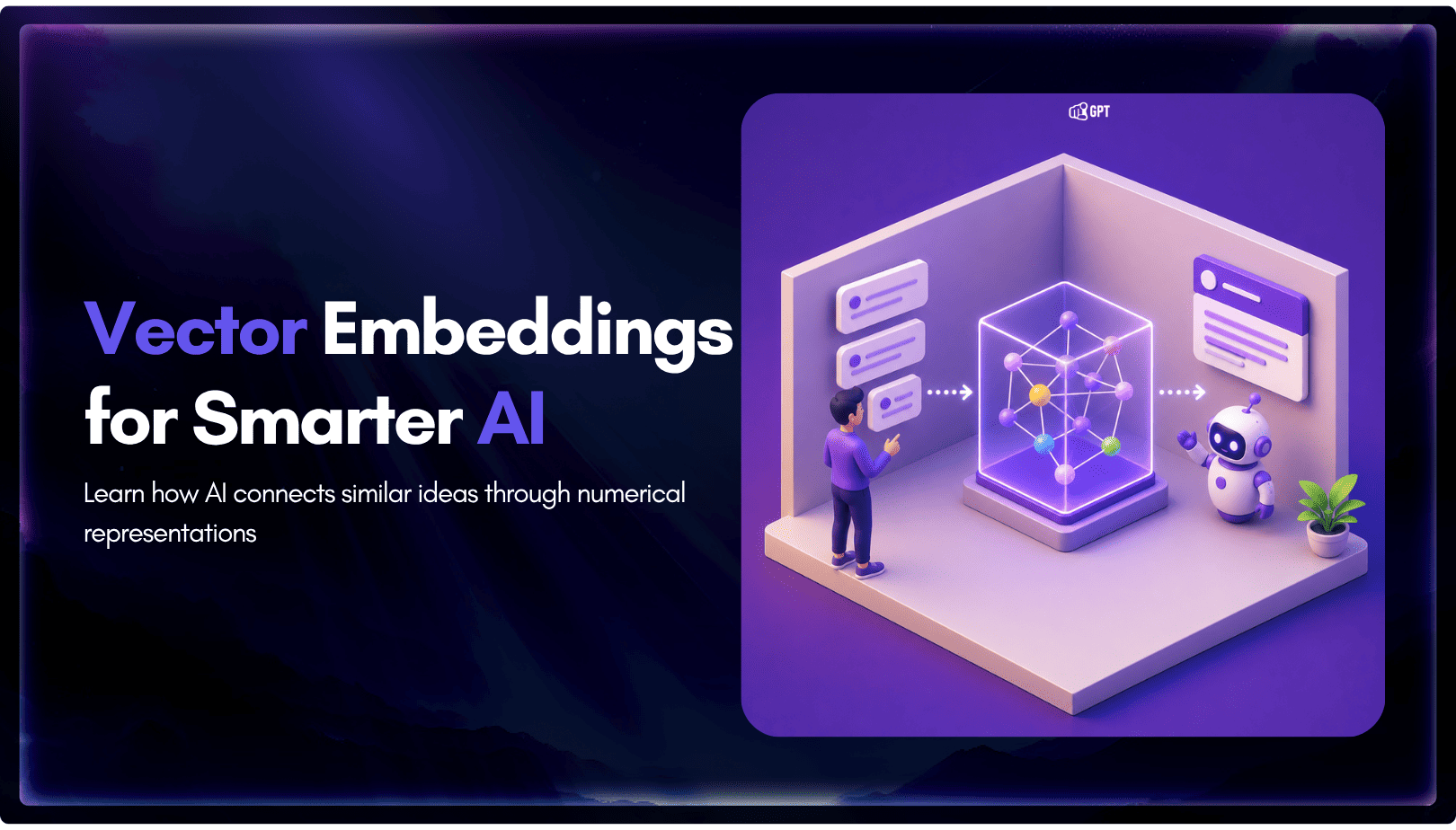
TL;DR A vector embedding is a list of numbers that represents meaning, placing similar concepts closer together in a mathematical space. AI chatbots use embeddings to match questions by meaning rather than exact wording, which is a core part of retrieval-augmented generation (RAG). Anthropic recommends Voyage AI for embeddings, while OpenAI, Google, and Cohere provide […]

TL;DR An FAQ chatbot answers repetitive questions by matching user queries with a knowledge base and returning grounded responses using rules, AI retrieval, or both. Modern FAQ chatbots use confidence checks to deliver instant answers for strong matches and fall back to broader retrieval or human handoff when confidence is low. Rule-based bots work well […]
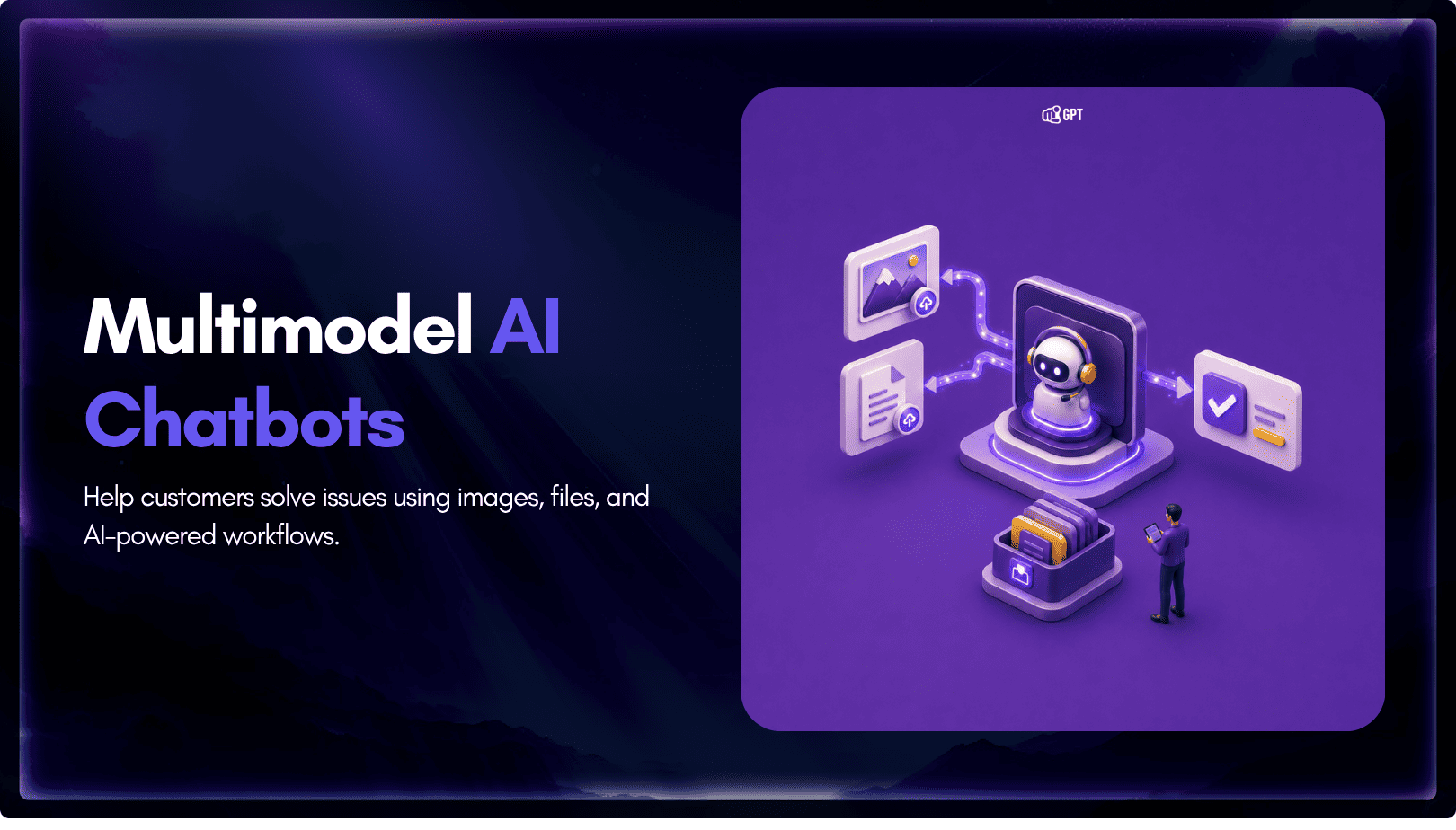
TL;DR Multimodal chatbots let customers share photos, screenshots, documents, video, or audio directly in a conversation, giving AI more context than text alone. YourGPT’s Attachment Capture node in AI Studio can collect these files mid-conversation, while vision-capable AI models can analyze and understand their contents. Key use cases include ecommerce returns, insurance and warranty claims, […]
A customer asks where their order is. A traditional bot pastes a tracking link and calls it done. An agentic system checks the carrier API, sees the shipment stuck at a depot, applies a credit under the delay policy, updates the CRM, and messages the customer before they’ve had time to get annoyed. Same question. […]