Foundations to Advanced AI: A Comprehensive Guide

Rohit Joshi
Last updated on August 5, 2026

Explore the fundamentals and advanced concepts of artificial intelligence, including machine learning, natural language processing, and voice AI.
The implementation of Artificial Intelligence (AI) models using its advanced Natural Language Processing (NLP) to understand and generate human like response is making a big difference in our daily lives.
Virtual assistants chatting like a real person easily passing the Turing test. As we type, the AI search engine understands what we need and generates the relevant response.
These technologies are changing how we interact with machines. Take, for example, AI chatbots like ChatGPT, which can provide information on most of the topic with just a few clicks. Similarly, an AI like YourGPT Chatbot helping businesses perform complex task along with knowledge base queries to improve customer interaction and enhance overall efficiency. Another example is Perplexity, which searches the web and finds the most relevant answer to your query by analysing various web pages.
Doesn’t it make you curious to learn more about AI?
In this blog post, we will start with the basics of AI and move to more advanced concepts. Our goal is to share with you how these technologies work and their applications in everyday life.

AI is the abbreviation for Artificial intelligence, is the capability of machines to carry out tasks that typically involve human intelligence, such as problem solving, learning, and decision making.
AI systems are trained on large amounts of data and use algorithms to make predictions or decisions based on that data.
AI is used for a wide range of applications, including speech recognition, image generation, analysis, natural language processing and so much more.
Now Let us explore a subset of AI known as machine learning (ML)

Machine learning is a branch of artificial intelligence that focuses on teaching computers to enhance their abilities on a particular task through experience, rather than being explicitly instructed. In other words, machine learning algorithms have the ability to learn from data and make predictions or decisions without needing explicit programming to perform those tasks.
Various forms of machine learning exist, such as:
Supervised learning is a type of machine learning in which an algorithm is trained on a labelled dataset, where the desired outputs are already known. The algorithm uses this labelled data to learn patterns and relationships between the input features and the output labels, so that it can make accurate predictions on new, unseen data.
There are two types of supervised learning:
Predicting a continuous output, such as predicting house prices based on features such as size, location, and age.
Predicting a categorical output, such as predicting whether an email is spam or not based on features such as the sender and subject line.
Unsupervised learning is a type of machine learning in which an algorithm is trained on an unlabelled dataset, where the desired outputs are not known in advance. The goal of unsupervised learning is to find patterns or structures in the data, such as clustering similar data points together or reducing the dimensionality of the data.
Some common unsupervised learning algorithms include:
Grouping similar data points together, such as clustering customers based on their purchasing behaviour.
Reducing the number of features in a dataset, such as reducing the number of pixels in an image.
Discovering relationships between variables in a dataset, such as discovering which products are often purchased together.
Reinforcement learning is a type of machine learning in which an algorithm learns by interacting with an environment and receiving rewards or penalties for its actions. The goal of reinforcement learning is to find the optimal sequence of actions that maximises the total reward over time.
The application of reinforcement learning is commonly seen in cases where the ideal behavior is not predetermined, such as in gaming or robot control. The method involves learning through trial and error, where the algorithm receives either rewards or punishments for its actions and adapts its behavior accordingly.
There are several commonly used algorithms in reinforcement learning:
Learning the optimal policy by updating a Q-table based on the rewards received for each action.
Using a deep neural network to approximate the Q-function in Q-learning, enabling the algorithm to handle high-dimensional state spaces.
Using separate networks for the policy (actor) and value function (critic), enabling the algorithm to learn both the optimal policy and the value function at the same time.
Deep learning is a type of machine learning that uses artificial neural networks with many layers (hence the term “deep”) to model complex, nonlinear relationships between inputs and outputs.
In a deep learning model, the layers are organised into a hierarchy, with each layer building on the features learned by the previous layer. The lowest layer learns the simplest features, while the highest layer learns the most complex features.
Deep learning models can be trained on large amounts of data and have shown impressive performance on tasks such as image classification, speech recognition, and natural language processing.
Some common types of deep learning models include:
Used primarily for image classification and object detection tasks, CNNs consist of convolutional layers that learn to detect features in the input images.
Used primarily for sequence data such as time series or natural language, RNNs have a “memory” that allows them to remember previous inputs and use that information to make predictions.
Used for generating realistic images, GANs consist of two neural networks — a generator that creates images and a discriminator that tries to distinguish between real and generated images.
Used for dimensionality reduction and feature extraction, autoencoders consist of an encoder that compresses the input data into a lower-dimensional representation and a decoder that reconstructs the original data from the compressed representation.
Machine learning has many applications, including image recognition, speech recognition, fraud detection, and recommendation systems, to name just a few.

AGI, short for Artificial General Intelligence. It refers to a form of artificial intelligence that will have the ability to understand, learn, and perform any intellectual task that a human being can. This includes abstract thought, reasoning, problem-solving, and learning from past experiences. An AGI system would be capable of handling complex, unfamiliar situations with human-like intelligence.
Currently, artificial intelligence systems are typically designed for specific tasks, referred to as narrow AI or weak AI.
Narrow AI means an AI that performs a specific task or a set of tasks.
Artificial General Intelligence (AGI), also known as strong AI, would have the potential to transform not just humanity but also the entire planet.

NLP, or natural language processing is a branch of artificial intelligence that focuses on the interaction between humans and computers using natural language.
The goal of NLP is to enable computers to understand, interpret, and generate human language, allowing humans to communicate with computers in a more natural way.
NLP uses linguistic, computer science, and machine learning techniques to achieve these tasks, including rule-based systems, statistical models, and deep learning models such as recurrent neural networks and transformer networks.

Natural Language Understanding (NLU) is a subtopic of Natural Language Processing (NLP) that focuses on machine reading comprehension. It is concerned with the interpretation of human language input and the extraction of meaning and intent from the text or speech.
NLU enables AI to understand the meaning of human language, such as context, semantics, and pragmatics, in order to accurately respond to or act upon the input. This includes tasks such as:
NLU is an essential component of conversational AI systems, chatbots, and virtual assistants, enabling them to engage in more natural and meaningful interactions with humans.

Natural Language Generation (NLG) is a subtopic of Natural Language Processing (NLP) that focuses on generating human-like text from structured data or unstructured information. The goal of NLG is to produce coherent, fluent, and contextually appropriate text that is indistinguishable from text written by a human.
Something tools like Walter’s humanizer platform are designed to enhance. These systems use various techniques and algorithms, including rule-based systems, statistical methods, and deep learning models like sequence-to-sequence and generative transformers.
NLG systems use various techniques and algorithms to accomplish this, including:
NLG has a wide range of applications, including:

A Large Language Model (LLM) is a type of deep learning model that is designed to process and generate natural language text. LLMs are typically based on transformer architecture and are trained on massive amounts of text data to learn the patterns and relationships between words and sentences.
LLMs have become increasingly popular in recent years due to release of ChatGPT and their remarkable ability to excel in various NLP tasks, including text generation, language translation, text summarization, question answering.
Some well-known LLMs include:
A parameter that controls the randomness in the model’s predictions by defining the probability mass that must be assigned to the most probable tokens.
A parameter that determines the number of potential tokens the model considers when generating the next token.
A scaling factor is used to modify the output probabilities generated by the model.
In the context of Large Language Models (LLMs) and natural language processing (NLP), context size is a parameter that defines the maximum length of the input sequence a model can process when making predictions.
For example, If a model has a context size of 1024 tokens, it can process up to 1024 tokens (words or characters) from the input text when generating output. If the input text is longer than the context size, the model might process it in chunks or use techniques like sliding windows or hierarchical processing to handle longer inputs.
Let’s understand it with a more simplified example:
Imagine you are reading a book. The context size is like how many pages you can look at while trying to understand a particular sentence. A larger context size means you can look at more pages (more text) to better understand the meaning of that sentence based on the surrounding information.
Context size plays an important role in the performance and capabilities of an LLM, as it affects the model’s ability to handle longer and more complex texts, as well as its memory usage and computational requirements.

Generative AI refers to a type of artificial intelligence that focuses on generating new content, rather than simply analyzing or classifying existing data. Generative AI models use various machine learning techniques to learn the patterns and relationships in a dataset and then generate new data that is similar in style or content to the training data.
Some commonly implemented applications of generative AI include:
Generative AI models can be used for various purposes, including creative expression, content creation, data augmentation, and automation of repetitive tasks.
Some popular generative AI models include Generative Adversarial Networks (GANs), Variational Autoencoders (VAEs), and Transformer-based models like GPT.

Conversational AI refers to the use of artificial intelligence technologies to create systems that can engage in human-like conversations with users. These systems are designed to understand, interpret, and respond to user queries and requests in a natural and conversational manner.
Conversational AI systems typically involve the integration of various components and technologies, including:
Conversational AI is commonly used in various applications, such as:
The goal of conversational AI is to provide users with an efficient, personalised, and human-like interaction that can help them accomplish tasks, access information, or simply engage in a pleasant conversation.

A chatbot, or chatter, is a specific type of bot designed for conversational interactions with users. Chatbots are often integrated into messaging platforms, websites, or mobile apps to provide real-time support, answer questions, or facilitate transactions.
Chatbots use various techniques, including Natural Language Processing (NLP), Machine Learning (ML), and Artificial Intelligence (AI), to understand and respond to user input. Some chatbots are rule-based, following pre-defined scripts and patterns to generate responses, while others use more advanced AI techniques to learn from user interactions and adapt their responses over time.
Chatbots have become increasingly popular in recent years, with applications ranging from customer service and e-commerce to entertainment and social interaction. They offer several benefits, such as 24/7 availability, instant responses, and cost-effectiveness for businesses.

An AI agent, also known as an intelligent agent or a virtual agent, refers to a computer program or system that uses Artificial Intelligence (AI) technologies to perform tasks or interact with users on behalf of another entity, such as a human user or an organisation.
AI agents are designed to operate autonomously, using machine learning, natural language processing (NLP), and other AI techniques to understand and respond to user input, make decisions, and execute actions. They can be used in a wide range of applications, including:
AI agents can be integrated into various platforms, such as websites, mobile apps, or messaging channels, to provide a seamless and intuitive user experience.

IVR stands for Interactive Voice Response, which is an automated telephony system that interacts with callers through voice commands and touch-tone keypad selections. IVR systems are commonly used by businesses and organisations to provide 24/7 customer support, automate repetitive tasks, and reduce call center workloads.
IVR works by presenting callers with a pre-recorded voice menu or series of prompts, which guide them through a set of options and actions. Depending on the caller’s selections, the IVR system can provide information, execute transactions, or connect the caller to a live agent for further assistance.

Retrieval-Augmented Generation (RAG) is a technique used to optimise the output of large language models, such as GPT, by incorporating knowledge from external sources. In simple words, RAG helps LLMs generate more accurate and relevant responses by referencing information from outside their original training data.
The purpose of RAG is to improve the performance of LLMs in specific domains or contexts, without the need for re-training the entire model. This makes RAG a cost-effective approach for enhancing LLM output, as it enables the model to stay up-to-date and useful in various situations.
RAG is particularly important in applications such as intelligent chatbots, where the goal is to create conversational AI systems that can provide accurate and helpful responses to user queries.
By using RAG, these systems can access new information from external sources, ensuring their responses remain relevant and informed. a better

Embeddings are a key concept in machine learning, particularly in natural language processing (NLP) and computer vision, which help represent data in a more meaningful and efficient manner. They involve mapping high-dimensional data, such as text or images, into a lower-dimensional space called an “embedding space” while preserving the important relationships and structure of the original data.
In NLP, embeddings are used to represent words or sentences as dense vectors in a multi-dimensional space. This allows models to understand the relationships between words and capture semantic and syntactic similarities. By representing words as dense vectors, machine learning algorithms can work with textual data more effectively, enabling tasks such as sentiment analysis, document classification, and translation.
Some of the popular embedding techniques in industry are Word2Vec, GloVe, BERT, and ELMo.

Semantic search refers to a search methodology that uses natural language processing (NLP) and machine learning (ML) techniques to understand the meaning and context of user queries. By using embeddings, which represent words and sentences as vectors in a high-dimensional space, semantic search captures the semantic relationships between terms. This approach enables search engines and other information retrieval systems to provide more relevant and accurate results for complex, conversational queries, outperforming traditional keyword-based search methods.
In semantic search, the system analyses the user’s query to identify the intent and entities involved, such as people, places, or things. It then uses this understanding to find and rank results that best match the user’s search intent, even if the exact keywords are not present in the query or the results.

The Turing test is a measure of a machine’s ability to exhibit intelligent behaviour that is indistinguishable from that of a human. Proposed by British mathematician and computer scientist Alan Turing in 1950, the test involves a human evaluator engaging in natural language conversations with a machine and a human, without knowing which is which.
Key points about the Turing Test include:
Some similar tests are the Multimodal Turing Test, The AI-Box Experiment and The Chinese Room Argument.

Evals is an abbreviation for “Evaluation Metrics.” Evaluation metrics are a set of quantitative measures used to assess the performance and capabilities of language models for specific tasks. These metrics help researchers and developers compare different models, identify their strengths and weaknesses, and drive improvements in model design and training.
Some common evaluation metrics are:

ASR is a technology that enables the recognition and conversion of spoken words into text by computers. It is a subfield of natural language processing (NLP) that focuses on capturing and transcribing human speech, allowing users to interact with systems and devices using their voices.
ASR systems work by analysing audio input and applying various algorithms and models to identify phonemes, words, and phrases in the speech signal. Some common approaches used in ASR include:

Text-to-Speech (TTS) is a technology that converts written text into spoken words or audio output. TTS systems take input in the form of text and use various algorithms, linguistic rules, and recorded speech segments to generate synthesised speech that resembles natural human speech.
TTS is an essential part of speech synthesis, which aims to create artificial speech that mimics the nuances and prosody of human speech. TTS systems use two main approaches to generate speech:

Speech-to-Speech (STS) have two main applications: Speech-to-Speech Translation (S2ST) and Speech-to-Speech Synthesis (STSS).
AI refers to machines performing tasks that normally require human intelligence. NLP is a branch of AI focused on understanding and processing human language. Machine learning is a method within AI that allows systems to learn from data without being explicitly programmed for every task.
Supervised learning trains algorithms using labelled data with known outputs. Unsupervised learning works with unlabelled data to identify patterns, relationships, or groupings without predefined outputs.
Context size defines how much input text a large language model can consider at one time. A larger context allows the model to process longer conversations or documents and generate more relevant and coherent responses.
Large language models use Natural Language Processing, Natural Language Understanding, and Natural Language Generation to interpret input, understand meaning and context, and produce human-like responses.
Embeddings convert words, sentences, images, or other data into numerical vectors. These vectors preserve semantic relationships, allowing AI systems to identify similar meanings and retrieve relevant information.
The Turing Test evaluates whether a machine can communicate in a way that is difficult to distinguish from a human. It remains an influential concept for assessing conversational behaviour in AI systems.
Generative AI is used for text generation, content creation, code writing, image synthesis, audio generation, video creation, game design, data augmentation, and workflow automation.
You can use a no-code platform such as YourGPT AI Chatbot to train a chatbot using your website, documents, FAQs, and business data. You can also build a custom chatbot using AI frameworks and development tools.
Automatic Speech Recognition converts spoken audio into written text. Text-to-Speech performs the opposite task by converting written text into spoken audio.
AI has changed the way we communicate every day. Virtual assistants can now have conversations that feel human and respond to our questions effectively. This shift goes beyond just communication; AI is making a big difference in many other areas too.
In this blog post, we try to explained concepts like AI, ML, and NLP, and topics such as RAG and speech AI.
AI industry is moving fast, and there’s huge potential for amazing new things like artificial general intelligence (AGI) or Artificial superintelligence (ASI). These advancements will help technology make our lives even better.
Start your AI journey now and transform your business.
Start for Free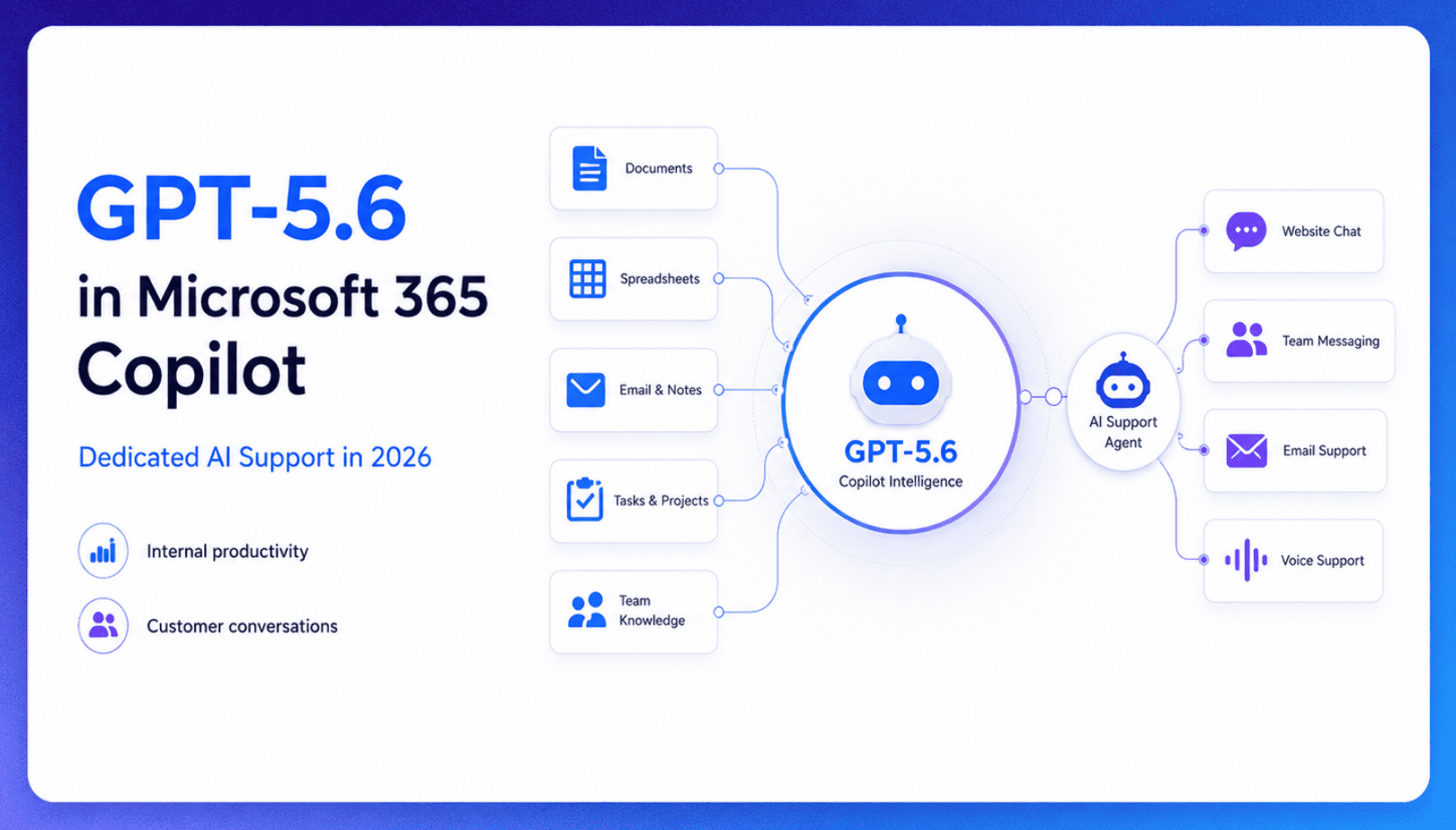
TL;DR Microsoft made GPT-5.6 the preferred model across Word, Excel, PowerPoint, Copilot Chat, and Cowork on July 9, 2026, focusing on internal workplace productivity rather than customer-facing support. Dynamics 365 Service Agent also reached general availability, but it mainly helps human support representatives manage cases within Microsoft’s existing permission structure and requires separate licensing. A […]

TL;DR Cheap frontier models now compete for the same high-volume support workloads, with DeepSeek V4 remaining the lowest-cost option in this comparison. Kimi K2.6 and GLM-5.2 are open-weight and self-hostable, while Qwen 3.7 Plus is proprietary and available only through an API. Claude Haiku 4.5 is the only model here that its developer explicitly recommends […]
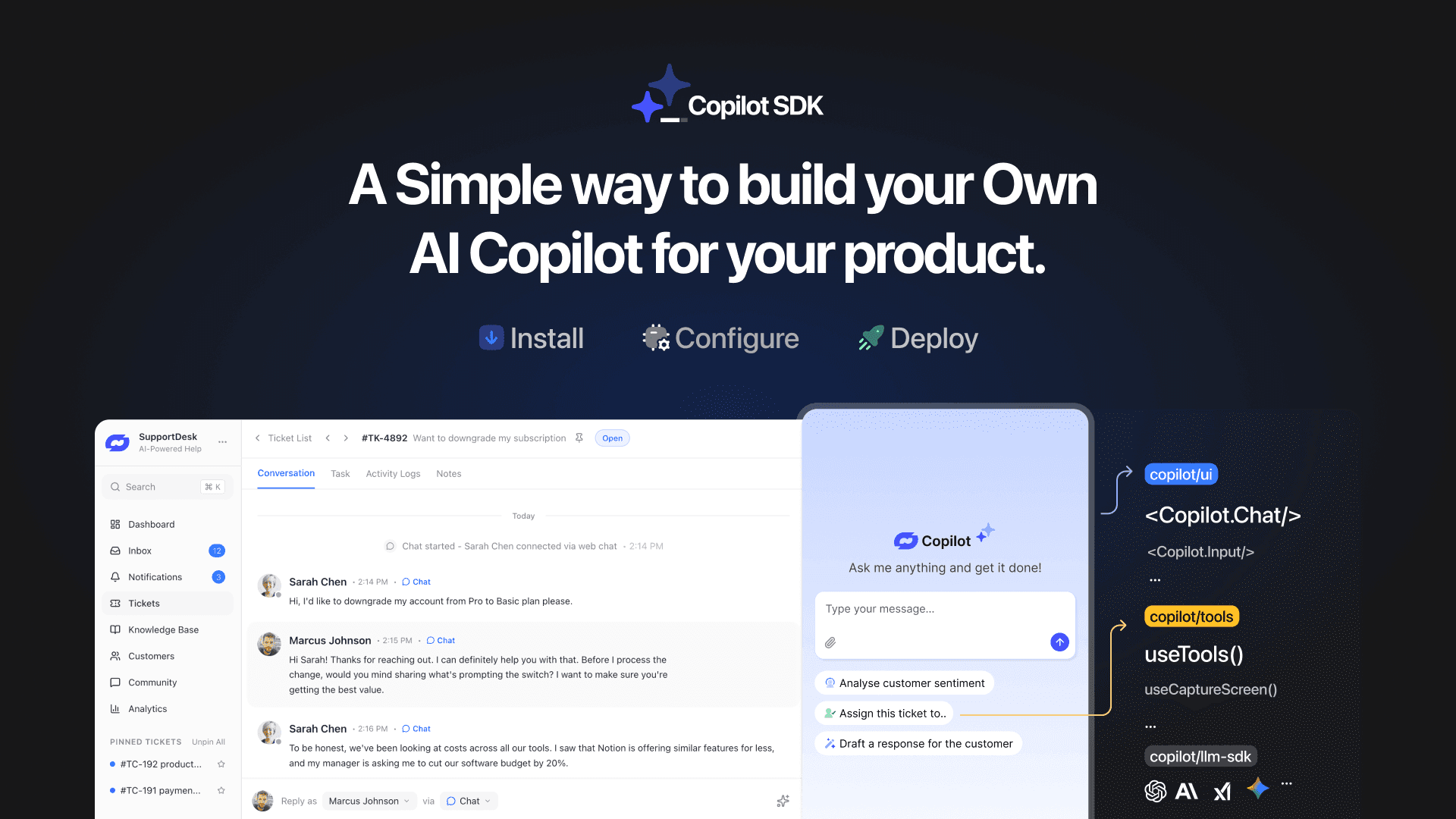
TL;DR YourGPT Copilot SDK is an open-source SDK for building AI agents that understand application state and can take real actions inside your product. Instead of isolated chat widgets, these agents are connected to your product, understand what users are doing, and have full context. This allows teams to build AI that executes tasks directly […]

TL;DR YourGPT 2.0 adds AI Studio for building, testing, and debugging automated workflows. It includes native MCP integration for more than 100 tools, upgraded voice agents, and native SDKs for iOS and Android applications. With shared context across web, WhatsApp, Instagram, Telegram, and mobile, YourGPT turns conversations into real actions across support, sales, and operations. […]
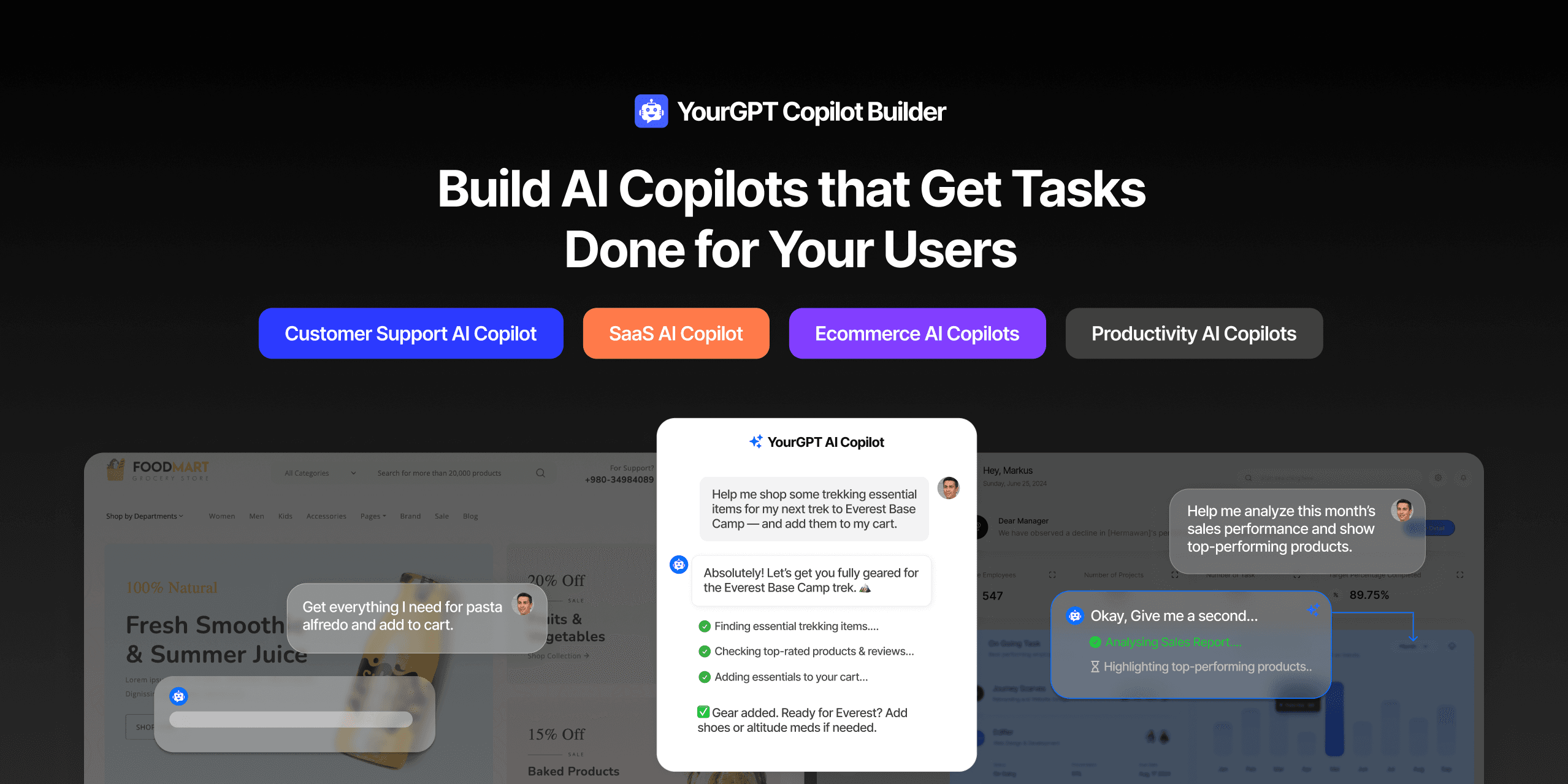
TL;DR Most AI tools provide answers but still leave users to complete the task through search results, settings pages, or checkout flows. AI Copilot Builder closes that gap by executing registered actions directly inside the product instead of only explaining what to do. Search, cart updates, account changes, and multi-step bookings can all happen within […]
TL;DR Building an AI-powered Telegram bot does not require custom development. BotFather provides the Telegram bot token, while a no-code platform like YourGPT handles AI training, free-form conversations, and the Telegram connection. This guide covers the full setup, from creating the bot in BotFather to connecting it with YourGPT and taking it live. Most Telegram […]
