Chatbot as a Service (CaaS): The Complete Business Guide for 2026

Rajni
Last updated on July 13, 2026
Customer conversations have become one of the most important parts of the customer experience, but they are also one of the hardest to scale. Businesses today are expected to provide instant responses across websites, messaging apps, social media, and support channels without significantly increasing support costs or team size.
This shift has made Chatbot as a Service (CaaS) one of the fastest-growing categories in customer experience technology. Instead of building and maintaining chatbot infrastructure in-house, businesses can subscribe to a cloud-based platform that provides AI-powered conversations, workflow automation, system integrations, analytics, and ongoing platform updates.
The value of CaaS extends well beyond answering frequently asked questions. Modern platforms can qualify leads, automate repetitive support requests, assist with customer onboarding, schedule appointments, retrieve information from business systems, and hand complex conversations to human agents with full context.
The difference between successful and unsuccessful deployments rarely comes down to the AI model itself. It depends on selecting the right use cases, connecting the chatbot to reliable business data, integrating it with existing workflows, and continuously improving performance using real conversation insights.
This blog explains everything businesses need to know about Chatbot as a Service in 2026, including how it works, where it delivers the highest return on investment, typical pricing models, emerging industry trends, and how to choose the right platform.
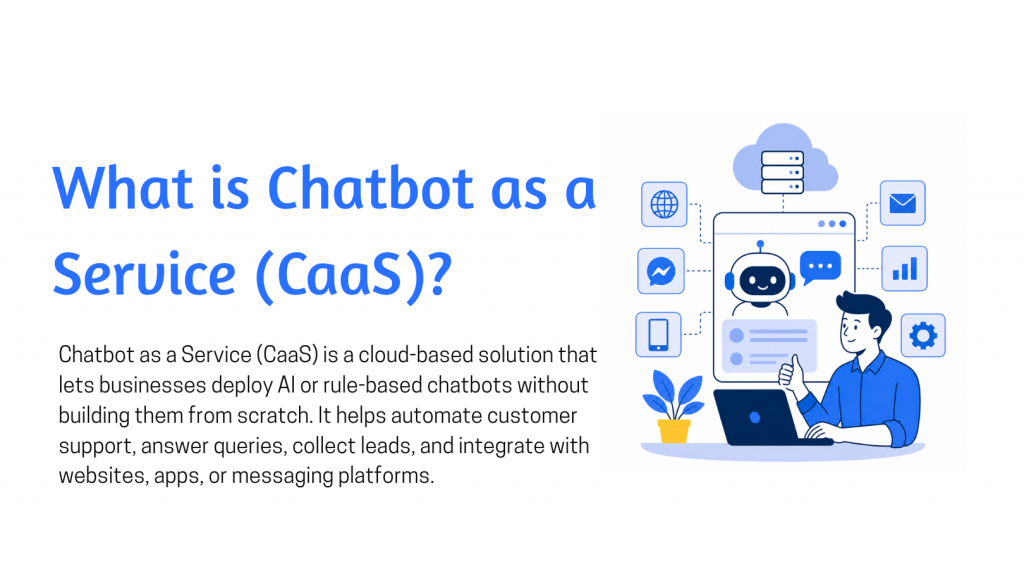
Chatbot as a Service (CaaS) is a cloud-based software model that allows businesses to deploy AI chatbots through a subscription instead of building and maintaining the technology themselves. The provider manages the infrastructure, platform updates, security, and maintenance, while your team focuses on conversation design, business workflows, integrations, and knowledge sources.
Much like a CRM or marketing automation platform, CaaS removes the complexity of building core technology from scratch. Instead, businesses configure the platform to support their own products, customers, and internal processes.
For most organizations, the biggest advantage is speed. A chatbot platform can often be deployed within days or weeks, depending on the number of integrations and workflows involved. Building a comparable solution internally typically requires significantly more time for architecture, development, testing, security reviews, deployment, and ongoing maintenance.
Unless a business requires highly specialized conversational logic or complete infrastructure control, Chatbot as a Service provides a faster, lower-risk, and more cost-effective path to deployment.
Chatbots have evolved far beyond simple website support widgets. Businesses are now adopting conversational AI to improve customer support, accelerate sales, automate repetitive work, and provide consistent customer experiences across multiple channels.
This shift is reflected in market growth.
According to Grand View Research, the global chatbot market was valued at $9.56 billion in 2025 and is projected to reach $41.24 billion by 2033, growing at a CAGR of 19.6% between 2026 and 2033.
More important than market size is how businesses are changing the way they use chatbots.
Until recently, many organizations treated chatbots as pilot projects or limited experiments. Today, they are becoming part of core business operations across customer support, sales, ecommerce, employee help desks, and customer onboarding.
Recent industry research highlights this transition:
These trends indicate that conversational AI is no longer viewed solely as a customer support tool. It has become part of broader customer engagement, revenue generation, and operational efficiency strategies.
Businesses already using CaaS platforms are expanding automation, improving integrations, and increasing workflow complexity. Organizations still evaluating chatbot adoption have significant opportunities, but the competitive advantage increasingly comes from learning through real customer conversations rather than delaying implementation.
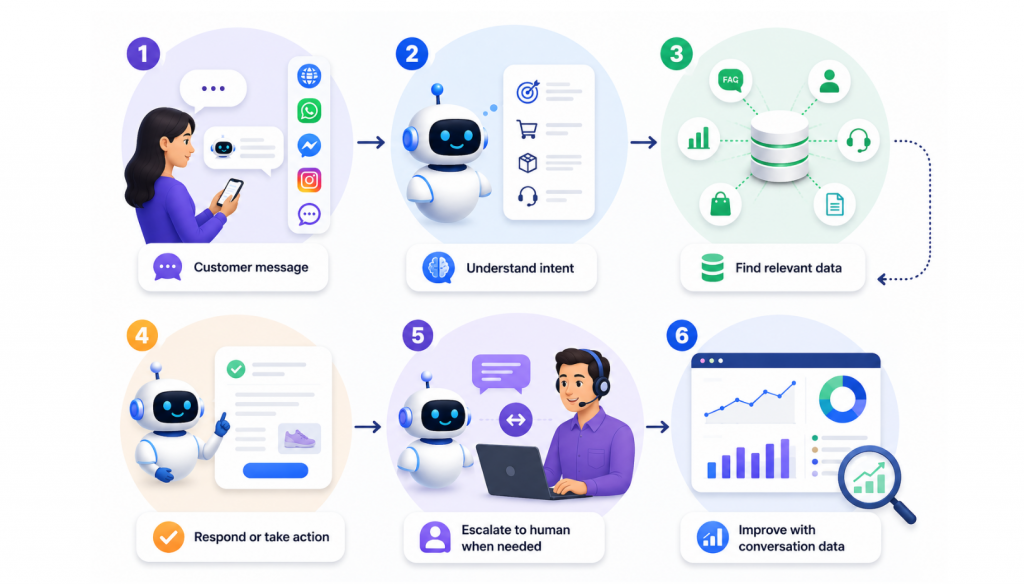
A Chatbot as a Service platform acts as the conversation layer between your customers and your business systems. Rather than operating as a standalone chatbot, it connects to the channels, applications, and data sources your business already uses.
These connections may include your website, mobile application, CRM, helpdesk, ecommerce platform, booking software, internal documentation, product catalog, knowledge base, or messaging channels such as WhatsApp and Facebook Messenger.
When integrated properly, the chatbot can understand customer requests, retrieve accurate information, complete predefined actions, and seamlessly involve human agents whenever necessary.
The process typically follows six stages.
Every interaction begins when a customer sends a message through one of your supported channels.
This could be a visitor asking about pricing on your website, a customer checking an order through WhatsApp, someone requesting technical support inside your application, or a shopper comparing products before making a purchase.
Instead of navigating multiple departments or contact forms, customers begin with a single conversational interface.
The platform analyzes the message to understand what the customer is trying to do. For example, the customer may want to track an order, reset a password, compare pricing plans, book a demo, return a product, check availability, or speak with support.
This intent recognition is what separates a modern CaaS platform from an old rule-based chatbot. Instead of forcing customers through rigid menu options, the chatbot can interpret natural language and match the request to the right workflow.
Once the chatbot understands the request, it looks for the right information. Depending on how the system is configured, it may pull from FAQ pages, product catalogs, help centers, CRM records, support ticket history, order management systems, inventory databases, or internal documents.
This is where many chatbot projects either succeed or fail. A chatbot is only as useful as the data it can access. If it is connected to outdated FAQs or incomplete information, it will produce weak answers. If it is connected to accurate business data, it can resolve real customer problems.
After finding the right information, the chatbot either gives the customer an answer or performs an action.
For support teams, that could mean answering a common question, creating a ticket, checking case status, or guiding the customer through troubleshooting. For sales teams, it could mean qualifying a lead, asking discovery questions, recommending a product, or booking a meeting. For ecommerce businesses, it could mean tracking an order, explaining return policies, checking product availability, or helping a customer choose between options.
This is the point where CaaS moves beyond simple automation. The chatbot is not just replying. It is helping complete the customer’s task.
Not every conversation should be automated. A good CaaS deployment knows when to stop and hand the customer to a human agent.
Escalation may happen when the issue is complex, emotional, high-value, sensitive, or outside the chatbot’s confidence range. When the handoff happens properly, the human agent receives the conversation history, customer details, and context, so the customer does not have to repeat everything.
The goal of CaaS is not to remove humans from customer experience. The goal is to remove repetitive work from human teams so they can focus on conversations that require judgment, empathy, negotiation, or problem-solving.
Every chatbot interaction creates useful performance data. Your team can review unanswered questions, failed responses, escalation patterns, conversion rates, customer satisfaction scores, and drop-off points.
That data shows where customers are getting stuck, which workflows need improvement, and which questions should be added to your knowledge base. Over time, the chatbot becomes more accurate because the business understands what customers are actually asking, not just what the team assumed they would ask.
The strongest CaaS deployments are built around this improvement loop. Launching the chatbot is only the starting point. The real value comes from reviewing the data, improving workflows, expanding integrations, and training the system around real customer behavior.
Businesses often associate Chatbot as a Service with lower support costs and 24/7 customer service. While those are important advantages, they represent only part of the value.
The biggest benefit of CaaS is its ability to improve how customer conversations are managed across support, sales, marketing, and operations. By automating repetitive interactions and connecting conversations with business systems, organizations can improve efficiency, respond faster, and deliver more consistent customer experiences.
The following benefits explain why CaaS has become a strategic investment for businesses in 2026.
1. Lower Support Costs : One of the most immediate benefits of CaaS is reducing the cost of handling repetitive customer conversations.
Tasks such as order tracking, password resets, appointment confirmations, billing questions, return policies, and account updates consume a significant portion of most support teams’ workload. These interactions follow predictable workflows and can often be automated without affecting customer experience.
As chatbot performance improves through better knowledge sources and workflow optimization, the percentage of automated conversations typically increases over time.
For example, if a business receives 20,000 support conversations each month and automates 40% of them, approximately 8,000 conversations no longer require full human involvement. Assuming an average human support cost of $6 per interaction and an AI-assisted cost of $0.50 per interaction, this could represent annual savings of hundreds of thousands of dollars before accounting for platform costs.
The long-term advantage is scalability. While growing customer demand usually requires hiring additional agents, a well-managed CaaS platform can absorb much of that growth with minimal additional operational cost.
2. Increase Revenue : CaaS is equally valuable for revenue generation. Customers frequently have questions while evaluating products or services. Delayed responses during these high-intent moments often result in lost opportunities.
An AI chatbot can engage visitors immediately by:
Because these conversations happen in real time, businesses can continue moving prospects through the buying journey even outside business hours.
Instead of acting solely as a support channel, the chatbot becomes an active contributor to lead generation and sales.
3. Scale During Peak Demand : Customer demand is rarely consistent throughout the year. Seasonal campaigns, product launches, promotional events, shipping delays, and unexpected service disruptions can generate large spikes in conversation volume.
Hiring temporary support staff for short-term increases is often expensive and time-consuming.
CaaS provides operational flexibility by automatically handling routine requests such as:
Human agents remain focused on complex situations that require investigation, decision-making, or empathy, while the chatbot manages predictable requests at scale.
4. Improve Service Consistency : Support quality naturally varies between individual agents. Different team members may explain the same policy differently, new employees require training, and response quality can fluctuate during busy periods.
A properly configured chatbot delivers approved information consistently across every conversation.
It follows predefined workflows, applies the same business rules, maintains brand tone, and escalates conversations according to established policies.
This consistency is particularly valuable in industries such as finance, healthcare, insurance, education, travel, and legal services, where inaccurate information can create compliance or operational risks.
Rather than replacing human expertise, the chatbot handles repeatable conversations while allowing specialists to focus on situations that require professional judgment.
5. Generate Customer Insights : Every chatbot conversation provides valuable operational data.
Businesses can identify:
These insights extend beyond customer support.
Repeated pricing questions may indicate unclear pricing pages. Frequent return policy questions could highlight gaps in product descriptions. Large volumes of order tracking requests may reveal opportunities to improve post-purchase communication.
Viewed this way, CaaS becomes more than an automation platform. It becomes an ongoing source of customer intelligence that helps improve products, documentation, marketing, sales, and support operations.
6. The Business Value of CaaS : The success of a Chatbot as a Service deployment should not be measured solely by the number of conversations it handles.
More meaningful metrics include:
Organizations that treat chatbot performance as a continuous optimization process typically achieve significantly greater long-term value than those that view deployment as a one-time project.
Successful chatbot implementations begin with a clearly defined business objective rather than a decision to “add a chatbot.”
The strongest return on investment comes from automating conversations that are frequent, structured, and directly connected to measurable business outcomes.
Below are the use cases where Chatbot as a Service consistently delivers the greatest value.
Ecommerce businesses manage thousands of repetitive customer questions every month, making them one of the strongest candidates for chatbot automation.
Customers commonly ask about:
Instead of waiting for an agent, shoppers receive immediate assistance while remaining on the website.
Beyond answering questions, modern chatbots can recommend products, suggest alternatives when items are unavailable, recover abandoned carts, and guide customers through checkout.
These capabilities improve both customer satisfaction and conversion rates while reducing support workload.
Customer support remains the most common starting point for CaaS adoption.
The highest-impact opportunities are repetitive Tier 1 requests, including:
Automating these requests allows support teams to dedicate more time to complex issues.
Equally important is intelligent escalation.
When the chatbot cannot resolve a request, it should collect relevant customer information, summarize the conversation, classify the issue, and transfer everything to the appropriate support agent.
This reduces handling time while creating a smoother customer experience.
The first few days after user registration often determine whether a customer becomes an active user or eventually churns.
Within SaaS products, chatbots can guide new users through onboarding by:
These conversations reduce onboarding friction while helping users reach value more quickly.
At the same time, chatbot analytics help product teams identify recurring onboarding problems and improve the product experience over time.
Healthcare organizations benefit most when chatbots automate administrative tasks rather than clinical decision-making.
Typical use cases include:
These high-volume interactions reduce administrative workload while improving patient convenience.
Healthcare deployments should also include strict security controls, regulatory compliance, and clear escalation paths whenever medical judgment is required.
Website visitors often arrive with strong purchase intent but leave because their questions remain unanswered.
A chatbot can engage prospects immediately by:
This is particularly effective on pricing pages, product pages, comparison pages, and demo request pages where buying intent is highest.
Responding immediately while interest is still active significantly increases the likelihood of conversion.
Not every business process should be automated.
The most successful chatbot implementations share three characteristics.
| Characteristic | Why It Matters |
|---|---|
| High Volume | Automation delivers the greatest savings when conversations occur frequently. |
| Clear Intent | The chatbot can accurately identify what the customer wants. |
| Repeatable Workflow | The response or action follows a predictable process. |
Order tracking, appointment scheduling, lead qualification, onboarding assistance, return requests, and Tier 1 support consistently meet these criteria.
Rather than launching a chatbot for every department at once, businesses achieve better results by focusing on one high-impact workflow, measuring performance, and expanding automation as confidence and experience grow.
The current generation of CaaS platforms is no longer limited to basic FAQ automation. Many platforms now support integrations, live-agent handoff, workflow automation, analytics, and AI-assisted responses. But the platforms pulling ahead are not just getting better at answering questions. They are changing what a chatbot can actually do for the business.
These four shifts are worth watching because they will shape how companies evaluate CaaS platforms over the next two years.
The biggest shift in CaaS is the move from chatbots that respond to chatbots that act.
An older chatbot might tell a customer how to request a refund. An agentic chatbot can check the order, confirm eligibility, initiate the refund, send the confirmation, and close the ticket without requiring a human agent for every step.
That difference matters. When a bot only answers questions, the human team still has to complete the task. When the bot can complete the workflow, the business removes more manual work from the process.
Gartner describes this shift as a move from AI systems that generate text or summarize interactions to agentic systems that can act autonomously to complete tasks. Gartner also predicts that agentic AI will autonomously resolve 80% of common customer service issues by 2029.
For high-volume support teams, this has a direct staffing impact. The more complete resolutions the bot can handle, the more human agents can focus on cases that require judgment, empathy, negotiation, or exception handling.
The key requirement is control. Agentic bots should not have unlimited authority. Refunds, cancellations, account changes, billing actions, and sensitive customer decisions need clear permissions, audit trails, and escalation rules.
Most chatbot deployments are reactive. A customer opens the chat, asks a question, and the bot responds.
The next stage is proactive engagement. Instead of waiting for the customer to ask for help, the bot starts the conversation when behavior shows intent or friction.
For example, a customer spends several minutes on the pricing page without converting. The bot offers to answer questions. A SaaS user has not logged in for 10 days. The bot sends a re-engagement message with a helpful resource. A subscription renewal is coming up in two weeks. The bot checks whether the account is healthy before the renewal date.
This changes the role of CaaS. It is no longer only a support tool. It becomes part of sales, retention, onboarding, and customer success.
The value is timing. A chatbot that appears at the right moment can reduce hesitation, answer objections, guide users to the next step, and prevent avoidable churn. Gartner also notes that agentic AI has potential for proactive issue identification and resolution, which supports this shift from reactive support to proactive service.
The risk is overuse. Proactive chat should be based on useful signals, not annoying pop-ups. If the bot interrupts too often, it damages the experience instead of improving it.
Many chatbot deployments still treat each channel separately. A customer starts on the website, switches to WhatsApp, and follows up by email. At each step, the customer may have to explain the problem again.
That is one of the biggest weaknesses in automated support.
The better model is omnichannel context: one shared customer history across chat, email, social, messaging apps, and support tickets. When this works well, the bot and the human agent can both see what already happened, what the customer asked, what was answered, and what still needs to be resolved.
Freshdesk positions its omnichannel support around handling customers across channels with AI, context, and workflows in one connected view. Salesforce also describes Einstein Bots as multi-channel bots that can integrate with Salesforce data.
This should be on the CaaS evaluation checklist now. The question is not just, “Does the chatbot work on WhatsApp, email, and website chat?” The better question is, “Does the customer context travel across those channels?”
Without shared context, omnichannel support becomes multi-channel support with extra friction.
A year ago, many businesses did not think much about which large language model powered their chatbot. That has changed.
Enterprise buyers now care about model flexibility because LLM pricing, performance, latency, privacy rules, and regional compliance requirements can change quickly. A model that works well today may not be the best choice a year from now.
A platform that locks the business into one model creates risk. If costs rise, performance drops, or compliance rules change, switching becomes difficult. A more flexible platform lets the business choose the best model for the task or switch providers without rebuilding the entire chatbot setup.
Voiceflow, for example, explicitly promotes avoiding model lock-in by letting teams choose from major LLM providers or bring their own model. Its documentation also describes fallback LLM providers for outage protection.
This is becoming an important procurement question:
Can the business change the underlying model without rebuilding the chatbot from scratch?
For small teams, this may not matter immediately. For larger companies, regulated industries, and high-volume support operations, model flexibility is becoming part of long-term risk management.
The Chatbot as a Service market offers hundreds of platforms, each promising faster support, higher automation, and better customer engagement. Choosing the right platform is less about comparing feature lists and more about selecting a solution that aligns with your business goals, workflows, and long-term growth.
The most successful deployments begin with a clear business objective, integrate with existing systems, and expand gradually based on measurable results.
Use the following checklist to evaluate potential CaaS providers.
The biggest mistake companies make is starting too broad. They want one chatbot for support, lead generation, onboarding, internal helpdesk requests, and customer success all at once. That usually creates a weak generalist deployment.
Start with the use case that has the highest volume and clearest ROI. For ecommerce, that may be order tracking or cart recovery. For SaaS, it may be onboarding or product support. For service businesses, it may be appointment booking or lead qualification.
Build one use case well, measure the results, then expand.
Every vendor demo looks polished. The real test is how the chatbot handles your actual customers.
Before committing, test the platform with 20 to 30 real customer messages from your support history. Include misspellings, vague questions, incomplete sentences, emotional complaints, and edge cases specific to your business.
Pay attention to what happens when the bot does not know the answer. Does it guess, ask a follow-up question, or escalate properly? That tells you more than a scripted demo.
Before testing, remove personal data, payment details, account numbers, and anything sensitive.
A chatbot that cannot connect to your core systems will have limited value.
Before comparing platforms, list the tools the chatbot must connect with on day one: your CRM, helpdesk, ecommerce platform, booking system, knowledge base, payment system, or internal database.
Then check whether those integrations are native and deep enough. A basic connection that sends a notification is not the same as one that can update records, create tickets, check order status, or trigger workflows.
The key question is simple: can the chatbot take action inside the systems your team already uses?
Basic analytics show conversation volume, deflection rate, and escalation count. That is not enough.
A strong CaaS platform should show where conversations fail, which questions the bot cannot answer, where users drop off, which topics create escalations, and which chatbot-assisted sessions convert best.
This is what helps your team improve the bot after launch. Without deeper analytics, the chatbot becomes something you set up once and rarely optimize.
Ask every vendor where conversation data is stored, who owns it, how long it is retained, whether it is used to train models, and which subprocessors can access it.
This matters for regulated industries, but it also matters for any business handling customer names, emails, phone numbers, order details, billing issues, or sensitive complaints.
If you operate in healthcare, finance, education, or serve EU customers, review privacy, security, GDPR, HIPAA, and data-processing requirements before signing a contract.
AI quality matters, but control matters just as much.
The platform should let you define what the chatbot can answer, what it should avoid, when it must escalate, and which actions require human approval. This is especially important for refunds, billing changes, cancellations, account access, medical questions, financial topics, or legal issues.
Look for confidence thresholds, human handoff rules, audit logs, fallback responses, role-based access, and conversation review tools.
Do not choose a CaaS platform based only on the cheapest plan.
The real cost may include agent seats, AI conversations, resolved-interaction fees, WhatsApp or SMS charges, CRM integrations, multilingual support, analytics, implementation, and premium support.
The better question is not “Which platform is cheapest?”
It is “Which platform gives us the lowest cost per useful outcome?”
That outcome may be a resolved ticket, a booked demo, a recovered cart, a completed appointment, or a qualified lead.
The best CaaS platform is the one that solves one important use case well, connects cleanly to your systems, gives you useful performance data, and gives your team enough control to expand automation safely.
Chatbot as a Service (CaaS) is a cloud-based platform that lets businesses deploy AI chatbots without building and maintaining the underlying infrastructure. Instead of developing a chatbot from scratch, businesses can use platforms like YourGPT to automate customer support, qualify leads, answer questions, and integrate AI with their existing business systems.
For most businesses, Chatbot as a Service offers a faster and more cost-effective approach. A CaaS platform manages infrastructure, AI updates, security, and maintenance, allowing teams to focus on delivering better customer experiences. Custom-built chatbots provide greater flexibility but typically require higher development costs, longer implementation timelines, and ongoing maintenance.
Modern CaaS platforms can automate customer support, qualify leads, recommend products and services, book appointments, retrieve information from CRMs and knowledge bases, route conversations to human agents, and automate business workflows through integrations. Platforms like YourGPT combine conversational AI with workflow automation to help businesses streamline customer interactions across multiple channels.
Implementation depends on the complexity of your business processes and integrations. A basic chatbot connected to a website and knowledge base can often be deployed within days, while larger implementations involving CRM, helpdesk, and workflow automation may take several weeks. Most businesses achieve the best results by launching one high-impact use case first and expanding over time.
When evaluating a CaaS platform, look beyond pricing. Consider AI accuracy, integration capabilities, workflow automation, analytics, security, scalability, and ease of management. The right platform should fit your business processes today while giving you the flexibility to expand as your requirements grow. YourGPT supports businesses with AI-powered conversations, knowledge base integration, workflow automation, and omnichannel deployment from a single platform.
YourGPT helps businesses build AI chatbots that do more than answer questions. With support for knowledge bases, websites, documents, APIs, CRM integrations, helpdesks, workflow automation, and human handoff, businesses can automate customer support, engage leads, and streamline operations from one platform. Whether you’re launching your first AI chatbot or scaling enterprise automation, YourGPT provides the flexibility to grow with your business.
Chatbot as a Service has evolved from a simple customer support tool into a business platform that helps organizations automate conversations, improve operational efficiency, and deliver better customer experiences at scale.
Its value extends beyond answering frequently asked questions. Modern CaaS platforms support lead generation, customer onboarding, appointment scheduling, ecommerce assistance, workflow automation, and intelligent handoffs that allow human teams to focus on higher-value work.
Success depends less on choosing the platform with the longest feature list and more on solving the right business problem. Businesses that begin with a clearly defined use case, integrate the chatbot with reliable business systems, and continuously refine performance using real conversation data consistently achieve better long-term results.
As conversational AI continues to become more capable, Chatbot as a Service will play an increasingly important role in customer engagement, sales, and business operations. Organizations that invest in thoughtful implementation today will be better positioned to deliver faster service, improve efficiency, and scale customer interactions as expectations continue to grow.
If your goal is to automate customer support, qualify leads, streamline business workflows, and deliver AI-powered conversations across multiple channels, YourGPT provides a flexible Chatbot as a Service platform that helps businesses turn conversational AI into measurable business outcomes.
Turn customer conversations into measurable business outcomes with YourGPT. Automate support, qualify leads, answer questions from your business knowledge, and connect AI to the tools your team already uses all from a single Chatbot as a Service platform.
No credit card required • Deploy your AI chatbot in minutes
TL;DR Insurance platforms are using AI to automate claims support, quote intake, and policy servicing, reducing reliance on call centers and static forms. This guide compares five commonly shortlisted platforms: YourGPT, Ada, Sierra AI, Decagon, and Forethought. None are purpose-built exclusively for insurance, so configuration flexibility and proven insurance use cases matter. Pricing ranges from […]

TL;DR The core distinction is retrieval versus training. RAG pulls outside documents into a prompt when an answer is generated, while fine-tuning changes a model’s weights during a separate training step. The 2026 shift matters because OpenAI’s wind-down of its self-serve fine-tuning platform, announced in May 2026, closed off the default path many teams expected […]
TL;DR Real deployments show measurable results. Georgia Tech’s Jill Watson achieved 78.7% classroom question accuracy compared with 30.7% for a stock OpenAI Assistant, while Georgia State’s Pounce chatbot improved enrollment outcomes in a randomized controlled trial. The strongest use cases are admissions, student services, and staff workload reduction rather than homework assistance. Guardrails matter more […]
TL;DR AI is now part of most SEO workflows, but the real advantage comes from using it within a disciplined process rather than simply producing content faster. As Google AI Overviews and tools like ChatGPT answer more queries directly, content must be structured to earn both traditional search rankings and citations from AI assistants. AI […]
TL;DR Restaurant AI agents help reduce staffing pressure by handling reservations, food orders, and customer inquiries around the clock without increasing headcount. Unlike basic chatbots, they integrate with booking systems, POS platforms, and messaging channels to automate reservations, order processing, and routine customer support. The biggest benefits include automated reservation management, order intake across phone, […]
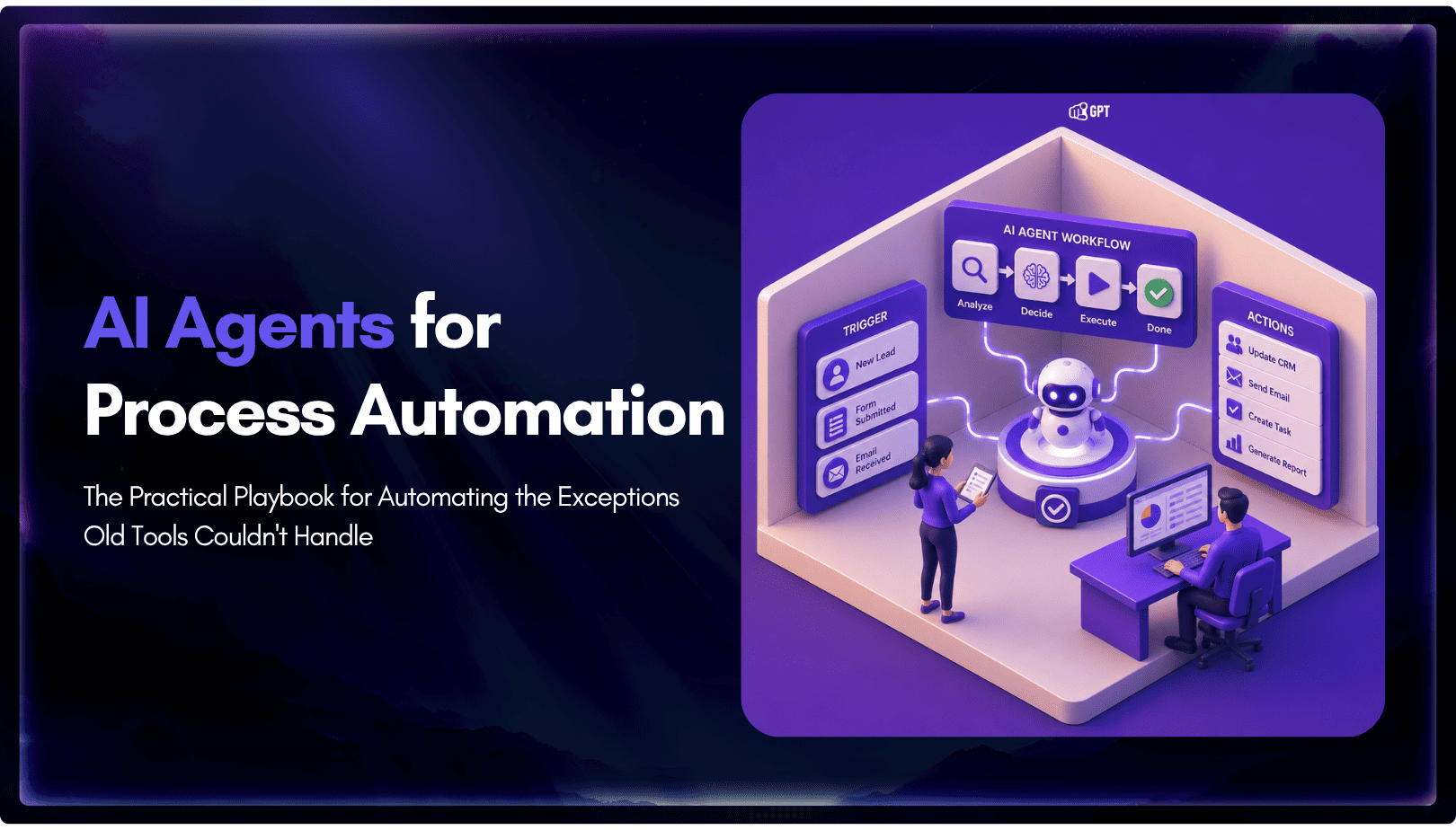
TL;DR Business process automation with AI agents lets software plan multi-step work, call tools, and handle exceptions instead of following fixed scripts like traditional RPA. AI agents can adapt when a process changes, but that flexibility also requires clear permission boundaries, reliable data, and human oversight for consequential actions. Start with one repetitive process, document […]