7 Best AI Chatbots for E-commerce Websites

Akansha
Last updated on April 8, 2026
AI chatbots are now became essential tools for e-commerce brands aiming to increase sales, reduce workload, and offer faster support.
80% of customer service organizations will use generative AI in some form by 2026. E-commerce is leading that shift—using chatbots to answer common queries, assist with purchases, and even recover abandoned carts.
During the 2024 holiday season, AI-powered chatbots helped drive a 4% rise in online sales, reaching $282 billion in the U.S
These numbers aren’t surprising when you consider how modern chatbots handle everything from product recommendations to delivery updates—24/7, without delay.
In this blog, we’ll cover:

E-commerce chatbot is an AI tool that handles customer queries on online shopping platforms. It works through websites, apps, and messaging services like WhatsApp and Instagram to understand and respond to customers in real-time.
These chatbots help with various shopping tasks – answering product queries, suggesting items based on customer preferences, providing order updates, handling return requests, and processing payments within the chat itself.
Modern chatbots connect directly with your business systems – they check your inventory database for product availability, use customer information from your CRM to personalize interactions, and link with payment gateways for smooth transactions.
The main benefit is practical – customers get immediate assistance whenever they shop (even late night), while your business saves on support costs and increases sales by converting more visitors into customers.
AI chatbots have become a key part of how e-commerce businesses run in 2026. They do much more than reply to customer queries—they help drive sales, save time, and keep the experience smooth for everyone involved. Here’s how they add real value to your online store:
Customers expect quick answers. AI chatbots instantly respond to common questions—like tracking orders, handling returns, or resolving payment issues. And if things get tricky, the chatbot smoothly connects your customer with a human representative.
Not every visitor is ready to buy immediately. Chatbots engage shoppers in conversation, collecting details like their interests and contact info. This information can instantly go into your CRM, helping your sales team quickly identify and act on the best opportunities.
Instead of just showing standard products, AI chatbots suggest items based on what each customer browses or buys. This personalized touch helps shoppers find what they’re looking for faster and encourages more sales.
Chatbots aren’t shy about selling. They can suggest add-ons or better alternatives right when the customer is making their choice, or follow up if a customer leaves items in their cart. These targeted recommendations help drive higher average order values.
Manual tasks slow your team down. AI chatbots handle repetitive activities automatically—processing returns, cancellations, scheduling appointments, or sending delivery confirmations—freeing your staff for tasks that really matter.
Customers prefer simple searches over complicated filters. Chatbots understand everyday language like “Show me black running shoes under $50,” helping shoppers quickly find exactly what they want, especially on mobile.
The best AI chatbots in e-commerce aren’t just smart—they’re practical. Here’s a breakdown of the core capabilities that make them valuable in real business use:
Connect with shoppers wherever they are—your website, mobile app, WhatsApp, Instagram, Facebook Messenger, and more. The chatbot should carry conversations across platforms without losing context.
Understand customer intent across multiple messages. Whether a user asks about shipping, returns, or products in separate messages, the chatbot should keep track and respond accordingly.
Let customers check order status, initiate returns, or ask about delivery—all from the chat window. A good chatbot connects directly to your order system to give instant, accurate answers.
Serve a global customer base by responding in multiple languages. Language detection, auto-translation, and local currency display help reduce friction and improve conversions.
Some customers prefer speaking over typing. Voice chatbots allow for real-time spoken interactions—ideal for mobile shoppers or accessibility needs.
When the chatbot reaches its limit, it should pass the conversation to a live support agent. All chat history, user data, and context must carry over for a smooth handoff.
Connect your chatbot to tools you already use—Shopify, WooCommerce, Salesforce, or HubSpot. This allows the bot to access order data, customer profiles, and update your CRM automatically.
Go beyond text. Send product carousels, images, videos, or payment buttons directly in chat to drive engagement and speed up decisions.
1. YourGPT: A no-code AI chatbot builder with multilingual support, API integrations, and custom workflows for sales, support, and automation.
2. Tolstoy AI Shopper: A video-first AI shopping assistant with shoppable videos, product discovery, and virtual try-ons to improve conversions.
3. Gorgias: An eCommerce support platform with deep Shopify integration, enabling automation for order tracking, refunds, and customer queries.
4. Intercom (Fin AI): An advanced AI chatbot with omnichannel messaging, CRM integration, and automated workflows for scalable customer support.
5. Octane AI: Shopify-focused chatbot platform offering quizzes and product recommendations to personalize the buying experience.
6. Chatfuel: A social commerce chatbot platform for WhatsApp, Instagram, and Messenger, designed for lead generation and sales automation.
7. BotStar: A drag-and-drop chatbot builder with CRM integrations and multi-language support for fast deployment without coding.
| Tool | Best for | Pricing shape | Website fit | Why it stands out | Main tradeoff |
|---|---|---|---|---|---|
| YourGPT | On-site sales, support, and automation across channels | Affordable, usage-based (varies) | High | Combines support, sales, and operations with custom AI workflows | Smaller vendor compared to incumbents |
| Tolstoy AI Shopper | Product discovery and conversion via video | Custom pricing (~$99+) | High (Shopify-focused) | Video-first shopping with shoppable content and AI guidance | Limited beyond Shopify ecosystems |
| Gorgias | Shopify support and order management | From $10–$60/month | Medium-high | Deep Shopify integration with direct order actions | More support-focused than conversion-focused |
| Intercom (Fin AI) | Scalable AI support for growing brands | From $29/seat + usage | High | Advanced AI resolution with strong automation and CRM | Higher cost and setup complexity |
| Octane AI | Personalized product recommendations | Shopify-based plans | Medium-high | Quiz-based personalization that increases conversions and AOV | Primarily Shopify-focused |
| Chatfuel | Social commerce and messaging automation | Free tier + paid plans | Medium | Strong automation for WhatsApp, Instagram, and Messenger | Limited for on-site website support |
| BotStar | Quick no-code chatbot deployment | Tiered pricing (SMB-friendly) | Medium | Easy drag-and-drop builder with multilingual support | Less advanced AI capabilities |
These 7 AI chatbots are built to help e-commerce stores increase sales, reduce support load, and deliver faster, personalized customer experiences.

YourGPT is a no-code AI chatbot platform that help e-commerce businesses automate customer support, boost conversions, and reduce operational load. Designed for fast setup and real-time performance, it enables online stores to handle product inquiries, track orders, recover abandoned carts, and assist buyers across websites and messaging platforms.
It works well with platforms like WooCommerce, Webflow, and BigCommerce, and is made to set up quickly so you can start helping customers without delay.
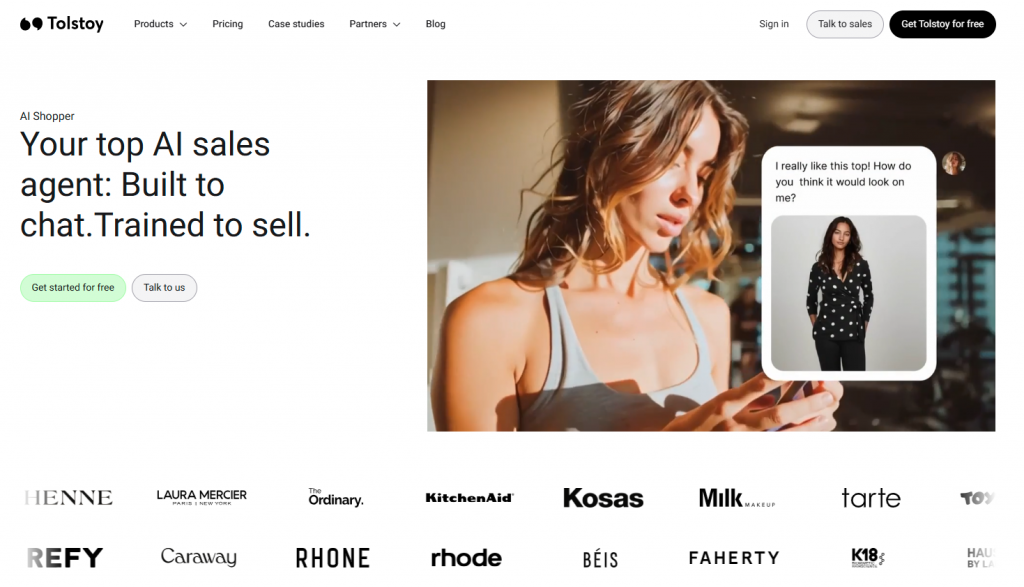
Tolstoy AI Shopper is a video-first AI shopping assistant designed for eCommerce brands that want to improve product discovery and increase conversions. It combines conversational AI with interactive video experiences to help customers explore products, get recommendations, and make faster buying decisions.
Built for modern online stores, it allows brands to create shoppable videos, guided shopping flows, and AI-powered conversations that feel more like a personal shopping experience than a traditional chatbot. This makes it especially effective for reducing decision friction and increasing engagement on product pages.

Gorgias is an eCommerce-focused customer support platform designed to help online stores manage high volumes of support while staying closely connected to their store data. It acts as a centralized helpdesk where support teams can view customer conversations and take actions without switching tools.
Built with Shopify in mind, Gorgias allows businesses to automate repetitive queries and handle order-related requests like refunds, cancellations, and tracking directly from the support interface. This reduces response time and helps teams resolve issues faster while maintaining a smooth customer experience.

Intercom is an advanced AI customer messaging platform designed for scaling support across growing eCommerce businesses. It combines AI chatbots with a powerful CRM and automation system to handle large volumes of customer conversations efficiently.
With strong omnichannel capabilities, it helps brands deliver fast, consistent support while reducing manual workload through AI-driven resolutions and workflows.

Octane AI is a Shopify-focused chatbot platform designed to personalize the shopping experience through quizzes and product recommendations. It helps eCommerce brands guide customers to the right products based on their preferences and behavior.
By combining conversational flows with zero-party data collection, Octane AI helps increase conversions and average order value through more relevant product suggestions.

Chatfuel is a social commerce chatbot platform designed to help eCommerce brands automate conversations across messaging apps like WhatsApp, Instagram, and Messenger. It focuses on driving sales, capturing leads, and managing customer interactions through automated flows.
It is widely used for marketing automation and customer engagement, especially for brands that rely heavily on social channels for sales.

BotStar is a no-code chatbot platform built for businesses that want to launch and manage AI-driven conversations without technical complexity. It helps eCommerce brands automate customer support, capture leads, and guide users through buying journeys using a visual drag-and-drop builder.
Designed for quick deployment, BotStar supports multi-language conversations and integrates with CRM systems, making it a practical choice for growing stores that need scalable automation without heavy setup.
Launching a chatbot is just the start. If you want it to deliver real results more sales, fewer support tickets, higher retention you need to go beyond setup. These tips will help you turn your chatbot into a real asset across the buying journey.
Not every chatbot feature gives equal value. Start with workflows that move the needle:
These are the conversations that drive decisions. Prioritising them gets you faster results.
Forget pre-filled templates. Train your chatbot using your actual conversations and store data:
The more your chatbot understands your actual business, the fewer “Sorry, I didn’t get that” moments you’ll have.
Where the chatbot appears affects how useful it is. Don’t just keep it on the homepage. Instead deploy custom AI agents to website pages where users may need them most:
Well-placed chatbots catch users when they’re most likely to convert or need help.
Don’t make your chatbot interrupt for no reason. Set it to respond to user intent:
Behavioral triggers make conversations feel timely and useful—not annoying or random.
If a user wants to talk to a human, don’t make them fight the chatbot to get there:
This reduces drop-offs and makes your support look reliable, not robotic.
You don’t need 100 metrics—just the right ones:
These tell you what’s working and where the chatbot needs fixing or retraining.
Don’t wait for complaints. After every conversation, ask something simple:
Short feedback loops help you fix gaps quickly, improve your flows, and avoid repeating the same mistakes.
Use whatever context you have to personalise the interaction:
The closer it feels to a human conversation, the better your conversion and satisfaction rates will be.
For most eCommerce stores, tools like YourGPT and Tidio work well because they balance sales and support without complex setup. Intercom is a better fit for larger teams that need advanced automation, while BotStar is useful for simple no-code deployments.
The highest impact use cases include order tracking, cart recovery, product recommendations, and handling returns. These directly influence conversions or reduce support workload.
Yes. In eCommerce, support and sales are closely linked. Questions about delivery, returns, or product details often come from users who are still deciding whether to buy.
Use real business data like product catalogs, FAQs, past conversations, and policy pages. Keep it updated with inventory and offers for better accuracy.
Place it on high-impact areas like product pages, cart, checkout, and help sections. You can also trigger it based on user behavior like exit intent.
Yes. Chatbots can handle order tracking, cancellations, refunds, and delivery updates by integrating with your backend systems.
They reduce friction by answering questions instantly, recommending products, and recovering abandoned carts, helping users complete purchases.
You need an AI agent when actions are required, such as managing orders, updating data, or running workflows across systems.
Track resolution rate, response time, customer satisfaction, and assisted conversions to understand real business impact.
Yes. Modern chatbots support websites, WhatsApp, Instagram, and Messenger, allowing consistent communication across platforms.
Avoid generic responses, poor training, and hiding human support. A chatbot should assist, not frustrate users.
AI chatbots are now a practical part of eCommerce operations. They reduce support workload, recover lost sales, and improve how customers interact with online stores.
Platforms like YourGPT, Gorgias, and Octane AI are built to handle key tasks such as cart recovery, product queries, and order support. They integrate with Shopify, WooCommerce, and other platforms, making them easy to set up and deploy.
To see real results, focus on clear use cases, train the chatbot using your actual business data, and track performance using meaningful metrics. A well-implemented chatbot does more than answer questions. It helps increase conversions, improves customer experience, and reduces manual effort across your team.
Compare features, automate support, and turn more visitors into customers with an AI chatbot built for modern online stores.
Use YourGPT to help Black Friday shoppers choose products, check orders and understand returns. Prepare your answers and team before the sale.

Add in-app chat support to your SaaS or mobile app. Place it on the screens where users stall, pass who they are, and hand hard cases to your team.

Group new-account tickets by onboarding stage, train an AI agent on your docs, and place it in the product where new users get stuck.
AI agents can now find and buy products for shoppers. See what agentic commerce changes for a Shopify store and which support jobs stay yours.
Build a Halloween shopping assistant for Shopify with YourGPT. Set up product recommendations, stock checks, cart actions and human support before launch.

See what a good customer effort score looks like, how to word and calculate CES on each scale, and which support habits raise customer effort.